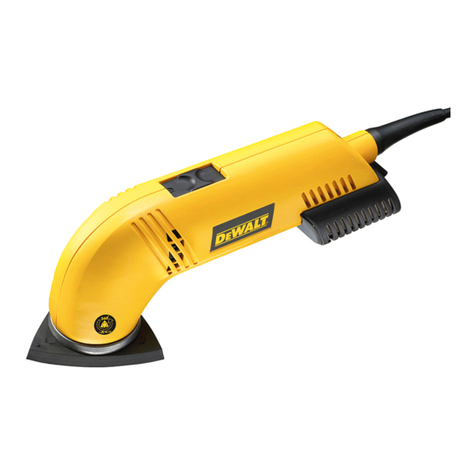
DeWalt D26430 User manual

1
®
D26430

2
Copyright DEWALT
Dansk 7
Deutsch 13
English 20
Español 26
Français 32
Italiano 38
Nederlands 44
Norsk 50
Português56
Suomi 62
Svenska 68
Türkçe
74
EÏÏËÓÈη 80

3
B
1
4
3
2
A
5
3

4
C
D
39
7
8
2

5
DANSK
E
F
11 10 4
184
12

6
G
17141513
12 16

20
ENGLISH
DETAIL SANDER D26430
Congratulations!
You have chosen a DEWALT tool. Years of
experience, thorough product development and
innovation make DEWALT one of the most reliable
partners for professional power tool users.
Technical data
D26430
Voltage V 230
Power input W 300
Pad size mm 93 x 93 x 93
Orbits min
-1
14,000 - 22,000
Orbit ømm 1.8
Weight kg 1.3
Fuses:
Europe 230 V tools 10 Amperes, mains
U.K. & Ireland 230 V tools 13 Amperes, in plugs
The following symbols are used throughout this
manual:
Denotes risk of personal injury, loss of life
or damage to the tool in case of non-
observance of the instructions in this
manual.
Denotes risk of electric shock.
Fire hazard.
Explosion hazard.
EC-Declaration of conformity
D26430
DeWALT declares that these power tools have been
designed in compliance with: 98/37/EEC,
89/336/EEC, 86/188/EEC, EN 55014-2, EN 55014-1,
EN 60745, EN 61000-3-2 & EN 61000-3-3.
For more information, please contact DeWALT at the
address below, or refer to the back of the manual.
D26430
L
pA
(sound pressure) dB(A) 78
L
WA
(acoustic power) dB(A) 87.5
Weighted RMS acceleration value 4 m/s
2
K
pA
(sound pressure uncertainty) dB(A) 2.8
K
WA
(acoustic power uncertainty) dB(A) 2.8
Director Engineering and Product Development
Horst Großmann
DEWALT, Richard-Klinger-Straße 11
D-65510, Idstein, Germany

21
ENGLISH
General safety rules
Warning! Read all instructions. Failure to follow
all instructions listed below may result in electric
shock, fire and/or serious injury. The term
„power tool“ in all of the warnings listed below
refers to your mains operated (corded) power
tool or battery operated (cordless) power tool.
SAVE THESE INSTRUCTIONS.
1 Work area
a Keep work area clean and well lit. Cluttered
and dark areas invite accidents.
b Do not operate power tools in explosive
atmospheres, such as in the presence of
flammable liquids, gases or dust. Power tools
create sparks which may ignite the dust or fumes.
c Keep children and bystanders away while
operating a power tool. Distractions can cause
you to lose control.
2 Electrical safety
a Power tool plugs must match the outlet.
Never modify the plug in any way. Do not use
any adapter plugs with earthed (grounded)
power tools. Unmodified plugs and matching
outlets will reduce risk of electric shock.
b Avoid body contact with earthed or grounded
surfaces such as pipes, radiators, ranges and
refrigerators. There is an increased risk of
electric shock if your body is earthed or grounded.
c Do not expose power tools to rain or wet
conditions. Water entering a power tool will
increase the risk of electric shock.
d Do not abuse the cord. Never use the cord for
carrying, pulling or unplugging the power
tool. Keep cord away from heat, oil, sharp
edges or moving parts. Damaged or entangled
cords increase the risk of electric shock.
e When operating a power tool outdoors, use
an extension cord suitable for outdoor use.
Use of a cord suitable for outdoor use reduces
the risk of electric shock.
3 Personal safety
a Stay alert, watch what you are doing and use
common sense when operating a power tool.
Do not use a power tool while you are tired or
under the influence of drugs, alcohol or
medication. A moment of inattention while
operating power tools may result in serious
personal injury.
b Use safety equipment. Always wear eye
protection. Safety equipment such as dust
mask, non-skid safety shoes, hard hat, or
hearing protection used for appropriate
conditions will reduce personal injuries.
c Avoid accidental starting. Ensure the switch
is in the off position before plugging in.
Carrying power tools with your finger on the
switch or plugging in power tools that have the
switch on invites accidents.
d Remove any adjusting key or wrench before
turning the power tool on. A wrench or a key
left attached to a rotating part of the power tool
may result in personal injury.
e Do not overreach. Keep proper footing and
balance at all times. This enables better control
of the power tool in unexpected situations.
f Dress properly. Do not wear loose clothing or
jewellery. Keep your hair, clothing and gloves
away from moving parts. Loose clothes, jewellery
or long hair can be caught in moving parts.
g If devices are provided for the connection of
dust extraction and collection facilities,
ensure these are connected and properly
used. Use of these devices can reduce dust
related hazards.
4 Power tool use and care
a Do not force the power tool. Use the correct
power tool for your application. The correct
power tool will do the job better and safer at the
rate for which it was designed.
b Do not use the power tool if the switch does
not turn it on and off. Any power tool that
cannot be controlled with the switch is
dangerous and must be repaired.
c Disconnect the plug from the power source
before making any adjustments, changing
accessories, or storing power tools.
Such preventive safety measures reduce the risk
of starting the power tool accidentally.


22
ENGLISH
d Store idle power tools out of the reach of
children and do not allow persons unfamiliar
with the power tool or these instructions to
operate the power tool. Power tools are
dangerous in the hands of untrained users.
e Maintain power tools. Check for misalignment
or binding of moving parts, breakage of parts
and any other condition that may affect the
power tools operation. If damaged, have the
power tool repaired before use. Many accidents
are caused by poorly maintained power tools.
f Keep cutting tools sharp and clean. Properly
maintained cutting tools with sharp cutting edges
are less likely to bind and are easier to control.
g Use the power tool, accessories and tool bits
etc., in accordance with these instructions
and in the manner intended for the particular
type of power tool, taking into account the
working conditions and the work to be
performed. Use of the power tool for operations
different from those intended could result in a
hazardous situation.
5 Service
a Have your power tool serviced by a qualified
repair person using only identical
replacement parts. This will ensure that the
safety of the power tool is maintained.
Additional safety rules for sanders
Contact with or inhalation of dusts
arising from sanding applications may
endanger the health of the operator and
possible bystanders. Wear a dust mask
specifically designed for protection
against toxic dust and fumes and ensure
that persons within or entering the work
area are also protected.
•Use this tool in a well-ventilated area when
sanding ferrous metals. Do not operate the tool
near flammable liquids, gases or dust. Sparks or
hot particles from sanding or arcing motor
brushes may ignite combustible materials.
•Do not use the dust filter cassette or the dust
extraction adaptor to store objects.
Sanding paint
Observe the applicable regulations for sanding paint.
Pay special attention to the following:
1 Whenever possible, use a vacuum extractor for
dust collection.
2 Take special care when sanding paint which is
possibly lead based:
•Do not let children or pregnant women enter the
work area.
•All persons entering the work area should wear a
mask specially designed for protection against
lead paint dust and fumes.
•Do not eat, drink or smoke in the work area.
3 Dispose of dust particles and any other removal
debris safely.
Package contents
The package contains:
1 Detail sander
1 Dust filter cassette
1 Dust filter
3 Sheets of sanding paper
1 Instruction manual
1 Exploded drawing
•Check for damage to the tool, parts or accessories
which may have occurred during transport.
•Take the time to thoroughly read and understand
this manual prior to operation.
Description (fig. A)
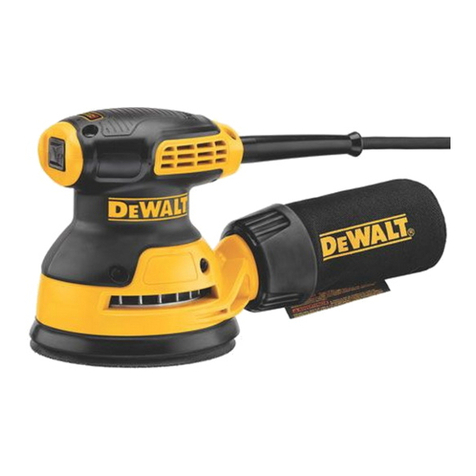
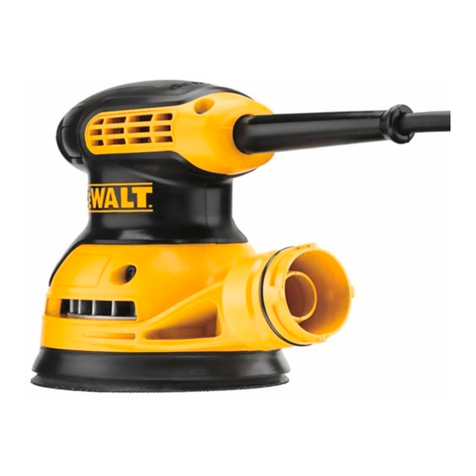
Your detail sander D26430 has been designed for
quick sanding of wood, metal and plastics in a
professional environment.
1 On/off switch
2 Speed control dial
3 Sanding pad
4 Dust filter cassette
Electrical safety
The electric motor has been designed for one
voltage only. Always check that the power supply

corresponds to the voltage on the rating plate.
Your DEWALT tool is double insulated in
accordance with EN 60745; therefore no
earth wire is required.

23
ENGLISH
Mains plug replacement
(U.K. & Ireland only)
•Should your mains plug need replacing and you
are competent to do this, proceed as instructed
below. If you are in doubt, contact an authorized
DEWALT repair agent or a qualified electrician.
•Disconnect the plug from the supply.
•Cut off the plug and dispose of it safely; a plug
with bared copper conductors is dangerous if
engaged in a live socket outlet.
•Only fit 13 Amperes BS1363A approved plugs
fitted with the correctly rated fuse (1).
•The cable wire colours, or a letter, will be marked
at the connection points of most good quality
plugs. Attach the wires to their respective points
in the plug (see below). Brown is for Live (L) (2)
and Blue is for Neutral (N) (4).
•Before replacing the top cover of the mains plug
ensure that the cable restraint (3) is holding the
outer sheath of the cable firmly and that the two
leads are correctly fixed at the terminal screws.
Never use a light socket.
Never connect the live (L) or neutral (N)
wires to the earth pin marked E or .
For 115 V units with a power rating exceeding 1500 W,
we recommend to fit a plug to BS4343 standard.
Using an extension cable
If an extension cable is required, use an approved
extension cable suitable for the power input of this
tool (see technical data). The minimum conductor
size is 1.5 mm2.
When using a cable reel, always unwind the cable
completely.
Also refer to the table below.
Conductor size (mm
2
) Cable rating (Amperes)
0.75 6
1.00 10
1.50 15
2.50 20
4.00 25
Cable length (m)
7.5 15 25 30 45 60
Voltage Amperes Cable rating (Amperes)
115 0 - 2.0 6 6 6 6 6 10
2.1 - 3.4 6 6 6 6 15 15
3.5 - 5.0 6 6 10 15 20 20
5.1 - 7.0 10 10 15 20 20 25
7.1 - 12.0 15 15 20 25 25 -
12.1 - 20.0 20 20 25 - - -
230 0 - 2.0 6 6 6 6 6 6
2.1 - 3.4 6 6 6 6 6 6
3.5 - 5.0 6 6 6 6 10 15
5.1 - 7.0 10 10 10 10 15 15
7.1 - 12.0 15 15 15 15 20 20
12.1 - 20.0 20 20 20 20 25 -
Assembly and adjustment
Prior to assembly and adjustment always
unplug the tool.
Fitting sanding sheets (fig. B)
The tool uses hook and loop sanding sheets.
•Place the tool on a table, sanding pad (3) up.
•Place the sanding sheet (5) directly on top of the
sanding pad.
•Hold the sanding pad with one hand and align
the dust extraction holes.
•Press the sheet firmly onto the sanding pad.
Rotating the sanding pad (fig. A)
The sanding pad is adjustable in 60°increments.
•Hold the tool upside down.
•Lift the sanding pad (3) up from the tool.
•At the same time, rotate the sanding pad in the
desired direction.
•Release the sanding pad.
•Move the sanding pad back and forth slightly
untile it engages in position.
Other manuals for D26430
2
Table of contents
Other DeWalt Sander manuals

DeWalt
DeWalt DW433-XE User manual

DeWalt
DeWalt DWP849X User manual

DeWalt
DeWalt DWP849 User manual

DeWalt
DeWalt DWP849X User manual

DeWalt
DeWalt D26453 User manual

DeWalt
DeWalt DWE7800 User manual

DeWalt
DeWalt D26453 User manual

DeWalt
DeWalt DWE7800 User manual

DeWalt
DeWalt XR LI-LON Series User manual

DeWalt
DeWalt D26430 User manual

DeWalt
DeWalt dwe6411 User manual

DeWalt
DeWalt DW849 User manual

DeWalt
DeWalt DCW200 User manual

DeWalt
DeWalt DW432 User manual

DeWalt
DeWalt XR DCE800 User manual

DeWalt
DeWalt DCM848P2 User manual

DeWalt
DeWalt D26451 User manual

DeWalt
DeWalt DW441 User manual

DeWalt
DeWalt DWE6421-IN User manual

DeWalt
DeWalt DW432 User manual