DIODE LASER LA12D001.X - USER MANUAL LI12D001.1_EN 2021-01-12 4
1.2. INTENDED USE
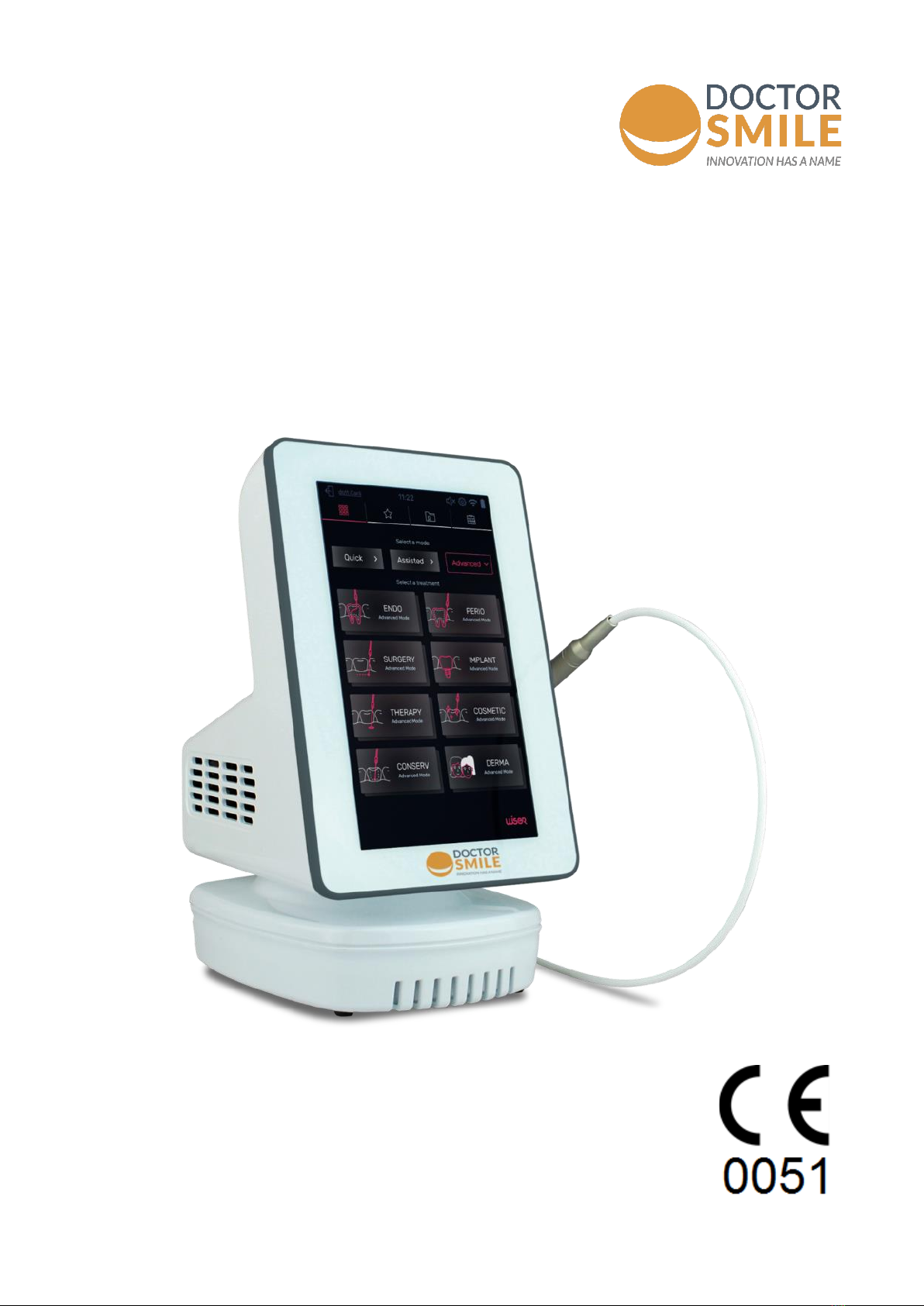
This laser equipment named “DIODE LASER” is a medical device and its application fields are:
•DENTAL SURGERY
•DENTISTRY
•DENTAL THERAPY
1.2.1. Examples of use
Some application fields are orthodontics, endodontics, periodontology, herpes therapy, canker sores,
chelitis, conservatives, whitening, care and maintenance of implants-peri-implantitis.
The use is temporary, related only to the therapeutic application.
1.2.2. Intended users and place of use
The ability and technical knowledge of dentistry and of the doctor who carries out the therapeutic
application correctly guide the choice of the type of treatment
The device is designed to be only used by specialized medical personnel who have received specific
training on the use of the laser device.
It must be only used within medical and/or dental studios, hospitals or other adequate sanitary
structures.
1.2.3. Intended patients, clinical applications, practical
suggestions and possible side effects
The medical device “DIODE LASER” is intended for patients suffering from oral problems related to
the dental system, the temporomandibular system, the musculoskeletal system, therefore mainly for
adult patients, but there are no contraindications to the use of the "diode laser" also on patients of other
age groups.
There are no exclusions in subjects who can be treated with the device using the treatments
described in the document AMNII78 Clinical Protocols.
The bibliography currently available, at international level, does not reveal any contraindication in the
use of the diode laser in the applications field reported in the intended use.
The laser has many beneficial effects on human tissue given the correct values of power, frequency
and application time. With high values of power and other inappropriate parameters it may though
cause either undesired vaporization or necrosis in the radiated tissue.
Should necrosis be desired, as in cases such as photodynamic therapy or in the equivalent use of the
scalpel, it will be unavoidable that along with the targeted tissue, the closest surrounding tissue might
be damaged as well. The extent of such harm is essentially determined by the energy density provided
to that tissue and exposure time. In many cases the harm will turn out as light and tolerable compared
to the benefits.
The user should therefore very attentively check the following parameters, in order not to cause
undesired effects on the patient:
•Power
•Diameter of the tip
•Distance between the end of the tip and the tissue spot
•Continuous or pulsed laser emission
•Application time