- 4 -
Installation and operation
The unit is simple to use and install.
Set the dipswitches by referring to the table and description below or the
table on the rear of the unit.
Connect breakout cable (when this option has been ordered).
Connect a valid SDI input and AES inputs. See the audio input section on
the page 6 for connecting to the AES breakout cable or to a 15-pin male
sub-D connector (not supplied).
AES inputs may be synchronous or asynchronous, and of any sample rate
up to 96kHz. Alternatively if the sample rate converters are bypassed they
must be 48kHz and synchronous to the video input.
Connect SDI outputs (if required).
Apply power to the unit either via the locking power connector from the
external power supply or 1U rack frame, or by sliding into the 2U rack
mounting frame with central power supplies.
On power-up the unit will perform a short (3 second) self test. The group
LEDs will flash while this is in progress.
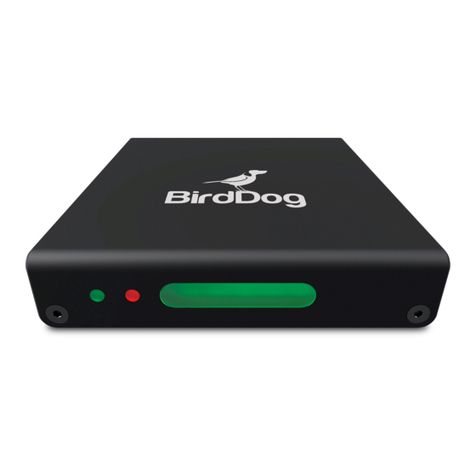
The signal LED will be green when there is power and a valid SDI signal
present or red when there is power but no SDI signal.
Two group LEDs will light corresponding to the groups selected by the
dipswitches (default on delivery groups 1&2). The LED will be green if
the unit is receiving a valid video signal and successfully embedding
audio from that group. The LED will otherwise be red. Orange LEDs
indicate which groups are already present in the SDI stream.
The switch settings can be altered whilst the unit is powered and the
changes are implemented immediately. Switch 1 is used to toggle through
all possible pairs of groups into which to insert audio.
The mounting bracket supplied can be used to install the unit. The bracket
should first be fixed vertically to any surface. The MiniBlox can then be
lowered onto the dovetail part of the bracket with the front endplate
uppermost to retain it.
Switch settings
SRC on SRC bypass
Switches 1& 2 are used to select the two groups into which the audio samples
are inserted. Toggling switch 1 or 2 will cycle through all possible groups with
- 5 -
the group selected shown on the LEDs. The group settings are stored in
EEPROM and are therefore retained even after the unit has been powered down.
Switch 3 determines whether existing audio packets are deleted from the video
signal. When the switch is off, new audio packets are appended without deletion
of existing packets allowing two units to be connected in cascade.
Switch 4 controls the bit depth of the embedded audio for SD SDI only (audio
depth is always 24 bit in 3G & HD). When the switch is off, extended audio
packets are multiplexed into the video signal (24 bit audio). When the switch is
on, extended audio packets are not included (20 bit audio).
Switch 5 selects between embedding on data stream one or two when
embedding to a 3G Level B signal.
Switch 6 is used to bypass the sample rate conversion.