5
ENGLISH
L2000012 Installation guide for DucoBox Eco (Revision E.1 | 13.05.2020)
02 Regulations and safety
Only an accredited and certified installer may install,
connect, commission and perform maintenance on
the DucoBox Eco, as described in this manual. The
installer is responsible for installing and commissi-
oning the unit.
Always adhere to the safety instructions in the
manual when installing the DucoBox Eco. The in-
stallation also requires to be in accordance with the
general and locally applicable construction, safety
and installation regulations of the local authority
and other agencies. Failure to adhere to these safety
instructions, warnings, notes and instructions could
result in damage to the DucoBox Eco or in personal
injury for which DUCO NV cannot be held liable.
Do not install or place this product in areas where
the following are present or could occur:
• Excessively fatty atmosphere.
• Corrosive or flammable gases, liquids or fumes.
Such as alcohol, insecticides, petrol, ammonia
(stables), etc.
• Local ambient temperatures above 40°C or below
1°C
• Relative humidity above 90%, an outdoor set-up
or exposure to the elements
• Obstacles that impede access to or opening the
device
• Bends in the ducts immediately upstream of the
fan unit.
• Connections to an extractor hood, cooker hood,
tumble dryer, water heaters, swimming pools,
saunas, etc.
• Spraying with water
Take care to ensure that the unit is kept upright at all
times in transit and while being unpacked.
The DucoBox Eco is supplied in individual packaging,
chosen so as to prevent any damage from occurring
during normal handling. Avoid shocks during trans-
port and handling.
Check that the unit and accessories are complete
and undamaged when you take them out of the
packaging. If you have any doubt about this, please
contact DUCO / your DUCO sales outlet.
Always leave the unit standing or suspended upright
first for half an hour before powering it up.
Attach the unit, in an enclosed space, using the
correct screws and mounting bracket, to a wall or
on the DucoBox Eco Mounting Plinth on a floor with
adequate load-bearing capacity. The weight of the
DucoBox Eco increases up to 95 kg in use.
The fan unit can only be used with the appropriate
DUCO accessories and user control(s).
Certain situations may require the use of acoustic
insulation materials. Take account of applicable
standards around noise requirements. (Belgium:
NBN S01-400-1)
When fitting the DucoBox Eco, take account of appli-
cable standards in respect of the distance away from
the flue pipe.
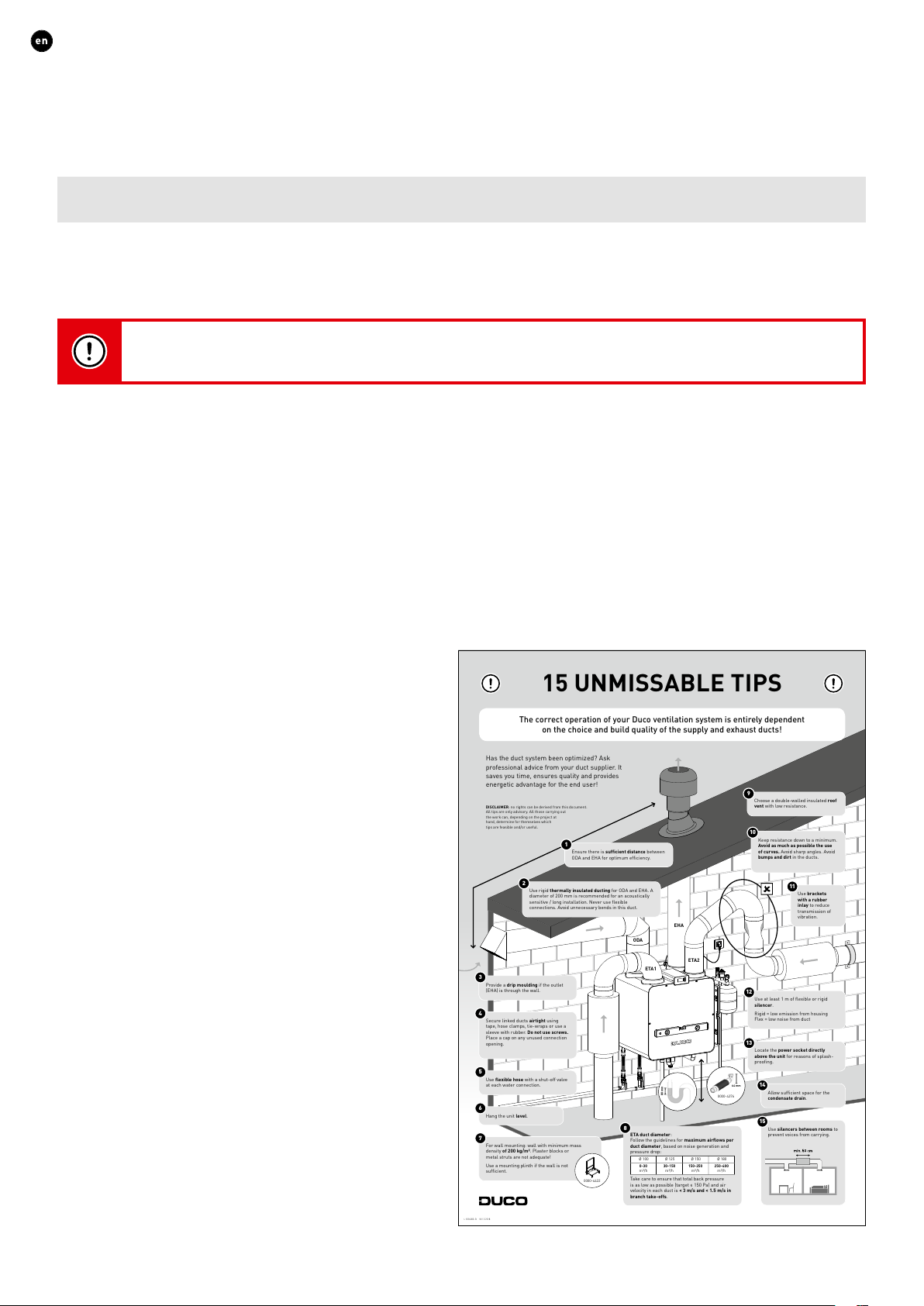
Ensure that the unit discharges into a single exhaust
duct that is suitable and installed for the purpose
and exhausts outdoors.
Keep the manual close to your unit.
Do not place any objects on the unit.
It must not be possible to touch the fan by hand.
A minimum of 900 mm of ducting must therefore
always be connected to the DucoBox Eco before it is
put into operation.
Use appropriate tools to work on the unit.
Use the unit only for applications for which it has
been designed as stated in this manual.
The ventilation unit is required to operate continuo-
usly, i.e. the DucoBox Eco must never be switched
off. (Legal requirement under NBN D50-001 Section
4.2. System C)
This unit is not intended for use by people (including
children) with reduced physical, sensory or mental
capabilities, or who lack experience or know-how,
unless they are supervised or have been given
instructions on the use of the unit by a person who is
responsible for their safety. Children must be super-
vised to ensure that they do not play with the unit.
The user is responsible for safely removing the
ventilation unit at the end of its useful life, in accor-
dance with locally applicable laws or regulations. You
can also take the unit to a collection point for used
electrical equipment.
The unit is only suitable for housing construction and
not for industrial use.
Modifications to the unit or to specifications stated in
this document are not permitted.
Always refer to the installer of your combustion
appliance to establish whether there is a risk of flue
gas ingress into the dwelling. Negative pressure in
the home can be reduced by making sure that win-
dow ventilators are always adequately open.
It is recommended that you take out a maintenance
contract to ensure the unit is regularly inspected and
cleaned.
The device must be fitted in a touch-safe man-
ner. This means, among other things, that under
normal circumstances no-one can reach moving or
electrically live parts of the fan, the cooling section
or controls without performing a conscious act to do
so, such as:
• Removing the cover using suitable tools.
• Opening the electrical control unit plus display
using the appropriate tools.
• Disconnecting a duct from the connection ope-
ning during normal operation.
• Taking the motor module out of the fan after
removing the cover.
Electrical and water installation must be carried out
by an individual who is qualified in accordance with
the applicable technical regulations by the relevant
competent authorities. Ensure that the system is in a
technically perfect condition after installation. Poor
installation can result in water leaks, electric shocks
or fire.
Electrical regulations
• Take care to ensure that the electrical supply is
a 230 V, single-phase earthed, 50/60 Hz, AC sys-
tem. The device must be connected to an earthed
and fused wall socket. Make sure that the
electrical system to which the unit is connected
complies with the stipulated conditions.
• Never touch the unit with wet hands.
• Never touch the device when barefoot.
• When handling electronics, always take measu-
res to inhibit ESD, such as wearing an earthed
wristband.
• Ensure that the electrical circuit is not damaged.
• Ensure that before work begins, the device is
isolated from the power supply by removing the
power cord from the wall socket or by switching
off the fuse. (Use a measuring instrument to
check that this is actually the case!)
• Check to ensure that cables and leads are not
damaged.
• The electronic components of the heat pump unit
may be live. In the event of a fault, contact a pro-
fessional installer and only have repairs carried
out by expert personnel.
• If the power cord is damaged, it must be replaced
by the manufacturer, after-sales support or indi-
viduals with comparable qualifications in order to
prevent any hazard.
• Do not pull on the cord to remove the plug from
the socket.
• Check that the voltage shown on the CE label
matches the local mains voltage before you
connect the unit. You will find the CE label on top
of the unit.
• Take care to ensure that all plumbing pipework
has been earthed correctly, as well as any metal
air ducting.
• The DucoBox Eco meets legal requirements
imposed on electrical equipment.
• We recommend to place the heat pump in a
separate circuit equipped with its own fuse (C
or D curve). Take also into account the section
of the electric wiring, so that it corresponds
with the current regulations regarding technical
installations.
Water regulations
• Use only mains quality tap water to connect to
the DucoBox Eco.
• Damage can occur if the water is very hard,
corrosive or contaminated with chemicals, for
example.
• Water pipes can be hot during operation. Do not
touch them with bare hands.
• Insulate all water pipes coming out of the unit
for optimum efficiency, against condensation or
against a burning hazard on contact.
• Recommended circulating water quality:
→ pH value 7.0 – 8.5
→ Hardness (°dH) 1 – 1.2
• Do not use any pipe fittings that give rise to
galvanic corrosion.
• Check the entire water system for leaks.
• Use an external expansion vessel and pressure
relief valve. There is no expansion vessel in the
DucoBox Eco.
• Use and maintain an external dirt separator for
optimum heat exchange efficiency.
• Use an external microbubble separator in your
water system.
• Fill the condensate drain before switching the
unit on.
Cooling regulations
R134a is one of the commonest ‘environmentally
friendly’ refrigerants on the market and does not
attack the ozone layer.
• All pipes are pressurised.
• Contact with this fluid can result in frostbite and
serious eye injuries.
• Depending on temperature and pressure, R134a
can form a flammable mixture with air.
• Do not discharge R134a into the open air.
• Only a qualified refrigeration technician is per-
mitted to work on the cooling system.
• At high temperatures, R134a can break down into
toxic and corrosive substance: hydrogen fluoride
and CO or CO2.