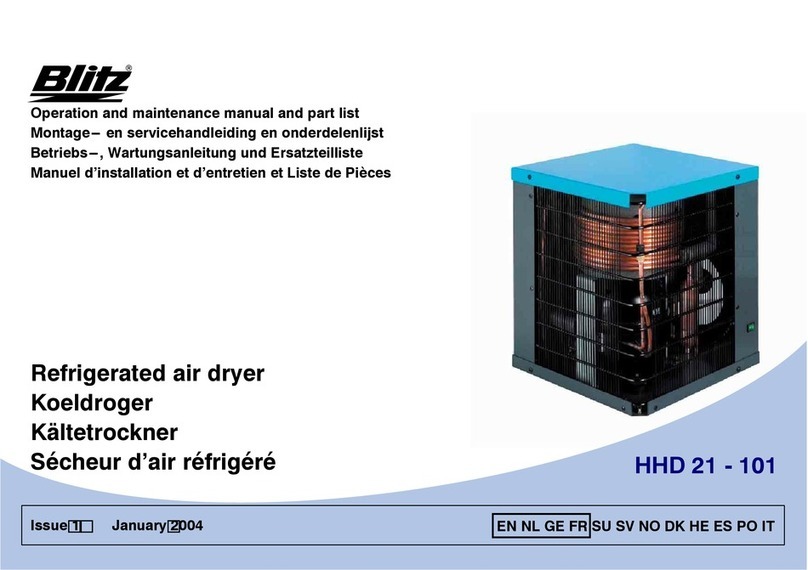
ELGi EGRD 600 Operating instructions

Refrigerated air dryer
EGRD
600 – 2900
Air – water cooled
EN - Operation, maintenance and troubleshooting
manual
EGRDUL600TO2900ENR00
7425MUM240UL_EN_04.0

2 – EN EGRD 600 – 2900
Dear Customer,
thank you for choosing our product. In order to get the best performances out of this product, please read
this manual carefully.
To avoid incorrect operation of the equipment and possible physical risk to the operator, please read and
strictly follow the instructions contained in this manual.
Note, these instructions are in addition to the safety rules that apply in the country where the dryer is
installed.
Before packing for shipment each EGRD series refrigerated air dryer undergoes a rigorous test to ensure
the absence of any manufacturing faults and to demonstrate that the device can perform all the functions for
which it has been designed.
Once the dryer has been properly installed according to the instructions in this manual, it will be ready for
use without any further adjustment. The operation is fully automatic, and the maintenance is limited to few
controls and some cleaning operations, as detailed in the following chapters.
This manual must be maintained available in any moment for future references and it has to be
intended as inherent part of the relevant dryer.
Due to the continuous technical evolution, we reserve the right to introduce any necessary change without
giving previous notice.
Should you experience any trouble, or for further information, please do not hesitate to contact us.

EGRD 600 – 2900 3 – EN
Contents
1Identification plate 5
2Warranty conditions 5
3Safety rules 6
3.1Definition of the conventional signs used in this manual 6
3.2Warnings 7
3.3Proper use of the dryer 7
3.4Instructions for the use of pressure equipment according to PED directive 97/23/EC 8
4Installation 8
4.1Transport 8
4.2Storage 8
4.3Installation site 9
4.4Installation layout 10
4.5Correction factors 11
4.6Connection to the compressed air system 12
4.6.1Inlet / outlet flanged air connections (only EGRD 600 – 1254) 12
4.7Connection to the cooling water network (Water-Cooled) 13
4.8Electrical connections 14
4.9Condensate drain 15
5Start-up 15
5.1Preliminary operation 15
5.2First start-up 16
5.3Start-up and shut down 17
6Technical data 18
6.1Technical data EGRD 600 – 2900 3/460/60 18
7Technical description 19
7.1Control panel 19
7.2Operation 19
7.3Flow diagram (Air-Cooled) 20
7.4Flow diagram (Water-Cooled) 20
7.5Refrigerating compressor 21
7.6Condenser (Air-Cooled) 21
7.7Condenser (Water-Cooled) 21
7.8Condenser water regulating valve (Water-Cooled) 21
7.9Filter dryer 21
7.10Capillary tube 22
7.11Alu-Dry module 22
7.12Hot gas by-pass valve 22
7.13Refrigerant pressure switches LPS – HPS 23
7.14Compressor crankcase heater 23
7.15Electronic instrument DMC24 24
7.15.1How to switch on the dryer 25
7.15.2How to switch off the dryer 25
7.15.3How to display the operating parameters – INFO Menu 25
7.15.4How a service warning is displayed 26
7.15.5How an alarm is displayed 27
7.15.6How to show the alarm memory – LOG Menu 28
7.15.7How to control dryer with remote control 28
7.15.8Operation of the failure / alarm dry contact (potential free) 28
7.15.9Connection to serial line 28
7.15.10How to change operating parameters – SETUP Menu 29
7.16Electronic drainer 30
8Maintenance, troubleshooting, spare parts and dismantling 31
8.1Checks and maintenance 31
8.2Troubleshooting 32

4 – EN EGRD 600 – 2900
8.3Maintenance operation on the refrigeration circuit 37
8.4Dismantling of the dryer 37
9Attachments 38
Exploded views – List of components 38
Electric diagrams – List of components 38
9.1Dryers dimensions 39
9.1.1EGRD 600 – 1254 39
9.1.2EGRD 1552 – 2900 40
9.2Exploded views 41
9.2.1EGRD 600 – 1254 Air Cooled 41
9.2.2EGRD 600 – 1254 Water Cooled 42
9.2.3EGRD 1552 – 2900 Air Cooled 43
9.2.4EGRD 1552 – 2900 Water Cooled 44
9.3Electric diagrams 45
9.3.1EGRD 600 – 1254 Sheet 1 of 3 45
9.3.2EGRD 600 – 1254 Sheet 2 of 3 46
9.3.3EGRD 600 – 1254 Sheet 3 of 3 47
9.3.4EGRD 1552 – 2900 Sheet 1 of 4 48
9.3.5EGRD 1552 – 2900 Sheet 2 of 4 49
9.3.6EGRD 1552 – 2900 Sheet 3 of 4 50
9.3.7EGRD 1552 – 2900 Sheet 4 of 4 51
10Blank pages 52
Pos: 1 /Beko Technisc he Dokumentation/Übersc hriften/1/Sic herheitshinweise @ 0\ mod_1183637609261_6.d oc @ 5365

Identification plate
EGRD 600 – 2900 5 – EN
1 Identification plate
The identification plate is located on the back of the dryer and shows all the primary data of the machine.
This data should always be referred to when calling the manufacturer or distributor. The removal or
alteration of the identification plate will void the warranty rights.
2 Warranty conditions
For 12 months from the installation date, but no longer than 18 months from the delivery date, the warranty
covers eventual faulty parts, which will be repaired or replaced free of charge, except the travel, hotel and
restaurant expenses of our engineer.
The warranty doesn’t cover any responsibility for direct or indirect damages to persons, animals or
equipment caused by improper usage or maintenance, and it’s limited to manufacturing faults only.
The right to warranty repairs is subordinated to the strict compliance with the installation, use and
maintenance instructions contained in this manual.
The warranty will be immediately voided in case of even small changes or alterations to the dryer. To require
repairs during the warranty period, the data reported on the identification plate must be notified.

Safety rules
6 – EN EGRD 600 – 2900
3 Safety rules
3.1 Definition of the conventional signs used in this manual
Carefully read instruction manual before attempting any service or maintenance procedures on the
dryer.
Caution warning sign. Risk of danger or possibility of damage to equipment, if related text is not
followed properly.
Electrical hazard. Warning message indicates practices or procedures that could result in personal
injury or fatality if not followed correctly.
Danger hazard. Part or system under pressure.
Danger hazard. High temperature conditions exist during operation of system. Avoid contact until
system or component has dissipated heat.
Danger hazard. Treated air is not suitable for breathing purposes; serious injury or fatality may
result if precautions are not followed.
Danger hazard: In case of fire, use an approved fire extinguisher, water is not an acceptable
means in cases of fire.
Danger hazard. Do not operate equipment with panels removed.
Maintenance or control operation to be performed by qualified personnel only [1].
ARIA
AIR
LUFT
AIR
Compressed air inlet connection point
ARIA
AIR
LUFT
AIR
Compressed air outlet connection point
Condensate drain connection point
Cooling water inlet connection point (Water-Cooled)
Cooling water outlet connection point (Water-Cooled)
Operations which can be performed by the operator of the machine, if qualified [1].
NOTE: Text that specifies items of note to be taken into account does not involve safety precautions.
In designing this unit a lot of care has been devoted to environmental protection:
CFC free refrigerants
CFC free insulation parts
Energy saving design
Limited acoustic emission
Dryer and relevant packaging composed of recyclable materials
This symbol requests that the user heed environmental considerations and abide with suggestions
annotated with this symbol.
[1] Experienced and trained personnel familiar with national and local codes, capable to perform the needed activities, identify and
avoid possible dangerous situations while handling, installing, using and servicing the machine. Ensuring compliance to all statutory
regulations.

Safety rules
EGRD 600 – 2900 7 – EN
3.2 Warnings
Compressed air is a highly hazardous energy source.
Never work on the dryer with pressure in the system.
Never point the compressed air or the condensate drain outlet hoses towards anybody.
The user is responsible for the proper installation of the dryer. Failure to follow instructions given in
the “Installation” chapter will void the warranty. Improper installation can create dangerous
situations for personnel and/or damages to the machine could occur.
Only qualified personnel are authorized to service electrically powered devices. Before attempting
maintenance, the following conditions must be satisfied:
Ensure that main power is off, machine is locked out, tagged for service and power cannot be
restored during service operations.
Ensure that valves are shut and the air circuit is at atmospheric pressure. De-pressurize the
dryer.
These refrigerating air dryers contain R407C HFC type refrigerant fluid. Refer to the specific
paragraph - maintenance operation on the refrigerating circuit.
Warranty does not apply to any unit damaged by accident, modification, misuse, negligence or
misapplication. Unauthorized alterations will immediately void the warranty.
In case of fire, use an approved fire extinguisher, water is not an acceptable means in cases of
electrical fire.
3.3 Proper use of the dryer
This dryer has been designed, manufactured and tested for the purpose of separating the humidity normally
contained in compressed air. Any other use has to be considered improper.
The Manufacturer will not be responsible for any problem arising from improper use; the user will bear
responsibility for any resulting damage.
Moreover, the correct use requires the adherence to the installation instructions, specifically:
Voltage and frequency of the main power.
Pressure, temperature and flow-rate of the inlet air.
Pressure, temperature and cooling water capacity (Water-Cooled).
Ambient temperature.
This dryer is supplied tested and fully assembled. The only operation left to the user is the connection to the
plant in compliance with the instructions given in the following chapters.
The purpose of the machine is the separation of water and eventual oil particles present in
compressed air.
The dried air cannot be used for breathing purposes or for operations leading to direct contact with
foodstuff.
This dryer is not suitable for the treatment of dirty air or of air containing solid particles.

Installation
8 – EN EGRD 600 – 2900
3.4 Instructions for the use of pressure equipment according to PED directive 97/23/EC
To ensure the safe operation of pressure equipments, the user must conform strictly to the above directive
and the following:
1. The equipment must only be operated within the temperature and pressure limits stated on the
manufacturer’s data nameplate.
2. Welding on heat-exchanger is not recommended.
3. The equipment must not be stored in badly ventilated spaces, near a heat source or inflammable
substances.
4. Vibration must be eliminated from the equipment to prevent fatigue failure.
5. Automatic condensate drains should be checked for operation every day to prevent a build up of
condensate in the pressure equipment.
6. The maximum working pressure stated on the manufacturer’s data nameplate must not be exceeded.
Prior to use, the user must fit safety / pressure relief devices.
7. All documentation supplied with the equipment (manual, declaration of conformity etc.) must be kept for
future reference.
8. Do not apply weights or external loads on the vessel or its connecting piping.
TAMPERING, MODIFICATION AND IMPROPER USE OF THE PRESSURE EQUIPMENT ARE
FORBIDDEN. Users of the equipment must comply with all local and national pressure
equipment legislation in the country of installation.
4 Installation
4.1 Transport
Check for visible loss or damage, if no visible damage is found place the unit near to the installation point
and unpack the contents.
To move the packaged unit we recommend using a suitable trolley or forklift truck. Hand carrying is not
recommended
Always keep the dryer in the upright vertical position. Damage to components could result if unit is laid on
its side or if placed upside down.
Handle with care. Heavy blows could cause irreparable damage.
4.2 Storage
SCC0001
Even when packaged, keep the machine
protected from severity of the weather.
Keep the dryer in vertical position, also when
stored. Turning it upside down some parts could
be irreparably damaged.
If not in use, the dryer can be stored in its
packaging in a dust free and protected site at a
temperature of 32°F (0°C) … 122°F (50°C), and
a specific humidity not exceeding 90%. Should
the stocking time exceed 12 months, please
contact the manufacturer.
The packaging materials are recyclable. Dispose of material in compliance with the rules
and regulations in force in the destination country.

Installation
EGRD 600 – 2900 9 – EN
4.3 Installation site
Failure to install dryer in the proper ambient conditions will affect the dryer’s ability to condense
refrigerant gas. This can cause higher loads on the compressor, loss of dryer efficiency and
performance, overheated condenser fan motors, electrical component failure and dryer failure due
to the following: compressor loss, fan motor failure and electrical component failure. Failures of this
type will affect warranty considerations.
Do not install dryer in an environment of corrosive chemicals, explosive gasses, poisonous gasses;
steam heat, areas of high ambient conditions or extreme dust and dirt.
In case of fire, use an approved fire extinguisher, water is not an acceptable means in cases of fire.
Minimum installation requirements:
Select a clean dry area, free from dust, and protected from atmospheric disturbances.
The supporting area must be smooth, horizontal and able to hold the weight of the dryer.
Minimum ambient temperature +34°F (+1°C).
Maximum ambient temperature +122°F (+50°C).
Ensure a proper cooling air replacement.
Allow a sufficient clearance on each side of the dryer for proper ventilation and to facilitate maintenance
operations.
The dryer does not require attachment to the floor surface.
Do not block, even partially, ventilation grid.
Avoid any possible re-circulation of the exhaust cooling air.
Protect the dryer from air drafts or forced cooling air conditions.

Installation
10 – EN EGRD 600 – 2900
4.4 Installation layout
1 Air compressor
2 Aftercooler
3 Condensate separator
4 Pre-Filter (min. 5 micron)
5 By-pass group
6 Dryer
7 Compressed air tank
8 Final filter
9 Condensate drain
In case of heavily polluted inlet air (ISO 8573.1 class 3.-.3 or worse quality), we recommend
the additional installation of a pre-filter (5 micron minimum) to prevent a clogging of the
heat exchanger.
Type A installation is suggested when the compressor operates at reduced intermittence and the total
consumption equals the compressor flow rate.
Type B installation is suggested when the air consumption can consistently change with peak values highly
exceeding the flow rate of the compressors. The capacity of the tank must be sized in order to compensate
eventual instantaneous demanding conditions (peak air consumption).
This manual suits for next models
7
Table of contents