logo
Brands
  1. Home
  2. •
  3. Brands
  4. •
  5. Etymotic Research
  6. •
  7. Accessories
  8. •
  9. Etymotic Research ER-15 User manual

Etymotic Research ER-15 User manual

This manual suits for next models

2

Other Etymotic Research Accessories manuals

Etymotic Research Music PRO User manual

Etymotic Research

Etymotic Research Music PRO User manual

Etymotic Research ER-15 User manual

Etymotic Research

Etymotic Research ER-15 User manual

Etymotic Research Isolator ER-6 Assembly instructions

Etymotic Research

Etymotic Research Isolator ER-6 Assembly instructions

Etymotic Research EB15 LE User manual

Etymotic Research

Etymotic Research EB15 LE User manual

Etymotic Research ER-20 User manual

Etymotic Research

Etymotic Research ER-20 User manual

Etymotic Research ER-20 User manual

Etymotic Research

Etymotic Research ER-20 User manual

Popular Accessories manuals by other brands

Hillco 2810 Operator's manual

Hillco

Hillco 2810 Operator's manual

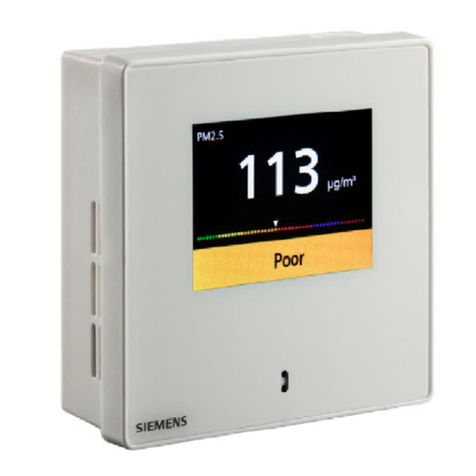
Siemens QSA2700D Basic documentation

Siemens

Siemens QSA2700D Basic documentation

Contours ZY024 manual

Contours

Contours ZY024 manual

Saivod VS621 manual

Saivod

Saivod VS621 manual

SCE ENVIRO-THERM SCE-TE170B24VSS user manual

SCE

SCE ENVIRO-THERM SCE-TE170B24VSS user manual

Z-Wave HSD-200Z user manual

Z-Wave

Z-Wave HSD-200Z user manual

turck FMX-IM-2UPLI63FX quick start guide

turck

turck FMX-IM-2UPLI63FX quick start guide

Decagon Devices 10HS manual

Decagon Devices

Decagon Devices 10HS manual

UPPAbaby Cup Holder user manual

UPPAbaby

UPPAbaby Cup Holder user manual

Elko SmartSensor Leakage Wireless manual

Elko

Elko SmartSensor Leakage Wireless manual

Grizzly H8371 instructions

Grizzly

Grizzly H8371 instructions

Panasonic HG-T Series user manual

Panasonic

Panasonic HG-T Series user manual

IFM Electronic Efector 250 Series Brief instructions

IFM Electronic

IFM Electronic Efector 250 Series Brief instructions

Virtuox VirtuCLEAN 2.0 user manual

Virtuox

Virtuox VirtuCLEAN 2.0 user manual

DigiDesign 888/24 I/O installation guide

DigiDesign

DigiDesign 888/24 I/O installation guide

PROZIS QUAY user manual

PROZIS

PROZIS QUAY user manual

patagonia PSI Vest user manual

patagonia

patagonia PSI Vest user manual

SFC Energy EFOY GO! manual

SFC Energy

SFC Energy EFOY GO! manual

https://manuals.online logo
https://manuals.online logoBrands
  • About & Mission
  • Contact us
  • Privacy Policy
  • Terms and Conditions

Copyright 2026 Manuals.Online. All Rights Reserved.

Frequently Asked Questions:
What’s wrong with conventional earplugs?
A
They muffle speech and music. Conventional earplugs reduce sound
more in the high frequencies than in the low and mid frequencies, which
makes music and voices unclear and unnatural. Deeply-inserted foam
earplugs can provide 30-40 dB of sound reduction, but only a small amount
is typically needed.
How much protection do people need?
A
Hearing loss is a function of exposure time, the average sound level,
and the peak level of very loud sounds. Some persons are more susceptible
to hearing loss from high-level sound than others. Most musicians do not
need maximum protection, and many industrial workers can be adequately
protected with as little as 10 dB of sound reduction. The majority of
eight-hour-equivalent noise exposure in industry falls between 85 and 95 dB.
Is there a non-custom high fidelity earplug?
A
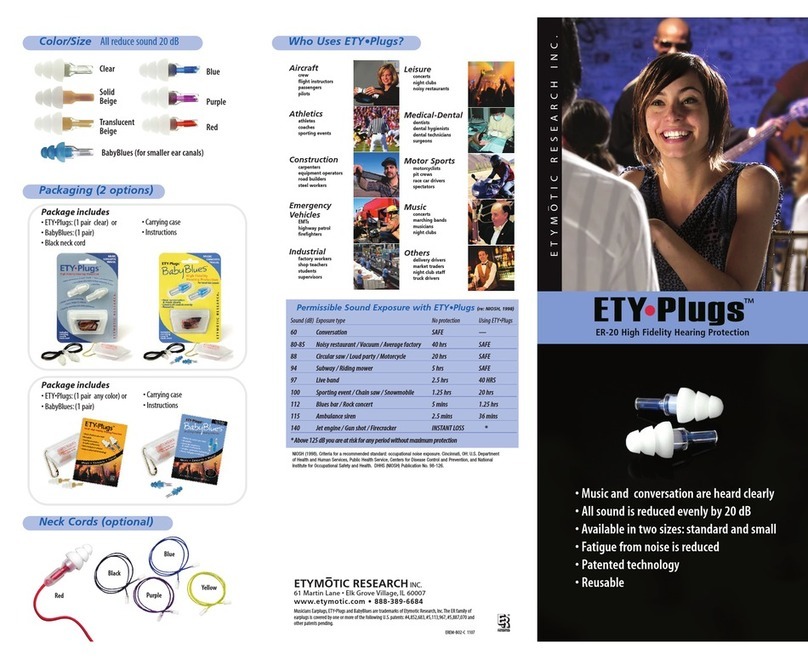
Yes. Etymotic Research designed and patented ETY•Plugs™
which are high fidelity ready-fit earplugs that reduce
sound evenly by 20 dB atall frequencies, so that music
and speech are heard clearly. Available in two sizes, for
regular and small ear canals.
Why are deep earmolds required for
Musicians Earplugs?
A
Earmolds need to seal deeply in the bony portion of the ear canal
or the wearer will hear a hollowor boomy sound in their own voice when
speaking, singing or playing a brass or wind instrument. This unpleasant or
distracting sound is called the occlusion effect. Deep earmolds (past the
second bend of the ear canal) will eliminate this problem.
What is the noise reduction rating (NRR)?
A
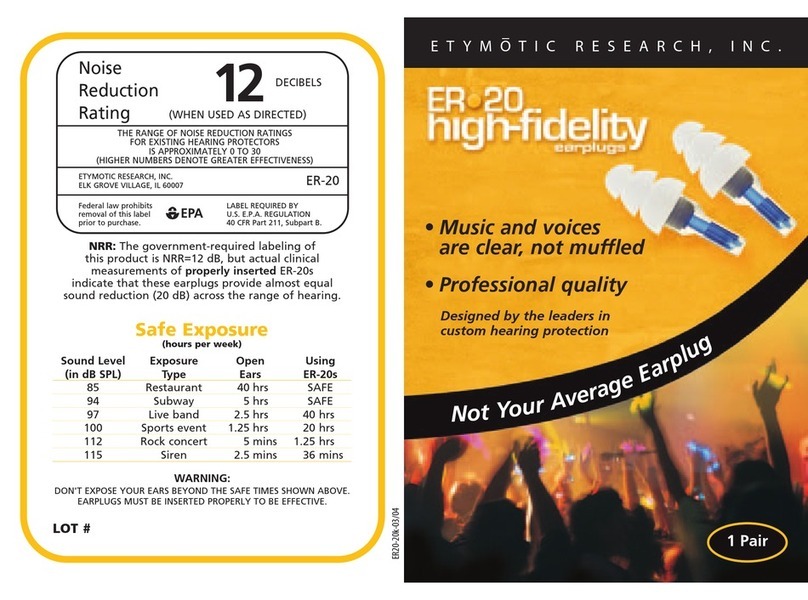
The U.S. Environmental Protection Agencyrequires manufacturers
to print a noise reduction rating (NRR) on all non-custom earplugs.
The formula used to determine NRR includes an adjustment for test
variability, individual variability, and for those persons who do not wear ear
protection as instructed. When worn properly, Etymotic earplugs provide more
sound reduction than the assigned NRR value. Laboratory data on subjects
wearing properly sealed ETY•Plugs™shows between 18-22 dB average
sound reduction over the 250-8000 Hz frequency range, but the NRR
calculated from the same data is 12 dB.
Q
Q
Q
Q
Q
ER-9
•
ER-15
•
ER-25
EREM-B01-B 0907
Who uses Musicians Earplugs?
ETYMOTIC RESEARCH INC.
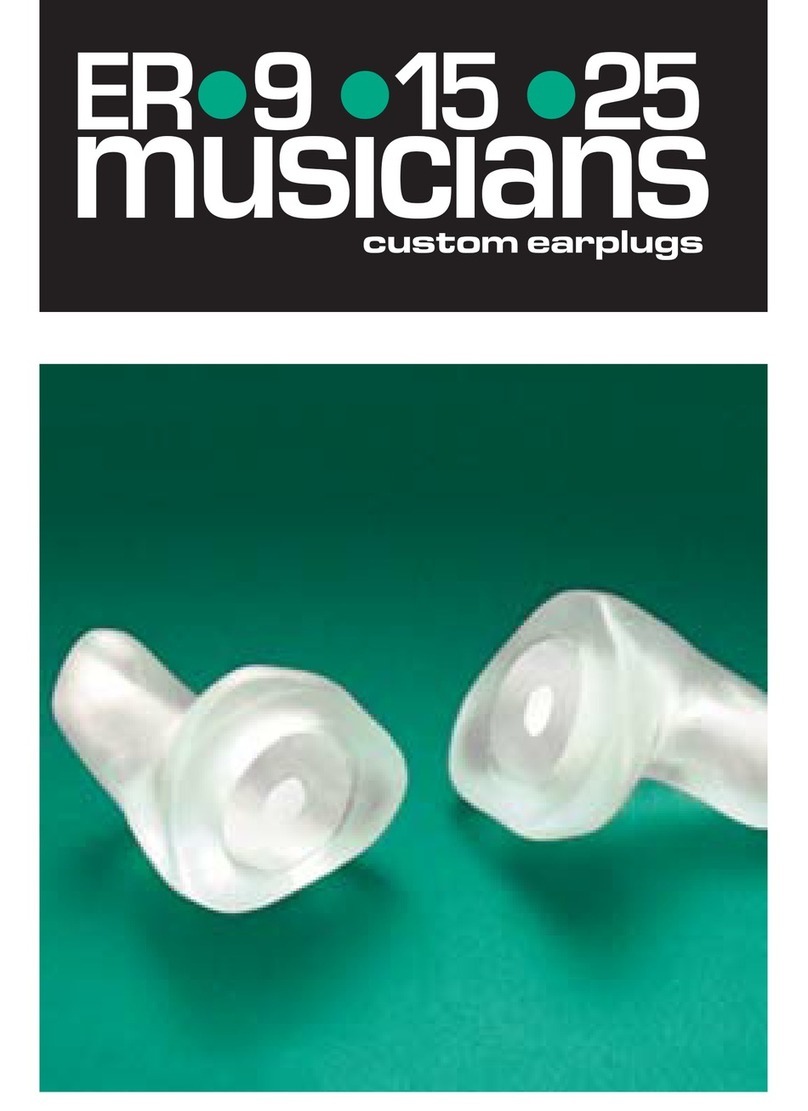
Musicians Earplugs™
•Custom high-fidelity hearing protection
• Sound quality is clear and natural, not muffled
•Noise fatigue and ear overload distortion are reduced
E
ET
TY
YM
MO
OT
TI
IC
CR
RE
ES
SE
EA
AR
RC
CH
HINC.
61 Martin Lane • Elk Grove Village, IL 60007
w
ww
ww
w.
.e
et
ty
ym
mo
ot
ti
ic
c.
.c
co
om
m•
•8
88
88
8-
-3
38
89
9-
-6
66
68
84
4
Musicians Earplugs™ is a trademark of Etymotic Research,Inc.The ER family of earplugs is covered by one
or more of the following U.S.patents:#4,852,683,#5,113,967, #5,887,070 and other patents pending.
Industrial
factory workers
shop teachers
students
supervisors
Leisure
concerts
night clubs
noisy restaurants
Construction
carpenters
equipment operators
road builders
steel workers
Aircraft
crew
flight instructors
passengers
pilots
Athletics
athletes
coaches
sporting events
Medical-Dental
dentists
dental hygienists
dental technicians
surgeons
Others
delivery drivers
market traders
night club staff
truck drivers
Music
concerts
marching bands
musicians
night clubs
Motor Sports
motorcyclists
pit crews
race car drivers
spectators
Emergency
Vehicles
EMTs
highway patrol
firefighters
Hearing loss is a function of exposure time, the average noise level and the
peak level of very loud sounds.
Regular Small
Permissible Sound Exposure Guidelines
NIOSH (1998). Criteria for a recommended standard: occupational noise exposure. Cincinnati, OH: U.S. Department
of Health and Human Services, Public Health Service, Centers for Disease Control and Prevention, and National
Institute for Occupational Safety and Health. DHHS (NIOSH) Publication No. 98-126.

UNPROTECTED EAR
15 dB
WITH ER-15 EARPLUG
ER-15
ER-9
ER-25
FOAM
Harmful Sound Comes From:
fidelity
/fidélitee/ n.
1. faithfulness;
loyalty. 2. strict
conformity to
truth or fact.
3. exact
correspondence
to the original
4. precision in
reproduction of
sound or video
ER-25 Musicians Earplug
ER-15 Musicians Earplug
Standard Partially countersunk Countersunk
ER-9 Musicians Earplug
Discoloration, shrinkage, cracking, hardening of earmold material, deterioration in performance.
Moisten the mold for ease of insertion.
Pull the ear outward and upward while easing the mold into the ear canal.
Remove button from mold. Use water and mild soapon the mold only.
Dry mold thoroughly before replacing button.
Musicians Earplugs require custom earmolds. Deep impressions past the second bend of the ear canal must be taken to ensure
the effectiveness of these earplugs and to reduce the occlusion effect.
Provides uniform 15 dB sound
reduction across all frequencies
Provides 25 dB of relatively flat
sound reduction across
all frequencies
Identical dimensions. Change buttons for different listening conditions.
BrownBeige
Red Blue
Description
Button Colors
Interchangability
Earmold styles
Insertion
Cleaning
Replacement
Flat 9 dB sound reduction through
the mid range. Same high
frequencyprotection as the ER-15
Small strings Own instrument, other strings
Large strings Brass
Woodwinds Brass, percussion
Brass Own instrument, other brass
Flutes Percussion
Percussion Own instruments, other percussion
Vocalists Own voice, speakers, monitors
Acoustic guitar Drums, speakers, monitors
Amplified instruments Speakers, monitors
Marching bands Multiple sources
Music teachers Multiple sources
Recording engineers Speakers, monitors
Sound crews Speakers, monitors
ER-9
ER-15
ER-25
Clear
Quick
Reference
Guide
Three types of
attenuator buttons
are available:
ER-9, ER-15, and
ER-25. The number
corresponds with
the amount of
sound reduction
provided in dB.
About Musician Earplugs
What Makes
Musicians Earplugs
High Fidelity?
Musicians Earplugs™replicate the
natural response of the ear canal so
that sound heard with these earplugs
has the same quality as the original,
just quieter.
Ref: Chasin, M. Musicians and the Prevention of Hearing Loss. Singular Publishing Group. 1996.
85 8 hours
88 4 hours
91 2hours
94 1hour
97 30 minutes
10015 minutes
1037.5 minutes
106 < 4 minutes
109 < 2 minutes
112 ~1minutes
115 ~30 seconds
Continuous Unprotected Permissible
Sound dBA Exposure Time
ER-15 Musician Earplugs provide 15 dB sound
reduction at each frequency.
Average sound reduction of Musicians Earplugs and
foam earplugs.
Permissible Sound Exposure Guidelines
Musicians Earplugs were designed to protect hearing
while preserving all the subtleties and richness of music.
Other earplugs, particularly foam, muffle sound so music
and speech are not heard distinctly. Musicians Earplugs
are made from custom ear impressions and tested to
ensure that sound heard with them is accurate and true
—the definition of high fidelity. Music and speech
reproduced through these earplugs sounds exactly as
it would in an ear without an earplug, but at a lower
(safer) loudness level.
Musicians practice and perform in a variety of different
settings and they are exposed to high levels of sound,
sometimes for long periods. They require different
amounts of hearing protection depending on the
sound levels they encounter during rehearsals and
performances. See the table to the right.
Which Earplug is Best for You?
ER-20
EtyPlugs™
NIOSH (1998)