Here are some places you might try searching for metal objects:
- Around old houses, especially near large trees where people often sit
down to rest.
- Along grassy areas next to paths.
- Sites where annual fairs, carnivals or circuses take place.
- Along beaches.
- Local areas where historic events such as battles occurred, or where
troops may have travelled or camped – remember to check current
local laws before detecting in any historical places.
- Your own front and back gardens.
Always remember to ask permission before searching on privately
owned property. Always tell an adult where you are going!
You will probably find lots of bottle caps, metal pull tabs, and foil wrap.
You should collect these and dispose of them in the relevant recycling
bins. Do not be discouraged. Keep searching and you will be sure to
find some rewarding objects.
6 7
In 1881, Alexander Graham Bell
(the inventor of the telephone) created the
earliest form of metal detector ever recorded,
when he tried to find a metal bullet lodged in the
President of the United States back. President
James Garfield lay dying of an assassin's bullet,
so Bell hurriedly invented an electromagnetic
device to try to locate it.
Tips
RESPECT OTHERS! Always ask permission from the property owner
before searching. Found objects are usually the property of the
landowner, unless you come to a different agreement. It is a good idea
to check current local, regional or national laws. If a find is of significant
monetary or historic value, you should report it to local authorities, as
ownership might automatically revert to the government which may pay
a ‘finder’s fee’.
RESPECT THE ENVIRONMENT and be thoughtful! It’s generally wise
to take an extra bag along for any rubbish you dig up. It is good practice
to remove and properly discard these findings instead of burying them
again. Do not leave rubbish for other coin hunters to find.
Metal detecting is usually forbidden at historic sites and in most parks,
so please check before searching.
When recovering lost items, always make the smallest hole possible and
return the ground surface to the way it was before you started to dig.
Do not use a shovel to dig! Many coin hunters use a small garden trowel
and a flat-blade screwdriver.
When searching in sand, you will find it easier to use a scoop or a sieve
with small holes.
If the coins you find are really dirty, you should be very careful in cleaning
them, especially if they are old and possibly of high value. Do not use
harsh chemicals or abrasives. Try soaking them for a day or two in olive
oil, and then rub them gently with an old towel to remove the dirt.
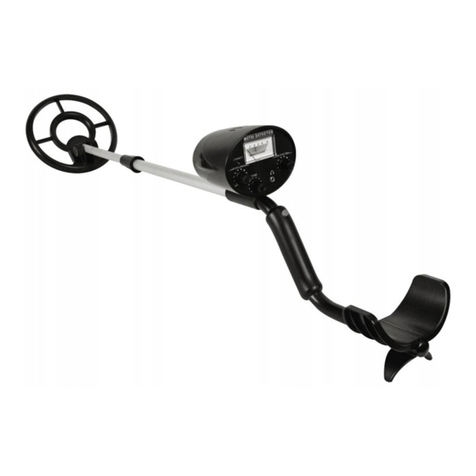
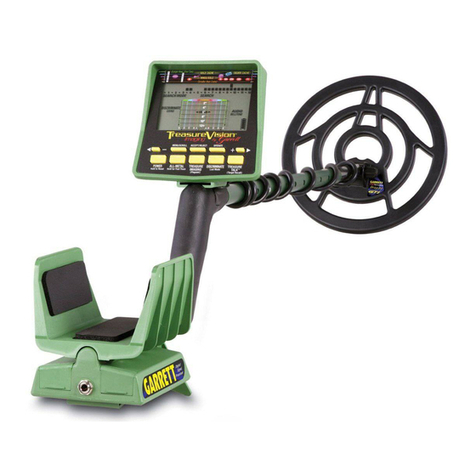
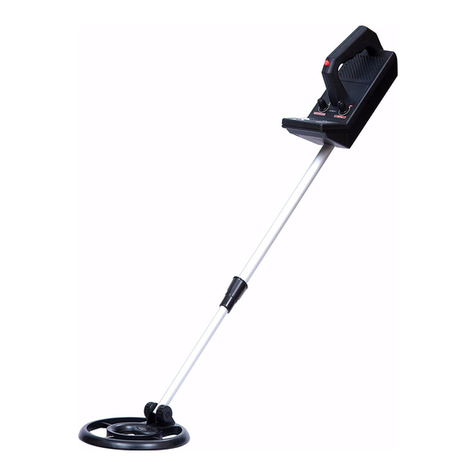
Metal detectors have coils.
Electricity (or an electromagnetic
charge) is sent through these coils
to the ground and back to the coils.
Metallic objects interrupt the signal,
which results in the unit creating an
audible sound (beep).
CAUTION: DO NOT DIP THE SEARCH COIL IN WATER.
THIS IS NOT AN UNDERWATER METAL DETECTOR.
YOU WILL DAMAGE THE UNIT.