11
ENGLISH ENGLISH
3. STATUS OF INPUTS
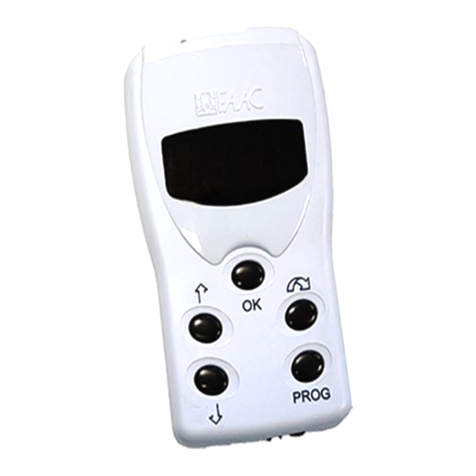
In stand-by mode, the Digiprogram display is used to indicate
the status of the inputs of the 462DF control board.
Fig 2 shows exactly how the LEDs on the display relate to the
inputs.
The table below shows the status of the LEDs in relation to to the
status of the inputs.
Note the following:
LED LIGHTED
= closed contact
LED OFF
= open contact
Checkthestate ofthesignalling LEDsasper Table.
Operation of the status signalling LEDs
NB.:
ThestatusoftheLEDswhilethegateisclosedatrestareshowninbold.
LEDs LIGHTED OFF
OP_A Command activated Command inactive
OP_B Command activated Command inactive
STOP Command inactive Command activated
CLOSE Command activated Command inactive
FSW CL Safety devices disengaged Safety devices engaged
FSW OP Safety devices disengaged Safety devices engaged
SAFETY CL Safety devices disengaged Safety devices engaged
SAFETY OP Safety devices disengaged Safety devices engaged
EMERG Command inactive Command activated
FCA1 (if used) Limit-switch free Limit-switch engaged
FCC1 (if used) Limit-switch free Limit-switch engaged
FCC2 (if used) Limit-switch free Limit-switch engaged
FCA2 (if used) Limit-switch free Limit-switch engaged
4. SIMPLE LEARNING
Check if the leaves are closed, then enter “
BASIC
PROGRAMMING
”, select the TIME LEARNING function and
press the +push-button for one second: the display starts flashing
and the leaves begin their opening movement - after this, follow
the subsequent instructions according to type of operation.
4.1 TIMED OPERATION
Wait for the leaves to reach the opening stop limit and, after a
few seconds, press push-button +to stop the movement: the
leaves stop and the display returns to stand-by mode.
The procedure has ended and the gate is ready to operate.
Notes: •
If you want the leaves to slow down, a complete
learning procedure is necessary (see chapter 5).
4.2 LIMIT-SWITCH OPERATION
The motors stop automatically when the opening limit-switch is
reached, but you must press push-button +to complete the
procedure. The display returns to stand-by mode and the gate is
ready to operate.
Notes: •both the limit-switches (opening and closing) for each
leaf must be present on the system.
4.3 OPERATION WITH GATECODER
The motors stop automatically when the opening stop limit is
reached, the display returns to stand-by mode and the gate is
ready to operate.
Notes: •
one gatecoder per leaf must be present on the system;
•
Using the gatecoder provides electronic anti-crushing
control while the leaf is moving at full speed;
•
the deceleration space near the stop limits is
automatically set by the 462DF board.
4.4 OPERATION WITH LIMIT-SWITCH AND
GATECODER
The motors stop automatically when the opening limit-switch is
reached. The display returns to stand-by mode and the gate is
ready to operate.
Notes: •both the limit-switches (opening and closing) and a
gatecoder for each leaf must be present on the system.
•if the limit-switch is tripped during normal operation,
this causes the movement to stop immediately;
•Using the gatecoder provides electronic anti-crushing
control while the leaf is moving at full speed;
5. COMPLETE LEARNING
Check if the leaves are closed, then enter “
BASIC
PROGRAMMING
”, select the TIME LEARNING function and
press the +key for more than 3 seconds: the display starts flashing
and leaf 1 begins the opening movement - after this, follow the
subsequent instructions according to type of operation.
5.1 TIMED OPERATION
By pressing key +the following functions are pulse-controlled:
1st PULSE-Deceleration on opening of leaf 1
2nd PULSE-Leaf 1 stops on opening and leaf 2 begins its
opening movement
3rd PULSE-Deceleration on opening of leaf 2
4th PULSE-Leaf 2 stops on opening and immediately begins its
closing movement
5th PULSE-Deceleration on closing of leaf 2
6th PULSE-Leaf 2 stops on closing and leaf 1 begins its closing
movement
7th PULSE-Deceleration on closing of leaf 1
8th PULSE-Leaf 1 stops on closing
The display stops flashing and the gate is ready for normal
operation.
Notes: •If you wish to eliminate deceleration in some stages,
wait for the leaf to reach its stop limit and supply 2
consecutive pulses with key +(within 1 second).
•If only one leaf is present, the entire sequence must
nevertheless be effected. When the leaf has finished
opening, supply 4 pulses with key +until the leaf begins
to close, and then resume normal procedure.
5.2 OPERATION WITH LIMIT-SWITCHES
The motors decelerate automatically when they reach the limit-
switches and, therefore, it is sufficient to inform the control board
that the stop limits have been reached, by sending pulses with
key +:
FCA1 -Deceleration on opening of leaf 1
1st PULSE-Leaf 1 stops on opening and leaf 2 begins its
opening movement
FCA2 -Deceleration on opening of leaf 2
2nd PULSE-Leaf 2 stops on opening and immediately begins its
closing movement
FCC2 -Deceleration on closing of leaf 2
3rd PULSE-Leaf 2 stops on closing and leaf 1 begins its closing
movement
FCC1 -Deceleration on closing of leaf 1
4th PULSE-Leaf 1 stops on closing
The display stops flashing and the gate is ready for normal
operation.
Notes: •If you wish to eliminate deceleration in some stages,
you must supply a pulse with key +within 1 second of
reaching the limit-switch.
•If some limit-switches are not installed, start the
corresponding deceleration by pressing key +(which
replaces the limit-switch).