Important
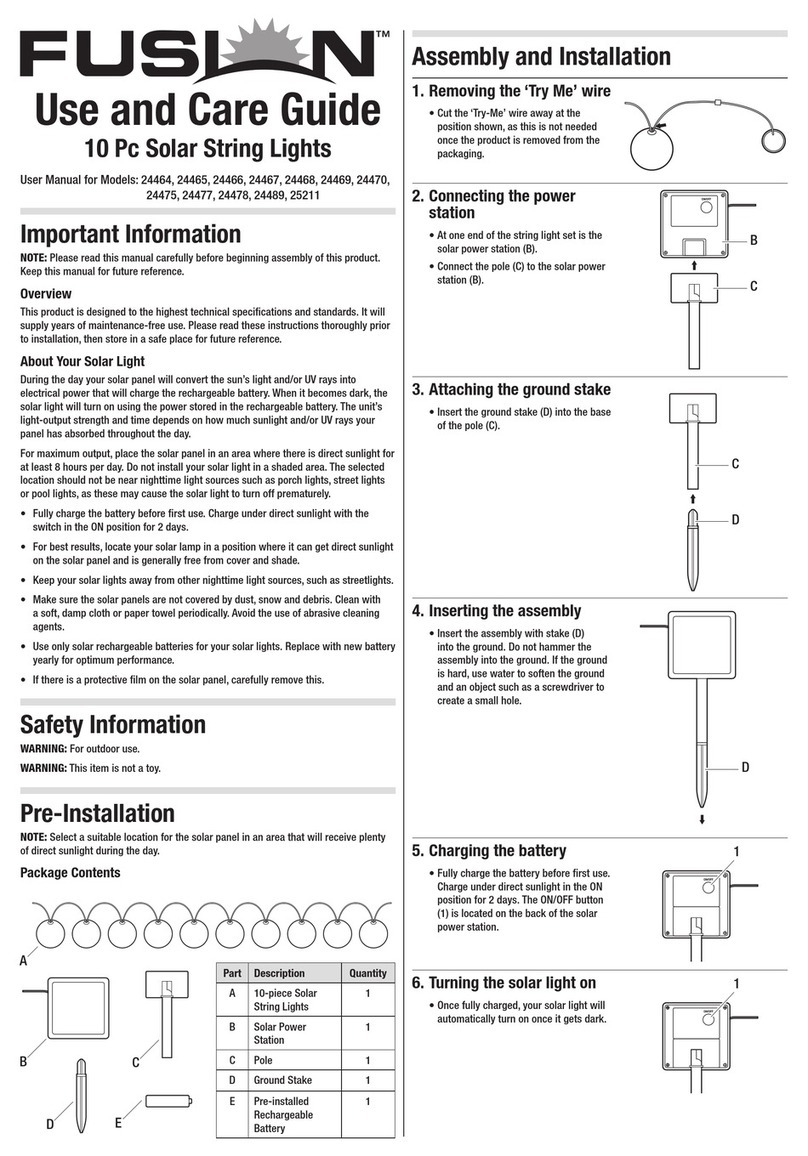
•Fully charge the battery before first use. Charge under direct
sunlight for 2 days.
•For best results, locate your solar lamp in a position where it
can get direct sunlight on the solar panel and generally free
from cover and shade.
•Keep your solar lights away from other night-time light
sources, such as streetlights.
•Make sure the solar panels are not covered by dust, snow
and debris. Clean it with a soft damp cloth or paper towel
periodically. Avoid the use of abrasive cleaning agents.
•Use only rechargeable batteries for your solar lights. Replace
with a new battery of the same size each year for optimum
performance.
•The performance of the solar light will vary with the time of
year. It will deliver more light when it has had a full day in
the sun rather than a day in overcast weather.
Operation
For First Time Use:
STEP 1:
Remove the lens from the solar housing
by carefully holding onto the solar
housing and turning the lens in a
counter-clockwise direction.
STEP 2:
Remove the pull tab from the battery
compartment.
STEP 3:
Secure lens back to solar housing.
STEP 4:
Fully charge the battery before first
use. charge under direct sunlight for 2
days. Your solar light will automatically
turn on once it gets dark.
Installation
STEP 1:
Select the correct adapter size size
depending on the size of the post.
STEP 2:
Mark holes and pre-drill if necessary before
securing adapter to post with screws (Figure
2). If attaching adapter to composite, vinyl,
PVC, or other; secure to post by pushing
adapter onto post (Figure 3).
STEP 3:
Attach the assembled light to the adapter by
turning clockwise until secure (Figure 2,3).
Routed Post Sleeve Option
STEP 1:
Remove the lens from the solar housing by
carefully holding onto the solar housing and
turning the lens in a counter-clockwise
direction.
STEP 2:
Select the correct adapter size size depending
on the size of the post.
STEP 3:
Secure adapter to post by pushing adapter
onto post (Figure 4).
STEP 4:
Attach solar housing to adapter by turning
clockwise until secure (Figure 4).