EN
OPERATION
This hood has been designed to prevent the formaon of con-
densaon on its lower surfaces when it is installed over an in-
ducon cooker.
Unlike a gas stove, an inducon cooker heats only the pans con-
taining the food and not the surrounding area, so the surfaces
of the hood remain cold.
When the hot cooking fumes go up, they hit the hood cold sur-
faces, condense and therefore release the humidity in the air
that quickly transforms into small water drops that inevitably
fall on the cooking surface and food, carrying with them fat and
impuries.
To prevent this from happening, all the lower surfaces of the
hood are heated by a system of internal and therefore invisi-
ble resistors, so the hood lower surfaces geng warm, even
without switching the cooker on, is quite normal and does not
show that the product is not working properly.
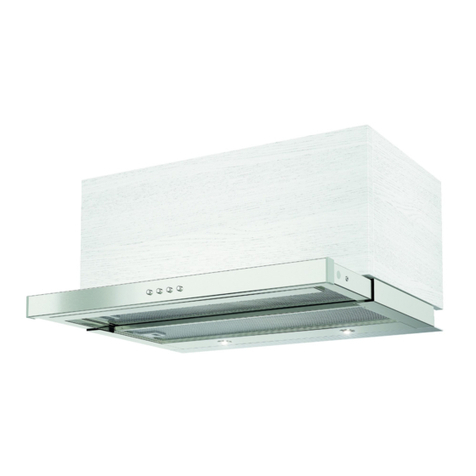
To switch the hood on, rst open the fume ap using the rela-
ve handle in the lower part. Lightly pull downwards and then
extract ap “A” fully (Fig. 6). A special sensor will automacally
switch the hood o when you try and close the ap with the
hood on.
The controls consist of keys to switch the TL lamp on, to switch
speed one on and switch extractor T1 o, to select the T2-T3-T4
running speeds and to acvate the an-condensaon funcon
T5 (Fig. 7). The an-condensaon funcon comes automacally
on when the hood is switched on with key T1, it can anyway be
switched on and o with key T5.
To switch the motor o, press T1 only once if the hood is opera-
ng in 1st speed, twice if it is running at other speeds.
The internal fat lter is not heated to allow condensang most
of the humidity in the air, this surface will therefore show some
drops that are collected in a special tray. This container should
be emped every me you nish cooking. To empty the contai-
ner, rst of all open fume ap “A” (Fig. 6), with the hood swi-
tched o, pull lever “B” (Fig. 8), located in the back of conden-
sate tray “C” downwards (Fig. 8) and at the same me posion
a container under drain valve “D” (Fig. 8) present in the lower
part of the same tray. The collected water and impuries will
drain from this valve.
The hood should be switched on a few minutes before starng
cooking to allow the lower parts to warm up and le on unl all
odours have disappeared.
While cooking, keep the hood maximum extracng speed on to
get the best possible performance in terms of both extracon
and reducon in surface condensaon.
Acvaon of adjustable delayed auto-o funcon
With the hood in operaon, select the desired speed, press
without releasing the key of the speed corresponding to the
auto-o minutes you wish to set, unl it starts ashing, keeping
in mind that:
T1 equals 5 minutes
T2 equals 10 minutes
T3 equals 15 minutes
The set speed can be modied during the auto-o me.
FILTER MAINTENANCE WARNING
Grease lter
Every 30 hours’ operaon, when the hood is switched o, all
the LEDs of the speed keys light up connuously for 30 seconds
to warn the grease lter “E” needs to be cleaned (Fig. 9). To
zero the mer, keep the T1 key pressed with the extractor OFF,
otherwise the device will give the same warning the next me
the hood is switched o.
Acve carbon an-odour lter (oponal)
Every 120 hours’ operaon, when the hood is switched o, all
the LEDs of the speed keys light up connuously for 30 seconds
to warn the acve carbon an-odour lter “F” needs replacing
(Fig. 9). To zero the mer, keep the T1 key pressed with the
extractor OFF, otherwise the device will give the same warning
the next me the hood is switched o.
Full condensate container warning
An electronic internal sensor immediately switches the hood
o and the speed LEDs on when the water in the condensate
collecon tray reaches the maximum level. To zero the warning
and switch the hood back on, the condensate collecon tray
needs to be emped.
MAINTENANCE
Before any maintenance or cleaning, disconnect the hood from
the mains and check there are no pans on the cooking surface.
Pay careful aenon to the fat lter, which is used to withhold
the fat parcles contained in the steam. The fat lter must be
washed when the relave warning is displayed or at least once
a month in warm water and detergent (in the dishwasher too).
Aer a few washes the lter may discolour. This is normal and
does not mean that it must be replaced.
For any maintenance, the fat lter must be removed from the
hood. First of all open the fume ap of the hood using the
appropriate handle located in the lower part, to do this slightly
pull downwards and then extract ap “A” fully (Fig. 6). With
the hood switched o, open the condensate tray “G” (Fig. 11)
pulling from the back “I” (Fig. 12). The tray will lower slightly
and rotate on itself at the front “L” (Fig. 12) to nally come
down.
You will then access the internal fat lter and be able to take it
out with the relave handle “H” (Fig. 11).
At this point you can proceed and clean the lter.
To reinstall the fat lter, repeat the instrucons in reverse order.
The funcon of the acve carbon an-odour lter, if any, is to
capture the odours in the cooking fumes. The air is puried
and released back into the room. The acve carbon an-odour
lter must not be washed but must be replaced when the
relave warning is displayed or at least 3-4 mes a year. Ask the
Manufacturer for lters.
To replace the acve carbon an-odour lter, rst of all open
the fume ap of the hood using the appropriate handle located
in the lower part, to do this slightly pull downwards and then
extract ap “A” fully (Fig. 6). With the hood switched o, open
the condensate tray pulling it from the back “I” (Fig. 12). The
tray will lower slightly and rotate on itself at the front “L” (Fig.
12) to nally come down.
You will then access the internal fat lter and be able to take it
out with the relave handle “H” (Fig. 11).
The acve carbon lter is located above the fat lter. To
replace the acve carbon an-odour lter, slide the steel frame
containing it towards the back (Fig. 10). Once the frame has
been extracted, the acve carbon an-odour lter inside it can
be removed and replaced.
To reinstall the new acve carbon an-odour lter, repeat the
operaons in reverse order.