manuals.online logo
Brands
  1. Home
  2. •
  3. Brands
  4. •
  5. GE
  6. •
  7. Laundry Appliance
  8. •
  9. GE 49-90280 User manual

GE 49-90280 User manual

This manual suits for next models

14

Other GE Laundry Appliance manuals

GE Spacemaker WSM2700R User manual

GE

GE Spacemaker WSM2700R User manual

GE Spacemaker WSM2000H Installation instructions

GE

GE Spacemaker WSM2000H Installation instructions

GE Spacemaker WSM2420S User manual

GE

GE Spacemaker WSM2420S User manual

GE Spacemaker WSM2780 User manual

GE

GE Spacemaker WSM2780 User manual

GE Spacemaker WSM2700 User manual

GE

GE Spacemaker WSM2700 User manual

GE Spacemaker WSM2780 User manual

GE

GE Spacemaker WSM2780 User manual

GE Spacemaker WSM2780 User manual

GE

GE Spacemaker WSM2780 User manual

GE Spacemaker WSM2780 User manual

GE

GE Spacemaker WSM2780 User manual

GE Spacemaker WSM2780 User manual

GE

GE Spacemaker WSM2780 User manual

GE Spacemaker WSM2480 User manual

GE

GE Spacemaker WSM2480 User manual

GE Spacemaker WSM2420S User manual

GE

GE Spacemaker WSM2420S User manual

GE Spacemaker WSM2700 User manual

GE

GE Spacemaker WSM2700 User manual

GE Spacemaker WSM2780 User manual

GE

GE Spacemaker WSM2780 User manual

GE Spacemaker GTUP270EMWW How to use

GE

GE Spacemaker GTUP270EMWW How to use

GE FPDW User manual

GE

GE FPDW User manual

GE Unitized Spacemaker WSM2420 User manual

GE

GE Unitized Spacemaker WSM2420 User manual

GE WSM2700WWW - 27" Unitized Spacemaker Washer User manual

GE

GE WSM2700WWW - 27" Unitized Spacemaker Washer User manual

GE Spacemaker WSM2700 User manual

GE

GE Spacemaker WSM2700 User manual

GE Spacemaker WSM2700L User manual

GE

GE Spacemaker WSM2700L User manual

GE Spacemaker Laundry WSM27TH User manual

GE

GE Spacemaker Laundry WSM27TH User manual

Popular Laundry Appliance manuals by other brands

LAUNDRY JET Plus installation guide

LAUNDRY JET

LAUNDRY JET Plus installation guide

Kenmore Kenmore 27" Wide LAUNDRY CENTER Washer -... Use and care guide

Kenmore

Kenmore Kenmore 27" Wide LAUNDRY CENTER Washer -... Use and care guide

LG WKGX301H A Series owner's manual

LG

LG WKGX301H A Series owner's manual

Frigidaire GLEH164DS1 Schematic diagrams

Frigidaire

Frigidaire GLEH164DS1 Schematic diagrams

Frigidaire GLEH1642DS0 Schematic diagrams

Frigidaire

Frigidaire GLEH1642DS0 Schematic diagrams

AEG LAVATHERM 65280AC user manual

AEG

AEG LAVATHERM 65280AC user manual

Milnor 64058TG1L Installation and service

Milnor

Milnor 64058TG1L Installation and service

Electrolux LAUNDRY Service manual

Electrolux

Electrolux LAUNDRY Service manual

Frigidaire FEX831F Factory parts catalog

Frigidaire

Frigidaire FEX831F Factory parts catalog

LG WK2116BST owner's manual

LG

LG WK2116BST owner's manual

Beyond LAUNDRY PRO 2.0 manual

Beyond

Beyond LAUNDRY PRO 2.0 manual

LG WKHC252HWA owner's manual

LG

LG WKHC252HWA owner's manual

UNITY LAUNDRY SYSTEMS UTS40 user manual

UNITY LAUNDRY SYSTEMS

UNITY LAUNDRY SYSTEMS UTS40 user manual

Frigidaire GLET1142CS0 operating instructions

Frigidaire

Frigidaire GLET1142CS0 operating instructions

Samsung WF0502NUV quick guide

Samsung

Samsung WF0502NUV quick guide

Mustee Utilatub Combo 14C installation instructions

Mustee

Mustee Utilatub Combo 14C installation instructions

Tricity Bendix 73188 Operating and installation instructions

Tricity Bendix

Tricity Bendix 73188 Operating and installation instructions

BÖWE P26 instruction manual

BÖWE

BÖWE P26 instruction manual

manuals.online logo
manuals.online logoBrands
  • About & Mission
  • Contact us
  • Privacy Policy
  • Terms and Conditions

Copyright 2025 Manuals.Online. All Rights Reserved.

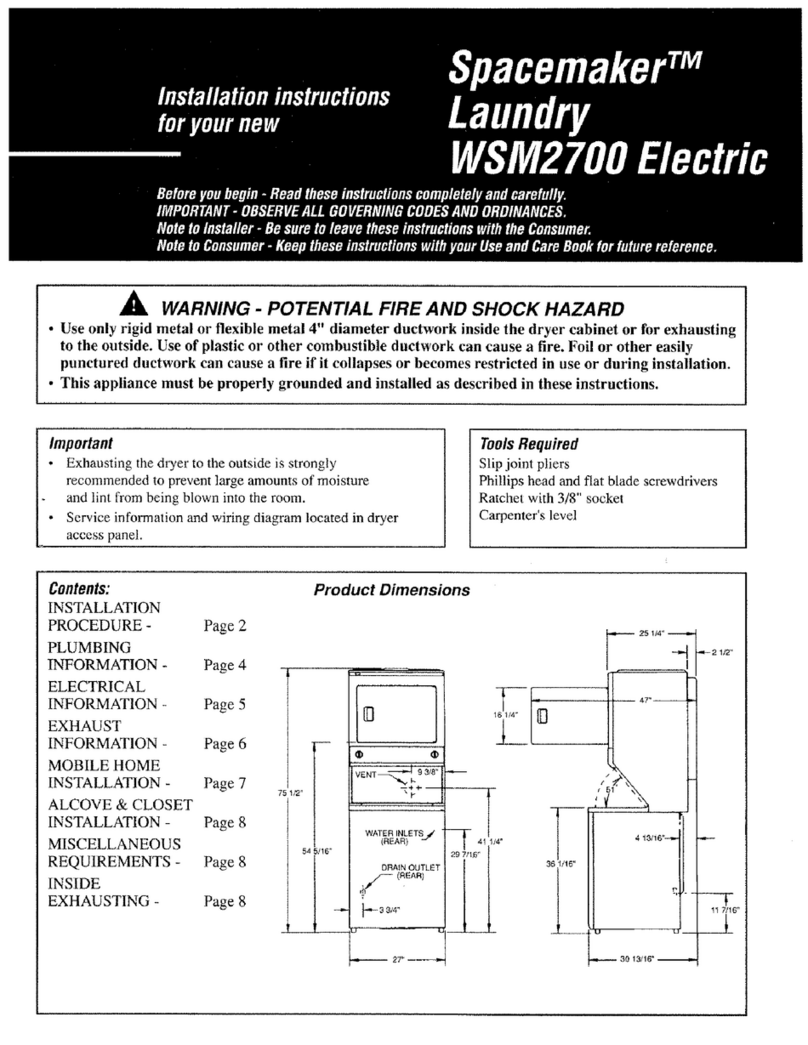
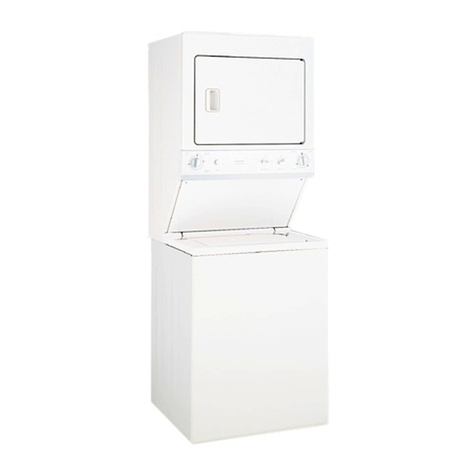
SpacemakerTMLaundry
Safety Instructions ...................3- 5
Operating Instructions, Tips
Controls Setting Guide ........................10, 1 1
Knits Drying Tips .............................................9
Lint Filter ........................................4, 9, 20, 21
Loading .............................................................7
Operating the Washer ...................................8
Operating the Dryer .......................................9
Permanent Press Drying Tips ..............9-1 1
Sorting Clothes ...........................................6, 7
Problem Solver .......................15-19
More questions ?...call
GEAnswer Center®800,628,2000
Preparation
Other Laundry Products .............................12
Ha rd Water .................................................... 13
Loading the Washer ...................................... 7
Pretreating .........................................6, 12, 13
Sorting Clothes ...........................................6, 7
....................................Stains .............................................................. 13
iiiiiiiiiiiiiiiiiiiiiiiiiiiiiiiiiii
Stain Removal Guide ................................... 14
Care and Cleaning ..................20,21
Dryer Exhaust ................................................21
Exterior ...........................................................20
Lint Filter ........................................8, 9, 20, 21
Storage and Vacation Tips ........................20
User Maintenance Instructions ........20, 21
Consumer Services
Appliance Registration ..................................2
Model and Serial Numbers ..........................2
Repair Service ..................................................2
Warranty ........................................Back Cover
IMoflels: WSM2700 WSM2780
GEQuality Product
175D1807P548
49-90280
12_05 JR
HELP US HELP YOU...
Before using your
Spacemaker TMLaundry,
read this book carefully.
It is intended to help you
operate and maintain your
new appliance properly.
Keep it handy for answers to
your questions.
If you don't understand something
or need more help, call:
GE Answer Center ®
800.626.2000
24 hours a day, 7 days a week
or visit our Web site at:
ge.conrl
Save time and money.
Before you request service...
check the Problem Solver
section. It lists causes of minor
operating problems that you can
correct yourself.
If you received a
damaged appliance...
Immediately contact the dealer (or
builder) that sold you the appliance.
Write down the model
and serial nmnbers.
You'll find them on a label on the
inside of the dryer door.
These numbers are also on the
Consumer Product Ownership
Registration Card that came with
your appliance. Before sending in
this card, please write these
numbers here:
Model Number
Serial Number
Use these numbers in any
correspondence or service
calls concerning your appliance.
WARN NG. o you sa ety t e io atio in t is a ua ust be fo owed to " "nil e
I"'F r r t_ h mt_rm lnl hi m n lm II mini z
the risk of fire or explosion or to prevent property damage, personal injury or loss of life.
Do not store or use gasoline or other
flammable vapors and liquids in the
vicinity of this or any other appliance.
--WHAT TO DO IF YOU SMELL GAS
•Do not try to light any appliance.
•Immediately call your gas supplier from a
neighbor's phone. Follow the gas supplier's
instructions.
•If you cannot reach your gas supplier, call
the fire department.
•Do not touch any electrical switch; Installation and service must be performed
do not use any phone in your building, by a qualified installer, service agency or
the gas supplier.
• Clear the room. building or area
All washing and drying instruction terms in this book conform to the Care
Labeling Rule established by the Federal Trade Commission, January 1984.
If You Need Service
We're proud of our service and want you to be
pleased. If for some reason you are not happy with the
service you receive, here are steps to follow for
further help.
First, contact the people who serviced your appliance.
Explain why you are not pleased. In most cases, this
will solve the problem.
NEXT, if you are still not pleased, write all the
details--including your phone number_to:
Manager, Customer Relations
GE Appliances, Appliance Park
Louisville, KY 40225
2
IMPORTANT SAFETY INSTRUCTIONS
Read all instructions before using this appliance.
California Sate Drinking Water and Toxic
Enforcement Act
This act requires the governor of California to
publish a list of substances known to the state to
cause cancer, birth defects or other reproductive
harm and requires businesses to warn customers of
potential exposure to such substances.
Gas appliances can cause minor exposure to four of
these substances, namely benzene, carbon monoxide.
formaldehyde and soot. ca used primarily by the
incomplete combustion of natural gas or LP fuels
Properly adjusted dryers will minimize incomplete
combustion. Exposure to these substances can be
minimized further by properly venting the dryer to
the outdoors.
Warning To reduce the risk of fire,
electric shock, or injury to persons when
using your appliance, follow
basic precautions, including the following:
• Use this appliance only for its intended
purpose as described in this Use and Care Book.
.This appliance must be properly
installed and located in accordance
with the Installation Instructions
before it is used. If you did not receive an
Installation Instructions sheet with your
appliance, you can obtain one by calling, toll
• Do not repair or replace any
part of the appliance or attempt
any servicing unless specifically
recommended in this Use and Care Book or
in published user-repair instructions that you
understand and have the skills to carry out.
•Turn off water faucets when the washer is not
in use to relieve pressure on hoses and valves.
and to minimize leakage if a hose or valve should
break or rupture.
. When disconnecting this appliance
pull by the plug rather than the cord
to avoid damage to the cord or junction
of cord and plug. Make sure that the cord is
located so that it will not be stepped on. tripped
over or otherwise subjected to damage or stress.
To Minimize the Possibility
of a Fire Hazard
•Exhaust Duct--See Installation Instructions.
Use only metal duct inside for exhausting dryer
to the outside. USE OF PLASTIC OR OTHER
COMBUSTIBLE DUCTWORK CAN CAUSE A
FIRE. FOIL OR OTHER EASILY PUNCTURED
DUCTWORK CAN CAUSE A FIRE IF IT
COLLAPSES OR BECOMES OTHERWISE
RESTRICTED IN USE OR DURING
INS TALLATION.
free. the GE Answer Center _.800.626.2000.
--Properly ground to conform with all
governing codes and ordinances. Follow
details in Installation Instructions.
--Locate where the temperature is above 50°E
(10°C,} for satisfactory operation of the
appliance control system. Do not install or
store the appliance where it will be exposed to
the weather.
--Connect to a properly rated, protected
and sized power supply circuit to avoid
electrical overload.
--Exhausting to the outside is STRONGLY
RECOMMENDED to prevent large amounts
of moisture and lint from being blown into the
room. Carefully follow the details in the
Installation Instructions. If your appliance is not
vented to the outside, see special instructions in
Care and Cleaning section. If this appliance has a
• Do nol use heat to dry articles containing rubber,
plastic, or similar materials (such as padded
bras. tennis shoes, galoshes, bath mats. rugs. bibs.
baby pants, plastic bags, etc.) as these materials
may melt or burn. Also. some rubber materials.
when heated, can under certain circumstances
produce fire by spontaneous combustion.
• Do not store items that may burn or melt
Isuch as clothing, paper material, plastics
or plastic containers, etc. I on top of the appliance
during operation.
•Garments labeled "Dry Away from Heat"
!such as life jackets containing Kapok I
must not be put in your dryer.
.'continued next page
gas &yer. it must be exhausted outside.
IMPORTANT SAFETY INSTRUCTIONS
(continued)
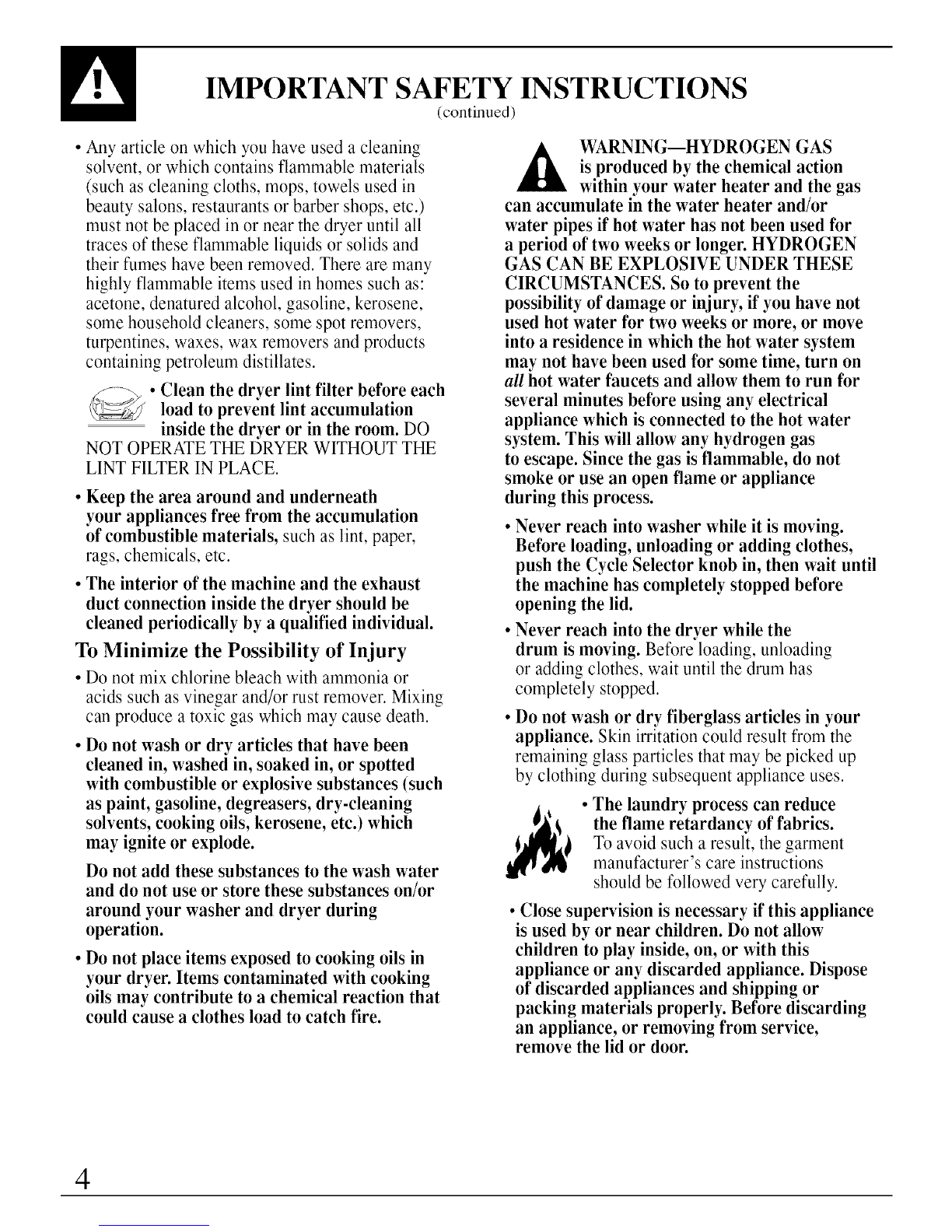
• Any article on which you have used a cleaning
solvent, or which contains flammable materials
(such as cleaning cloths, mops, towels used in
beauty salons, restaurants or barber shops, etc.)
must not be placed in or near the dryer until all
traces of these flammable liquids or solids and
their fumes have been removed. There are many
highly flammable items used in homes such as:
acetone, denatured alcohol, gasoline, kerosene,
some household cleaners, some spot removers,
turpentines, waxes, wax removers and products
containing petroleum distillates.
•Clean the dryer lint filter before each
_load to prevent lint accumulation
inside the dryer or in the room. DO
NOT OPERATE THE DRYER WITHOUT THE
LINT FILTER IN PLACE.
• Keep the area around and underneath
your appliances free from the accumulation
of combustible materials, such as lint, paper,
rags, chemicals, etc.
• The interior of the machine and the exhaust
duct connection inside the dryer should be
cleaned periodically by a qualified individual.
To Minimize the Possibility of Injury
• Do not mix chlorine bleach with ammonia or
acids such as vinegar and/or rust remover. Mixing
can produce a toxic gas which may cause death.
• Do not wash or dry articles that have been
cleaned in, washed in, soaked in, or spotted
with combustible or explosive substances (such
as paint, gasoline, degreasers, dry-cleaning
solvents, cooking oils, kerosene, etc.) which
may ignite or explode.
Do not add these substances to the wash water
and do not use or store these substances on/or
around your washer and dryer during
operation.
• Do not place items exposed to cooking oils in
your dryer. Items contaminated with cooking
oils may contribute to a chemical reaction that
could cause a clothes load to catch fire.
WARNING--HYDROGEN GAS
is produced by the chemical action
within your water heater and the gas
can accumulate in the water heater and/or
water pipes if hot water has not been used for
a period of two weeks or longer. HYDROGEN
GAS CAN BE EXPLOSIVE UNDER THESE
CIRCUMSTANCES. So to prevent the
possibility of damage or injury, if you have not
used hot water for two weeks or more, or move
into a residence in which the hot water system
may not have been used for some time, turn on
all hot water faucets and allow them to run for
several minutes before using any electrical
appliance which is connected to the hot water
system. This will allow any hydrogen gas
to escape. Since the gas is flammable, do not
smoke or use an open flame or appliance
during this process.
• Never reach into washer while it is moving.
Before loading, unloading or adding clothes,
push the Cycle Selector knob in, then wait until
the machine has completely stopped before
opening the lid.
•Never reach into the dryer while the
drum is moving. Before loading, unloading
or adding clothes, wait until the drum has
completely stopped.
• Do not wash or dry fiberglass articles in your
appliance. Skin irritation could result from the
remaining glass particles that may be picked up
by clothing during subsequent appliance uses.
• The laundry process can reduce
the flame retardancy of fabrics.
To avoid such a result, the garment
manufacturer's care instructions
should be followed very carefully.
•Close supervision is necessary if this appliance
is used by or near children. Do not allow
children to play inside, on, or with this
appliance or any discarded appliance. Dispose
of discarded appliances and shipping or
packing materials properly. Before discarding
an appliance, or removing from service,
remove the lid or door.
4

.eep all laundry additives (such
as detergents, bleaches, fabric
softeners, etc.) out of the reach
of children, preferably in a locked cabinet.
Observe all warnings on container labels to avoid
personal injury.
• Keep the floor around your appliance clean
and dry to reduce the possibility of slipping.
. o minimize the possibility of electric
shock, unplug this appliance from the
power supply before attempting any
maintenance or cleaning (except the removal
and cleaning of the lint filter).
NOTE: Pushing the washer Cycle
Selector knob in or turning the dryer
Cycle Selector to OFF does NOT
disconnect the appliance from the
power supply.
•Do not tamper with the controls.
• Do not operate this appliance if it is damaged,
malfunctioning, partially disassembled, or has
missing or broken parts, including a damaged
cord or plug.
• Never climb on or stand on the dryer top.
For washer operation
•Do not leave washer lid up during cycle. This
will stop the spin action and prevent completion
of the cycle.
Dryer-applied Fabric Softeners or
Anti-static Conditioners
You may wish to soften your laundered
fabrics or reduce the static electricity in them.
We recommend you use either a fabric softener
in the wash cycle, according to the manufacturer's
instructions for those products, or try a dryer-added
product for which the manufacturer gives written
assurance on the package that their product can be
safely used in your dryer.
Service or performance problems caused by
the use of these products are the responsibility
of the manufacturers of those products and are
not covered under the warranty of this appliance.
SAVE THESE
INSTRUCTIONS
5
HOW TO SORT CLOTHES FOR YOUR WASHER
It pays to check and prepare
clothes for washing.
• Empty pockets, brush out cuffs,
zip zippers, snap snaps, hooks
and buttons.
• Do any necessary mending--rips,
hems, tears.
• Check all items for areas of
heavy soil or stain.
•Remove stains. See Stain
Removal Guide.
• Turn poly knits inside-out to
minimize fabric surface damage.
Soaking and Pretreating--a
good way to loosen deep soils
and stains.
A thorough soaking with
detmgent or special soaking agent
is another way to remove heavy
soils, embedded dirt and even
some stains.
For information on how to
soak in your washer, see
Operating Instructions.
FOR INFORMATION on
SOAKING AGENTS, see Other
Laundry Products section.
Pretreat heavy soil by rubbing
in a small amount of liquid
detergent or a paste made of water
and powdered detergent
or soap. For best results, wait
1/2 hour before washing.
Sort by Surface Texture
Separate ,_ ,__,
'_,_ProLiunters _/ from '_oolL;nttors ]/
LINT PRODUCERS--such as terry toweling and
chenille--give up lint.
LINT COLLECTORS--such as man-made fibers
and napped fabrics like velveteen and corduroy--
attract lint. These must be washed separately.
For more information on lint control, see
The Problem Solver section.
Sort by Fabric
Separate
Linens
Ill addition to sorting
to reduce lint collection,
it is recommended
that fabrics of similar
construction be
washed together
whenever possible.
Sort by Soil
Separate ,_ ,__, ,_
_=,.!ght!#7 fro m _2_dj_m¢7 from _2_a_:# 7
Sort by Color
Separate
For instructions on
different fabrics and
loads, see the Controls
Setting Guide.
6
HOW TO SORT CLOTHES FOR YOUR DRYER
Sort by Weight
Separate ,_ ,_
_u_h tsaej)s__ frem _,_c_!ii_ 7
Normally, if you sort clothes correctly for washing,
you will have properly sorted drying loads.
LOADING THE WASHER PROPERLY
• Add measured amount of detergent.
• Load clothes loosely. Dry clothes level should be no
higher than the top row of circular holes in the wash
tub. Do not put clothes on the agitator or wind them
around it. For best results, mix large items with
small ones. When washing a single heavy item, such
as a shag rug or bedspread, add one or two other
pieces to balance the load. Large items should be no
more than one-half of the total load.
• To bleach the load, measure liquid bleach
according to directions on container. After washer
has filled and agitated for several minutes, add
diluted bleach to the bleach dispenser.
For information on how to use bleaches and fabric
softeners, see Other Laundry Products section.
• Close lid. Washer will fill and agitate but will
not spin with lid open. This washer has a Safety
Lid Lock. As a safety measure, the lid will be
automatically locked during the spin portion of each
cycle. The lid will automatically unlock about one
minute after the end of the spin cycle. To open lid
during spin cycle, push Cycle Selector IN and wait
for lid lock to release, about one minute, before
opening.
For your personal safety, never reach into
washer while parts are moving. Always stop
washer to load, unload, add forgotten items
or additional laundry additives.
• Always flush the dispenser
with one cup of water to
avoid bleach carry-over to
the next wash load.
NOTE: Do not use powdered
bleach in the bleach dispenser.
Follow directions on the package
when using powdered bleach in the wash load.
ACAUTION: Failure to follow these
directions can cause bleach damage to the
wash load.
WARNING: Do not
use chlorine bleach and
ammonia in the same
load. Poisonous gas can
occur, resulting in
serious injury or death.
7
HOW TO OPERATE YOUR WASHER
WARNING--To reduce the risk of fire, electric shock, or injury to persons,
read the IMPORTANT SAFETY INSTRUCTIONS before operating this appliance.
COLD MED
WashTemperature Water Level PermPress
Delicate OFF *s*oRegular
0 O GO
Set the controls
See the Controls Setting Guide.
O Select Wash Temperature. Cold rinse will be
automatically provided with all cycles.
Select Water Level.
LOW: Washer is less than 1/3 full of clothes.
MED: Between 1/3 and 2/3 full.
HIGH: Over 2/3 full of clothes.
PULt rO
STanT-PUSR
TOSVOP
Push Cycle Selector in and turn clockwise to
your selected wash cycle.
Pull Cycle Selector out to start the cycle.
NOTE: If you wish to change cycle setting after
washer has started, push Cycle Selector in and wait
for washer to stop. Then reset to the new position.
Setting can be changed at any time during the
Regular, Perm Press or Delicate cycles.
Self-cleaning lint filter
The lint filter needs no attention from you. Lint collected during
washing and rinsing of clothes is automatically flushed down
the drain.
How to soak in the washer
Set wash temperature control. Add detergent or soak agent. Turn Cycle Selector to
desired cycle. Start the washer. After washer fills and begins to agitate, push in the Cycle
Selector to stop washer. Allow to soak, turn to Spin. Pull out the Cycle Selector to complete the cycle.
Delicate Cycle
To get the full benefit of the Delicate Cycle, always
set the Cycle Selector at the beginning of the cycle.
During wash, the Delicate Cycle alternates between
agitation and pause, to protect delicate clothes.
Delicate
SPIN
RINSE
START =
OFF 15
8
HOW TO OPERATE YOUR DRYER
WARNING--To reduce the risk of fire, electric shock, or injury to persons,
read the IMPORTANT SAFETY INSTRUCTIONS before operating this appliance.
Delicate OFF .... Auto Dry
DnY
AI_rkUrr
_H_ATOFF) 10 MEDIUM HEAT
LOW
HEAT
OFF
OFF ©
70
50 Timed Dry Start
HiGH HEAT
O O
Set the controls
See the Controls Setting Guide.
O Turn Cycle Selector clockwise to desired cycle
and select correct dryness level or drying time for
load type.
l_ Press the Start button. (Opening door
during operation stops dryer. To re-start,
close door and press the Start button again.)
Load the dryer properly
•Load sorted clothes into dryer. See Loading section.
•Clean lint filter before each load.
Remove the lint filter by pulling
straight up. Wipe all accumulated
lira from screen. Properly reposition
lira filter after cleaning. Occasionally
wash filter using soap and warm water.
Rub lightly, rinse and dry thoroughly. This
will help remove all fabric softener buildup.
Do not use dryer-applied fabric softeners unless
you follow these lint cleaning instructions.
Do not operate dryer without lint filter in place.
• Close door. Door must be closed before dryer will
operate.
Polyester Knits & Perm Press Drying Tips
• Do not overload--Garments being dried or
dewrinkled should tumble freely.
• Remove clothes immediately--To help prevent
wrinkling, remove clothes from the dryer
immediately at the end of the drying cycles.
•Place on hangers--Permanent Press and
Polyester Knit garments look best if placed
on hangers after drying.
How Timed and Automatic Drying Differ
Automatic drying--The Automatic Dry Control
system continually senses air temperature in dryer
drum. Wet laundry keeps this air cool. When drum air
is warm enough, heat turns off. When the air cools,
heat turns back on. This on and off cycling may
happen a number of times (depending on the fabric,
load size and Cycle Selector setting). The Cycle
Selector advances (when the heat is off) until
it automatically turns dryer off.
Timed drying--You select the number of minutes
you wish the dryer to run and it turns off at the end
of this time period.
Dryness Guide for the Automatic Cycle
Set tG *For most normal loads.
Middle Auto Dry
Position OFF_%E
Set toward
MORE DRYoFF ,_E Auto Dry
•For loads that include hem, yweight
fabrics.
• If you desire to remove more
moisture.
Set toward
LESSDRY OFF %&_E
• For most nomml loads.
AutoOq • For very small loads. (Add two or
MEDFUMHEar more similar articles, even if dry, to
assist rambling. )
• If you desire to remove less moisture.
9
CONTROLS SETTING GUIDE
Controls Setting Guide for different fabrics and loads
Wash Water Wash Wash Cycle Dry
Load Temperature Cycle Setting Cycle
Baby Clothes
Plastic-lined items Warm Delicate* Set at START Air Fluff (No Heat)
Diapers Hot Regular See #1 below Timed Dry (High Heat)
Man-made fabrics** Warm Delicate* Set at START Delicate (Low Heat)
Mixed cottons Warm Perm Press See #2 below Automatic Dry (Medium Heat)
Follow Label Directions
Warm Delicate* Set at START Delicate (Low Heat)
Bedspreads
Blankets
Electric
Man-made**
Woolen
Cotton & Linens
Colorfast/White
Non-Colorfast
Curtains
Cotton
Man-made,** Sheers
Permanent Press
Delicates
Lingerie, Knits
Foundation Garments+
Glass Fiber
Permanent Press
Curtains
Draperies
Dresses, sportswear
Heavy slacks
Knits, man-made ':*
Lingerie
Sheets & pillowcases
White shirts, blouses
Work clothes
Plastic
Hot
Cold Regular See #1 below Timed Dry (High Heat)
Hot or Warm Regular See #1 below Timed Dry (High Heat)
Warm Delicate* Set at START Delicate (Low Heat)
Warm Perm Press See #2 below Automatic Dry (Medium Heat)
Warm Delicate* Set at START Delicate (Low Heat)
Do not wash or dry glass fiber in the Spaeemaker Laundry.
Warm Perm Press See #2 below Automatic Dry (Medium Heat)
Warm Delicate* Set at START Automatic Dry (Medium Heat)
Warm Perm Press See #2 below Automatic Dry (Medium Heat)
Warm Delicate* Set at START Delicate (Low Heat)
Hot Perm Press See #2 below Automatic Dry (Medium Heat)
Warm Delicate ': Set at START Air Fluff (No Heat)
Quilted Items Follow Label Directions
Swimsuits Follow Label Directions
Sweaters, man-made fabrics"* Warm Delicate" Set at START Delicate (Low Heat)
Synthetic Sheets Warm Delicate '_ Set at START Delicate (Low Heat)
Washable Woolens Warm Delicate* Set at START Delicate (Low Heat)
Work Clothes Hot Regular See #1 below Timed Dry (Higb Heat)
#1 Regular Cycle: 10 -15 minutes for Heavy soil, 5 -10 for Normal soil, up to 5 for Light soil.
#2 Perm Press Cycle: 12 minutes for Heavy soil, 4 8 for Normal soil, up to 4 for Light soil.
*Delicate cycle alternates between pauses and agitation during wasb.
**Man-made fibers (synthetics) sucb as polyester, nylon and acrylics must be dried using the Delicate (low heat) Cycle. If you mix various types
of fabrics in your drying load, set the controls for tire ligbtest weight fabrics and remove wben dry. Tben reset the control for tbe remaining fabrics.
_;-Never dry foam rubber or similarly textured, rubber-like materials in tbe dryer except on AIR FLUFF (no beat). Fire hazard may result.
l0