02/ 2019
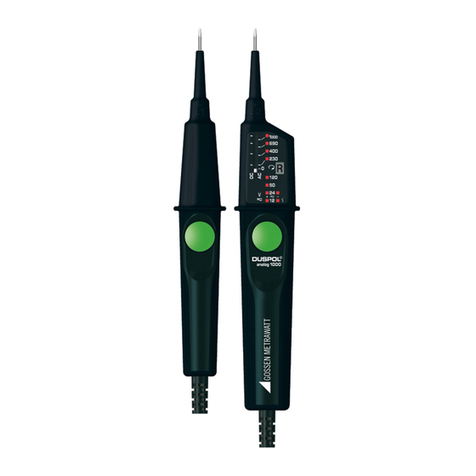
DUSPOL
®
expert 1000
8
(the phase indication only works in an earthed AC voltage
mains) and the vibration motor (the vibration motor is activated
by actuating both push-buttons). The installation is only free
of voltage, if all three test circuits (voltage indication, phase
indication and vibration motor) are signaling the absence of
voltage.
- Apply the two probe tips L1/+ 2and L2/- 3to the system
parts to be tested.
- The level of voltage applied is indicated by means of the
/('VWHSLQGLFDWRU9.
$IODVKLQJ/('VWHSLQGLFDWHVWKDWWKHYROWDJHYDOXHRIWKLV
/(' VWHS KDV QRW EHHQ UHDFKHG H[FHSW IRU /(' 9
9$/('VWHSZLOOVWDUWWROLJKWIURPWRRI
the step value onwards.
$OWHUQDWLQJYROWDJHV$&DUHLQGLFDWHGE\WKH9/('
and the 9/('OLJKWLQJXSVLPXOWDQHRXVO\
'LUHFW YROWDJHV '& DUH LQGLFDWHG E\ WKH 9 /('
RUWKH9/('OLJKWLQJXS7KHSRODULW\LQGLFDWLRQJ
shows the SRODULW\ (+ or -) applied to the probe tip L2/+ 3.
- To differentiate between low-energy and high-energy volt-
ages (e.g. capacitively induced interference voltages), an
internal load in the voltage tester can be connected by ac-
tuating both push-buttons (see section 5).
Overload indication
If the voltage applied to the probe tips L1/- 2and L2/+ 3
LV KLJKHU WKDQ WKH DGPLVVLEOH QRPLQDO YROWDJH DOO /('V RI
the step indicator 9DUHÀDVKLQJ2YHUORDGLVLQGLFDWHGIURP
9$&'&RQ
5. Load connection with vibration motor ¿JXUH%&
Both handles L1 7and L2 8are equipped with push-buttons
6. Here, voltage is applied to a vibration motor (motor with
unbalanced mass) in the display handle L2 8.
)URP DSSUR[ 9 RQ WKLV PRWRU LV VHW LQ URWDU\ PRWLRQ
With the voltage increasing, the motor's speed and vibration
increases as well. The duration of the test with a lower inter-
nal resistance (load test) depends on the level of voltage to
be measured. In order to avoid an inadmissible warming of
the device, it is provided with a thermal protection (controlled
reduction). With this controlled reduction, the speed of the vi-
bration motor is reduced and the internal resistance increases.
The load connection (with both push-buttons being actuated)
can be used ...
- to suppress reactive voltages (inductive and capacitive
voltages),
- to charge capacitors,
WRWULSP$5&'VDIHW\VZLWFKHV7KHWULSSLQJRIWKH
5&'VDIHW\VZLWFKLVGRQHE\WHVWLQJWKHH[WHUQDOFRQGXF-
WRUSKDVHLQGLFDWLRQWR3(HDUWKILJXUH'
([WHUQDOFRQGXFWRUWHVWSKDVHLQGLFDWLRQ¿JXUH'
- Fully grasp the handles L1 7and L2 8, in order to en-
sure a capacitive coupling to earth.
- Apply the probe tip L2/+ 3to the system part to be tested.
During the single-pole external conductor test (phase in-
dication), make absolutely sure not to touch the probe tip
L1/- 2and that it remains contactless.
,IWKHUHG/('쇵Klights up on the display, the external
conductor (phase) of an AC voltage is applied to this sys-
tem part.
Note:
The single-pole external conductor test (phase indication)
FDQEHFDUULHGRXWLQDQHDUWKHGPDLQVIURP9+]
(phase to earth) on. Protective clothing and insulating condi-
tions on site might impair the function.
Attention!
The absence of voltage can only be determined by means of
a two-pole test.
7. Phase sequence test ¿JXUH)*
- Fully grasp both handles L1 7and L2 8, in order to en-
sure a capacitive coupling to earth.
- Apply the probe tips L1/- 2and L2/+ 3to two external
conductors (phases) and check whether the external con-
GXFWRUYROWDJHRIHJ9LVDSSOLHG
- A clockwise phase sequence (phase L1 before phase L2)
LVJLYHQLIWKHJUHHQ/('ŹRIWKHSKDVHVHTXHQFHLQGLFD-
tion Llights up.
- A counter-clockwise phase sequence (phase L2 before
SKDVH/LVJLYHQLIWKHJUHHQ/('ŻRIWKHSKDVHVH-
quence indication Llights up.
- The phase sequence test always requires a countercheck
with the probe tips L1/- 2and L2/+ 3being inverted dur-
ing which the phase sequence must change.
Note:
The phase sequence test can be carried out in an earthed
three-phase mains from 9 9 +]SKDVH WR
phase) on. Protective clothing and insulating conditions on site
might impair the function.
&RQWLQXLW\WHVW¿JXUH+
- The continuity test must be carried out on system parts
which are free of voltage. If necessary, capacitors have to
be discharged.
- Apply the two probe tips L1/- 2and L2/+ 3to the system
parts to be tested.
,QFDVHRIFRQWLQXLW\ 5NȍDQDFRXVWLFVLJQDOLV
HPLWWHGDQGWKH\HOORZ/('ȍMfor continuity lights up.
-
This function also can be used to determine the conducting
and non-conducting direction of semiconductor components.
- If a voltage is applied to the test point, the voltage tester
automatically switches over to the voltage test function
and indicates this function.
9. Cable break detector ¿JXUH,
- The cable break detector is intended for the non-contact
localization of cable breaks on exposed live lines.
www.GlobalTestSupply.com
Find Quality Products Online at: sales@GlobalTestSupply.com