4. Residual risk / Side effects (med)
After risk reduction most risks are "acceptable". Only a few risks remain "widely acceptable".
In case fall prevention is not applied or not applied correctly, there are residual risks, such as falling of a person resulting
in skin abrasions, bruises, fractures or in worst case even death.
These risks may occur during use as well as when entering or leaving the device.
Furthermore there is residual risk such as unintended overload of the subject caused by wrong operation, wrong
assessment, or wrong application of the operator.
The residual risk of trapping of clothes / shoes / fingers / hair or other body parts in moving parts can not be excluded as
well. These risks are reduced by safety information within the IFU.
It cannot be excluded that unintended or forbidden use might cause further not yet regarded risks and that already
regarded risks might have been estimated incorrectly. It can also not be excluded that the daily use of the medical product
might show further risks.
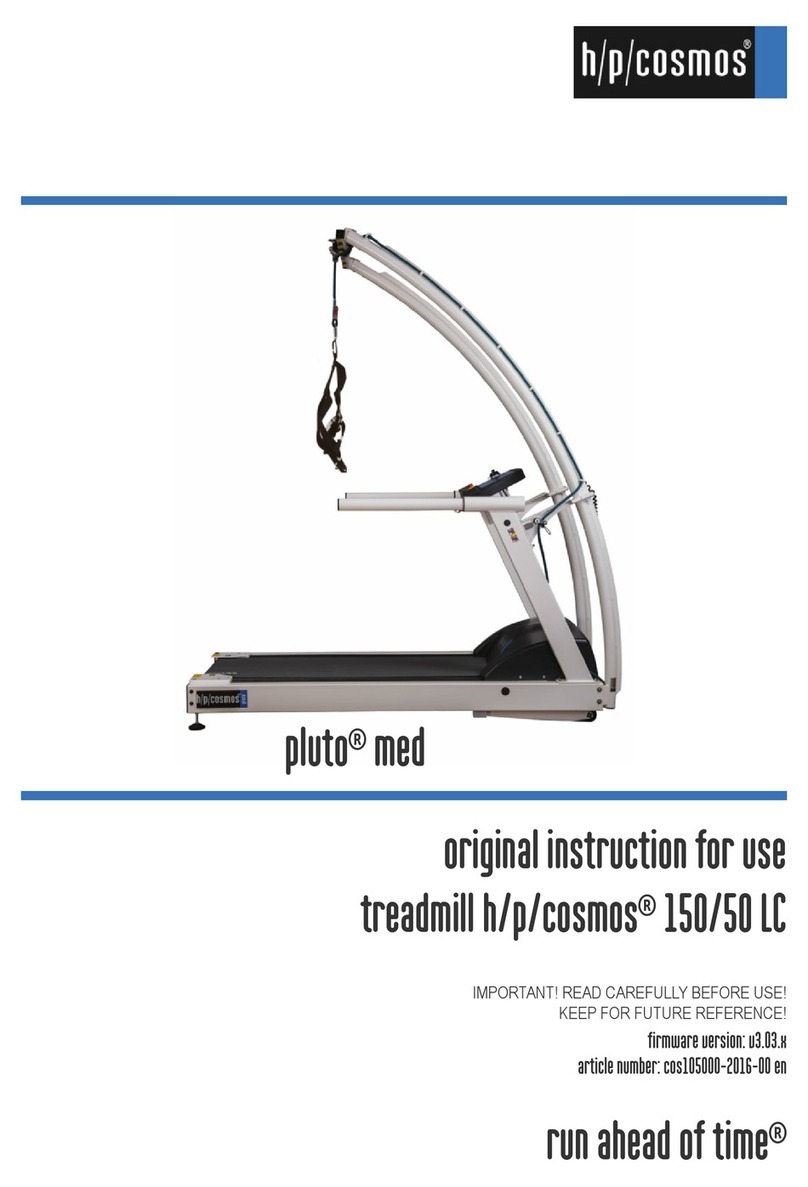
For medical applications such as parallel bar gait training there are alternatives such as overground gait training secured
only by the therapist.
However, the benefit of parallel bar gait training contrast to these alternatives is clearly outweighing the residual risk of
falling or overload with the known consequences utilizing this medical device.
In this risk analysis the "present state" of the device has been evaluated.
Having carried out the evaluation and validation of the product, the risk of appearance of a not acceptable risk is very low.
The device (it´s construction, it´s function as well as the intended application) does - under normal conditions - not
represent any unjustifiable risk for the subject, the user, the operator or third persons.
However, the risk of injury or even death due to a malfunction of this medical device is very low.
In over 30 years of history and with many medical devices on the worldwide market, there has never been such a reported
incident.
5. Forbidden Use / reasonably foreseeable misuse
NDo not modify the system and do not connect to other equipment which is not explicitly declared as compatible by
all involved manufactures.
NThe system must not be used without carefully trained specialist staff and without the staff having been instructed
on the safety regulations.
NThe subject must interrupt the training immediately if he/she starts feeling sick or dizzy and should see a doctor.
NSubjects with cardiac pacemakers or any kind of physical restriction must see a doctor before using the system and
ask for permission.
NIn the event of any detected and/or assumed malfunctions and/or defects or unreadable safety warning labels, the
device has to be taken out of operation, clearly marked as such and disabled. The supplier and authorized service
personnel have to be informed in writing.
NUnder no circumstances should a subject/patient or other user be overloaded or overstressed.
NAll prohibitions in the chapter “General safety requirements”.
NOther use than the explicitly mentioned intended use.