-5-
3. Venting
Procedure:
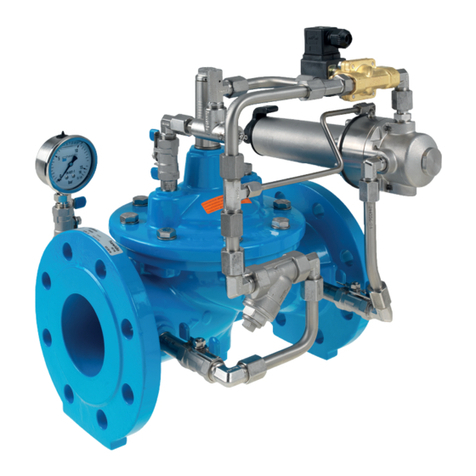
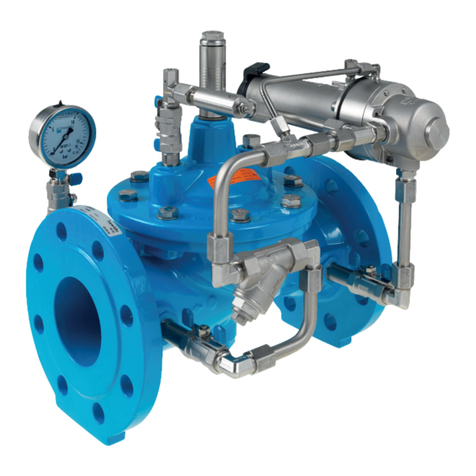
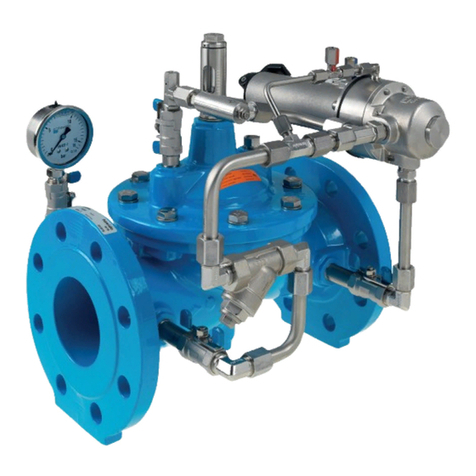
Screw in the plug on the valve cover until approx. one turn before the sealing point.
Slowly open the inlet gate valve on the inlet side until water flows into the valve.
Once the valve venting procedure has caused all the air to be expelled from the control line, retighten the
plug screw and the loosened union. Check that all the fittings are properly sealed, and re-tighten if
necessary.
Check: If the shut-off gate valve on the outlet side is slightly opened, the valve should close or remain
closed. Then close the shut-off gate valve again.
If the valve does not close, the commissioning procedure must be repeated from the previous chapter.
Particular care must then be taken to ensure that the upper valve chamber and control lines are properly
vented.
4. Commissioning the valve and the control system
The supplied electrical control system is commissioned by the customer.
On the valve:
•Slowly open the ball valve (2B)
•Slowly open the shut-off gate valve on the outlet side.
•Check electrical functions. The required flow rate can be regulated according to the one-way flow
restrictor settings (4A and 4B; according to the following chapter) and the electrical actuations of the
solenoid valves (5A and 5B). The base valve is locked hydraulically, if the solenoid valve (5A) is
energised and solenoid valve (5B) is voltage-free
5. Setting the reaction speed
If the HAWIDO does not operate quietly, or if pressure shocks occur in the supply network, this can be
corrected by the corresponding adjustment of the one-way flow restrictor (4A and 4B).
Strongly throttled one-way flow restrictors (4A and 4B) permit longer impulse times (contact the Hawle
Company for basic settings of impulse and pause lengths).
Procedure:
Loosen the locknut. Screw in the set screw clockwise with a screwdriver until the valve operates quietly.
Then retighten the locknut.
Caution
The setting screw must always remain at least 4 - 5 turns open, otherwise the valve will not reopen after the
closing sequence. A special setting is necessary for very high inlet pressures.
6. Checking for leakage
The HAWIDO's are tested at the factory for both leakage and function before delivery. When checking for
leakage under operational conditions, particular attention must therefore be given to the seals of the flange
connections, the control line and the central plug screw on the valve cover. Where necessary, ensure the
seal by retightening the connections.
Notes: