4 / 4Hövding 3 – Manual (GB)
hairstyles and headgear that are not recommended for use
with Hövding, visit hovding.com.
A hooded sweatshirt or jacket can be used with Hövding
provided that the hood is folded down and lies under the
Hövding, or if it is thinner, folded up inside the Hövding. The
hood must not cover any of the three tear seams (2) on the
Hövding (19, 20).
A scarf or shawl can be used with the Hövding but must not
cover any of the three tear seams (2) on the Hövding.
Hövding shall have a snug fit directly against your neck,
except if soft garments are used (by soft garments we mean
soft, thin fabric garments without zips or other fastenings,
e.g., collars, hoods, scarves) inside Hövding. Measure with
a tape measure around the neck including the garment, if
the measurement is less than 45 cm in circumference at the
largest point, it is possible to use the soft garment together
with Hövding.
Small in-ear headphones can be used with Hövding.
However, cycling with headphones is not recommended for
safety reasons as there is a risk that you will not hear signals
from traffic or signals emitted by Hövding.
FLYING WITH HÖVDING
Visit hovding.com for current information.
WHEN DOES HÖVDING PROVIDE PROTECTION?
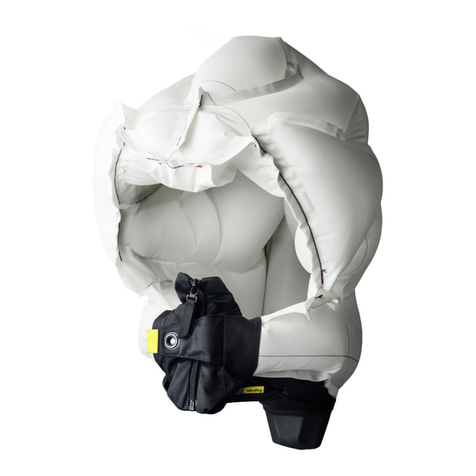
If Hövding interprets the cyclist’s movements as though the
cyclist is about to fall, the airbag will inflate in 0.1 second to
protect the cyclist’s head and neck.
Hövding will react and inflate in response to movements
that lies outside the programmed normal cycling pattern (by
the cyclist when in a bicycle accident). The airbag reaches
full inflation in 0.1 second. If there is an impact to the head
before Hövding has reacted and managed to fully inflate,
Hövding will not provide adequate protection. Examples of
such situations include objects falling from above directly
onto the cyclist’s head, the cyclist riding into a tree branch
at head height and the cyclist colliding directly with a flat-
fronted vehicle.
Hövding cannot guarantee full protection against sharp
objects.
In exceptional cases, Hövding may inflate in incidents that
are not considered bicycle accidents. A safety margin has
been built into the product for Hövding to register one
bicycle accident too many than one too few. When Hövding
is activated, it compares the cyclist’s movements with the
programmed movement pattern, 200 times per second.
Thousands of tests have been made to establish a normal
cycling pattern. Hövding can interpret movements that differ
from this pattern as an impending bicycle accident and will
then inflate to protect the cyclist.
AFTER INFLATION
An inflated Hövding cannot (for safety reasons) be reused.
Just like a traditional bicycle helmet, Hövding shall be
replaced with a new one after a bicycle accident.
LIFE SPAN
The expected lifetime of Hövding is around 5 years,
depending on the frequency of use.
IMPORTANT INFORMATION
When Hövding reaches a temperature of below -10 °C (14 °F), it
will emit a warning signal (read more about Hövding’s signals
at hovding.com) indicating that the temperature is too low,
and it can then not be activated. When Hövding returns to a
temperature above -10 °C (14 °F), it can be activated.
The following secondary effects of inflation are known in
some cases:
• The sound level during inflation is below the threshold for
injury but may still be unpleasant. If you have a hearing
impairment or impaired hearing, you should consult your
doctor before you use a Hövding.
• Teeth – we know of a few cases in which teeth and the
tongue have been damaged during inflation.
• Breathing/discomfort – when Hövding inflates, it fits
tightly around the neck to ensure that the airbag is
positioned correctly. The airbag maintains its pressure for
a few seconds before the air is slowly released. This is a
safety measure that is built in to optimise protection from
secondary impacts. It may lead to a feeling of discomfort,
and it may feel difficult to breathe. The pressure around
your neck is harmless. The aim is to stabilise your head
and neck in a bicycle accident.
• Fainting/discomfort – just as above, you may feel
discomfort when Hövding inflates. In very rare cases, the
user has fainted when Hövding is inflated.
EU DECLARATION OF CONFORMITY
We, Hövding Sverige AB, Box 17020, SE-200 10 Malmö,
Sweden declare under our sole responsibility that the
following Personal Protective Equipment, Hövding 3 ‘Airbag
for Urban Cyclists’, is in conformity with Regulation (EU)
2016/425 of the European Parliament and of the Council
of 9 March 2016 on personal protective equipment (PPE),
Directive 2011/65/EU of the European Parliament and of the
Council of 8 June 2011 on the restriction of the use of certain
hazardous substances in electrical and electronic equipment,
Regulation (EC) No 1907/2006 of the European Parliament
and of the Council of 18 December 2006 concerning the
Registration, Evaluation, Authorisation and Restriction of
Chemicals (REACH), Directive 2014/53/EU of the European
Parliament and of the Council of 16 April 2014 on the
harmonisation of the laws of the Member States relating
to the making available on the market of radio equipment
(RED), in accordance with SP method 4439 version 2:8, EN/
IEC 61000-6-1:2016, EN/IEC 61000-6-3:2006/A1:2010, ETSI
EN 301 489-1 v.2.1.1, -3 v2.1.1, and -17 v3.1.1., ETSI EN 300 328
v2.1.1 (pre-approved BLE radio module Laird BL652-SA), and
that the Hövding 3 ‘Airbag for Urban Cyclists’ is identical to
the Personal Protective Equipment which is the subject of
EC type examination No. SC0228-19 issued by Notified Body
No. 0402 RISE Research Institutes of Sweden AB, Box 857,
SE-501 15 Borås, Sweden. hovding.com
RECYCLING
For information about recycling, visit hovding.com.
CONTACT
hovding.com, Hövding Sverige AB, Box 17020,
SE-200 10 Malmö, Sweden