HP Z43 User manual

User Guide

© Copyright 2018 HP Development Company,
L.P.
HDMI, the HDMI Logo and High-Denition
Multimedia Interface are trademarks or
registered trademarks of HDMI Licensing LLC.
Windows is either a registered trademark or
trademark of Microsoft Corporation in the
United States and/or other countries.
The information contained herein is subject to
change without notice. The only warranties for
HP products and services are set forth in the
express warranty statements accompanying
such products and services. Nothing herein
should be construed as constituting an
additional warranty. HP shall not be liable for
technical or editorial errors or omissions
contained herein.
First Edition: January 2018
Document Part Number: L00418-001

About This Guide
This guide provides information on monitor features, setting up the monitor, using the software and technical
specications.
WARNING! Indicates a hazardous situation that, if not avoided, could result in bodily harm or loss of life.
CAUTION: Indicates a hazardous situation that, if not avoided, could result in damage to equipment or loss
of information.
IMPORTANT: Indicates information considered important but not hazard-related (for example, messages
related to property damage). A notice alerts the user that failure to follow a procedure exactly as described
could result in loss of data or in damage to hardware or software. Also contains essential information to
explain a concept or to complete a task.
NOTE: Contains additional information to emphasize or supplement important points of the main text.
TIP: Provides helpful hints for completing a task.
This product incorporates HDMI technology.
iii

iv About This Guide

Table of contents
1 Getting Started ............................................................................................................................................. 1
Important safety information ............................................................................................................................... 1
Product features and components ........................................................................................................................ 2
Features ............................................................................................................................................... 2
Rear components ................................................................................................................................ 3
Setting up the monitor .......................................................................................................................................... 4
Use caution when setting up the monitor ........................................................................................... 4
Attaching the monitor stand ............................................................................................................... 4
Connecting the cables ......................................................................................................................... 5
Connecting USB devices ...................................................................................................................... 9
Adjusting the monitor ....................................................................................................................... 10
Installing a security cable ................................................................................................................. 11
Turning on the monitor ..................................................................................................................... 12
Mounting the monitor ....................................................................................................................... 13
Removing the monitor stand .......................................................................................... 13
Attaching the monitor to a mounting device .................................................................. 14
2 Using the monitor ........................................................................................................................................ 15
Software and utilities .......................................................................................................................................... 15
The Information le ........................................................................................................................... 15
The Image Color Matching le ........................................................................................................... 15
Using the on-screen display (OSD) menu ............................................................................................................ 15
Assigning the function buttons ........................................................................................................................... 16
Using Picture-in-Picture (PIP) and Picture-beside-Picture (PBP) ....................................................................... 17
Adjusting to Low Blue Light Mode ....................................................................................................................... 17
Using Auto-Sleep Mode ....................................................................................................................................... 18
3 Support and troubleshooting ........................................................................................................................ 19
Solving common problems .................................................................................................................................. 19
Button lockouts ................................................................................................................................................... 19
Contacting support .............................................................................................................................................. 20
Preparing to call technical support ..................................................................................................................... 20
Locating the serial number and product number ............................................................................................... 20
4 Maintaining the monitor .............................................................................................................................. 21
Maintenance guidelines ....................................................................................................................................... 21
v

Cleaning the monitor ......................................................................................................................... 21
Shipping the monitor ......................................................................................................................... 21
Appendix A Technical specications ................................................................................................................. 22
Preset display resolutions ................................................................................................................................... 23
Entering user modes ......................................................................................................................... 24
Energy saver feature ........................................................................................................................................... 24
Appendix B Accessibility ................................................................................................................................. 25
Supported assistive technologies ....................................................................................................................... 25
Contacting support .............................................................................................................................................. 25
vi

1 Getting Started
Important safety information
A power cord is included with the monitor. If another cord is used, use only a power source and connection
appropriate for this monitor. For information on the correct power cord set to use with the monitor, refer to
the Product Notices provided in your documentation kit.
WARNING! To reduce the risk of electric shock or damage to the equipment:
• Plug the power cord into an AC outlet that is easily accessible at all times.
• Disconnect power from the computer by unplugging the power cord from the AC outlet.
• If provided with a 3-pin attachment plug on the power cord, plug the cord into a grounded (earthed) 3-pin
outlet. Do not disable the power cord grounding pin, for example, by attaching a 2-pin adapter. The grounding
pin is an important safety feature.
For your safety, do not place anything on power cords or cables. Arrange them so that no one may
accidentally step on or trip over them. Do not pull on a cord or cable. When unplugging from the AC outlet,
grasp the cord by the plug.
To reduce the risk of serious injury, read the Safety & Comfort Guide. It describes proper workstation setup
and proper posture, and health and work habits for computer users. The Safety & Comfort Guide also provides
important electrical and mechanical safety information. The Safety & Comfort Guide is available on the web at
http://www.hp.com/ergo.
IMPORTANT: For the protection of the monitor, as well as the computer, connect all power cords for the
computer and its peripheral devices (such as a monitor, printer, scanner) to some form of surge protection
device such as a power strip or uninterruptible power supply (UPS). Not all power strips provide surge
protection; the power strips must be specically labeled as having this capability. Use a power strip whose
manufacturer oers a damage replacement policy so you can replace the equipment if surge protection fails.
Use the appropriate and correctly sized furniture designed to properly support your HP LCD monitor.
WARNING! LCD monitors that are inappropriately situated on dressers, bookcases, shelves, desks, speakers,
chests, or carts may fall over and cause personal injury.
Care should be taken to route all cords and cables connected to the LCD monitor so that they cannot be pulled,
grabbed, or tripped over.
NOTE: This product is suitable for entertainment purposes. Consider placing the monitor in a controlled
luminous environment to avoid interference from surrounding light and bright surfaces that may cause
disturbing reections from the screen.
Important safety information 1

Product features and components
Features
The monitor features include the following:
●108 cm (42.5-inch) diagonal viewable area with 3840 x 2160 UHD resolution, plus full-screen support
for lower resolutions
●Wide color gamut to provide coverage of sRGB color spaces
●Nonglare panel with an LED backlight
●Wide viewing angle to allow viewing from a sitting or standing position, or moving from side to side
●Tilt and swivel capability
●Removable stand for exible monitor panel mounting solutions
●DisplayPort video input
●Mini DisplayPort video input
●One HDMI (High-Denition Multimedia Interface) video input
●Quad-PIP functionality to enable the DisplayPort and HDMI inputs to be viewed in each quadrant of the
screen
●Audio-out (headphone) jack
●USB 3.0 hub with one upstream port (connects to the computer) and four downstream ports (connect to
USB devices)
●USB cable provided to connect the monitor's USB hub to the USB connector on the computer
●Four function buttons under the right side of the bezel, three that can be recongured to quickly allow
selection of the most commonly used operations
●Plug and Play capability if supported by your operating system
●Security cable slot on the rear of the monitor for an optional cable lock
●Cable management feature for placement of cables and cords
●On-Screen Display (OSD) adjustments in several languages for easy setup and screen optimization
●HP Display Assistant software for adjusting monitor settings and enabling theft deterrence features
●HDCP (High-Bandwidth Digital Content Protection) copy protection on all digital inputs
●Energy saver feature to meet requirements for reduced power consumption
NOTE: For safety and regulatory information, refer to the Product Notices provided in your documentation
kit. To locate updates to the user guide for your product, go to http://www.hp.com/support, and then follow
the on-screen instructions to nd your product.
2 Chapter 1 Getting Started

Rear components
Component Function
1 Power button Turns the monitor on or o.
2 Function buttons Navigate through the OSD menu based on the indicators above the buttons
that are activated while the OSD menu is open.
NOTE: You can assign the function buttons in the OSD menu to quickly
select the most commonly used operations. See Assigning the function
buttons on page 16 for more information.
3 Master power switch Turns on or o all power to the monitor.
NOTE: Putting the switch in the O position will yield the lowest power
state for the monitor when not in use.
4 Power connector Connects a power cord.
5 Audio-out (headphone)
jack
Connects optional powered stereo speakers, headphones, earbuds, a
headset, or a television audio cable.
WARNING! To reduce the risk of personal injury, reduce the volume before
using headphones, earbuds, or a headset. For additional safety information,
see the Product Notices provided with your product.
6 HDMI port Connects the HDMI cable to a source device.
7 Mini DisplayPort port Connects the Mini DisplayPort cable to a source device.
8 DisplayPort port Connects the DisplayPort cable to a source device.
9 USB Type-C port
(upstream)*
Connects a USB Type-C cable to a source device.
10 USB Type-A ports (2)
(downstream)
Connect the USB Type-A cables to source devices.
11 Security cable slot Connects a security cable to a stationary object.
NOTE: The security cable is designed to act as a deterrent, but it may not
prevent the monitor from being mishandled or stolen.
12 USB Type-A port
(upstream)
Connects a USB Type-A cable to a source device.
Product features and components 3

Component Function
13 USB Type-C port
(upstream)*
Connects a USB Type-C cable to a source device.
*The USB Type-C port (upstream) can function as a DisplayPort audio/video input, as a USB 3.0 upstream connection,
or it can be used to deliver up to 65 watts of power to a device. Power outputs are 5 V/9 V/10 V/12 V/15 V/20 V to
achieve 65 W output.
Setting up the monitor
Use caution when setting up the monitor
To prevent damage to the monitor, do not touch the surface of the LCD panel. Pressure on the panel may
cause nonuniformity of color or disorientation of the liquid crystals. If this occurs the screen will not recover
to its normal condition.
If installing a stand, position the monitor facedown on a at surface covered with protective sheet foam or a
nonabrasive cloth. This prevents the screen from getting scratched, defaced, or broken and prevents damage
to the control buttons.
Attaching the monitor stand
CAUTION: The screen is fragile. Avoid touching or applying pressure to the screen; doing so can cause
damage.
TIP: Consider the placement of the monitor, because the bezel might cause interfering reections from
surrounding light and bright surfaces.
1. Lift the monitor from its box and place it facedown on a at surface covered by protective sheet foam or
a nonabrasive cloth.
2. Slide the hinge cover on the neck of the stand onto the hinge on the back of the monitor, and press until
it clicks into place.
4 Chapter 1 Getting Started
Other manuals for Z43
2
Table of contents
Other HP Monitor manuals




HP
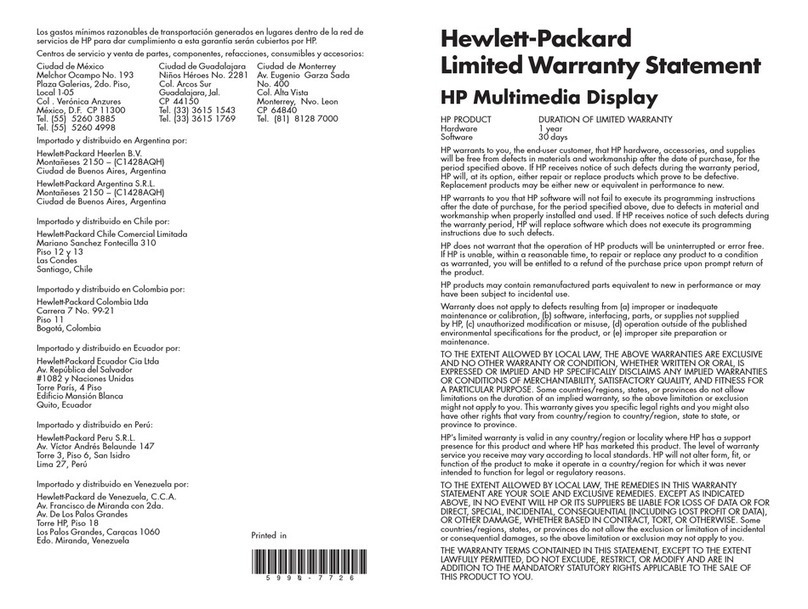
HP FV588AA User manual
HP
HP D5063H - Pavilion F50 - 15" LCD Monitor Use and maintenance manual
HP
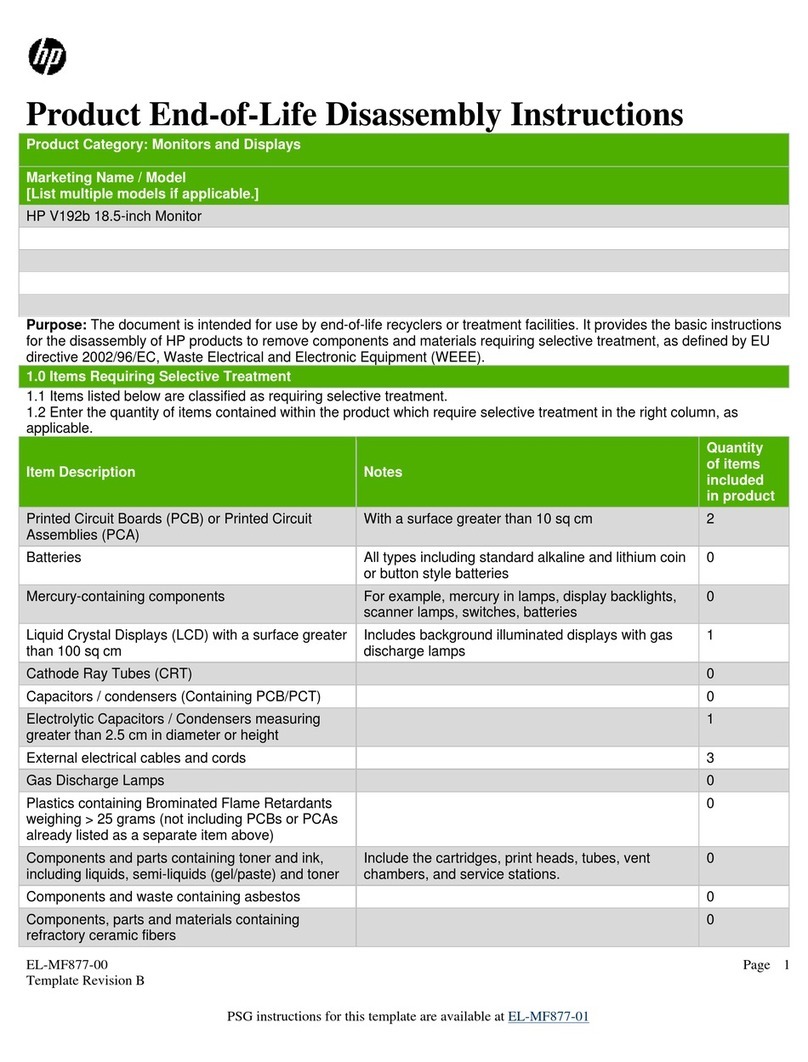
HP V192b Installation instructions
HP
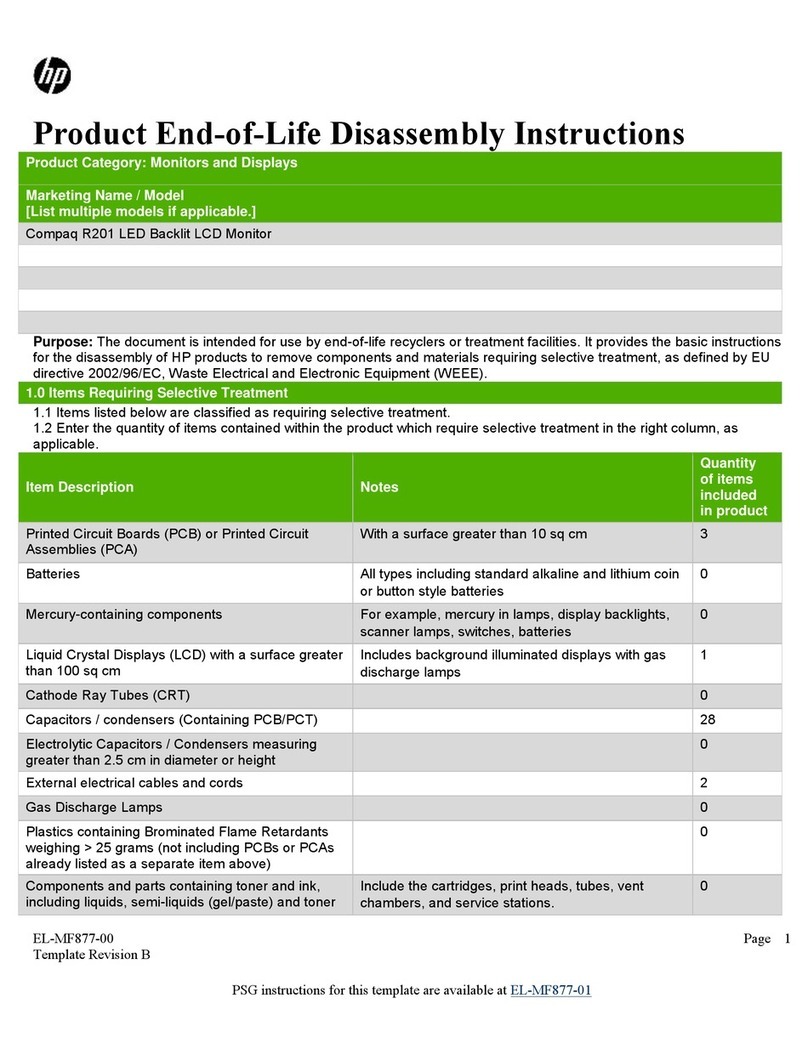
HP Compaq R201 Assembly instructions
HP
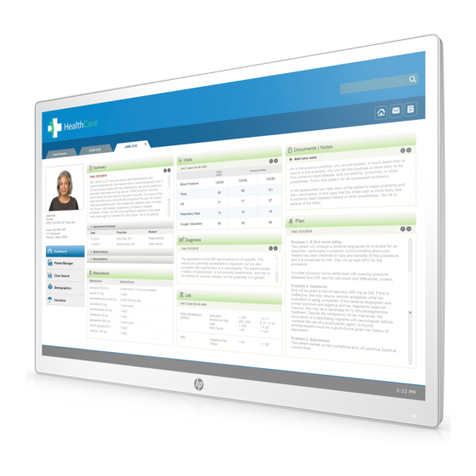
HP HC271p Installation instructions
HP
HP M22f Manual
HP
HP 1706 User manual
HP
HP Pavilion W1858 Owner's manual
HP
HP Compaq LE1901wl User manual
HP
HP E27 G4 Assembly instructions