3
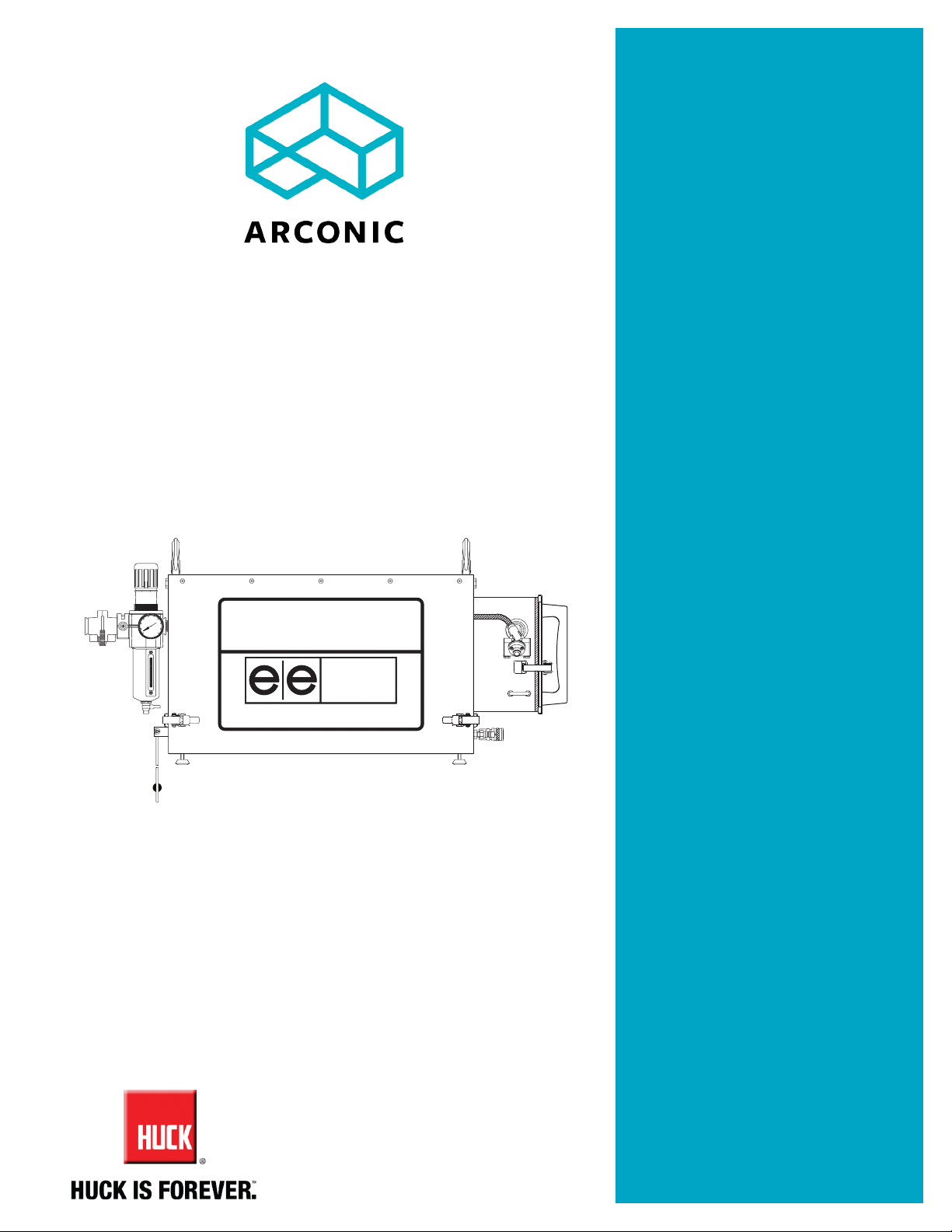
EPS1V series Ebbert Power Source (HK1031)
1. A 30-minute hands-on training session with qualified
personnel is recommended before using Huck equipment.
2. Huck equipment must be maintained in a safe working
condition at all times. Tools and hoses should be
inspected at the beginning of each shift/day for damage or
wear. Any repair should be done by a qualified repairman
trained on Huck procedures.
3. Repairman and Operator must read manual prior to using
equipment. Warning and Caution stickers/labels supplied
with equipment must be understood before connecting
equipment to any primary power supply. As applicable,
each of the sections in this manual have specific safety
and other information.
4. Read MSDS Specifications before servicing the tool.
MSDS Specifications are available from the product
manufacturer or your Huck representative.
5. When repairing or operating Huck installation equipment,
always wear approved eye protection. Where applicable,
refer to ANSI Z87.1 - 2003.
6. Disconnect primary power source before performing
maintenance on Huck equipment or changing Nose
Assembly.
7. Tools and hoses should be inspected for leaks at the
beginning of each shift/day. If any equipment shows signs
of damage, wear, or leakage, do not connect it to the
primary power supply.
8. Mounting hardware should be checked at the beginning of
each shift/day.
9. Make sure proper power source is used at all times.
10. Release tool trigger if power supply is interrupted.
11. Tools are not to be used in an explosive environment
unless specifically designed to do so.
12. Never remove any safety guards or pintail deflectors.
13. Where applicable, ensure deflector or pintail collector is
installed and operating prior to use.
14. Never install a fastener in free air. Personal injury from
fastener ejecting may occur.
15. Where applicable, always clear spent pintail out of nose
assembly before installing the next fastener.
16. There is possibility of forcible ejection of pintails or spent
mandrels from front of tool.
17. If there is a pinch point between trigger and work piece,
use remote trigger. (Remote triggers are available for all
tooling.)
18. Unsuitable postures may not allow counteracting of
normal expected movement of tool.
19. Do not abuse tool by dropping or using it as a hammer.
Never use hydraulic or air lines as a handle or to bend
or pry the tool. Reasonable care of installation tools
by operators is an important factor in maintaining tool
efficiency, eliminating downtime, and in preventing an
accident which may cause severe personal injury.
20.Never place hands between nose assembly and work
piece. Keep hands clear from front of tool.
21. There is a risk of crushing if tool is cycled without Nose
Assembly installed.
22. Tools with ejector rods should never be cycled with out
nose assembly installed.
23. When two piece lock bolts are being used always make
sure the collar orientation is correct. See fastener data
sheet of correct positioning.
24.Tool is only to be used as stated in this manual. Any other
use is prohibited.
25. There is a risk of whipping compressed air hose if tool is
pneudraulic or pneumatic.
26.Release the trigger in case of failure of air supply or
hydraulic supply.
27. Use only fluids or lubricants recommended.
28.Disposal instruction: Disassemble and recycle steel,
aluminum and plastic parts, and drain and dispose of
hydraulic fluid in accordance with local lawful and safe
practices.
29.If tool is fixed to a suspension device, ensure that the
device is secure prior to operating the tool.
Safety Instructions
GLOSSARY OF TERMS AND SYMBOLS:
- Product complies with requirements set forth by
the relevant European directives.
- Read manual prior to using this equipment.
- Eye protection is required while using this
equipment.
- Hearing protection is required while using this
equipment.
Notes: are reminders of required procedures.
Bold, Italic type, and underline: emphasize a specific
instruction.
WARNINGS: Must be understood to avoid
severe personal injury.
CAUTIONS: Show conditions that will damage
equipment or structure.