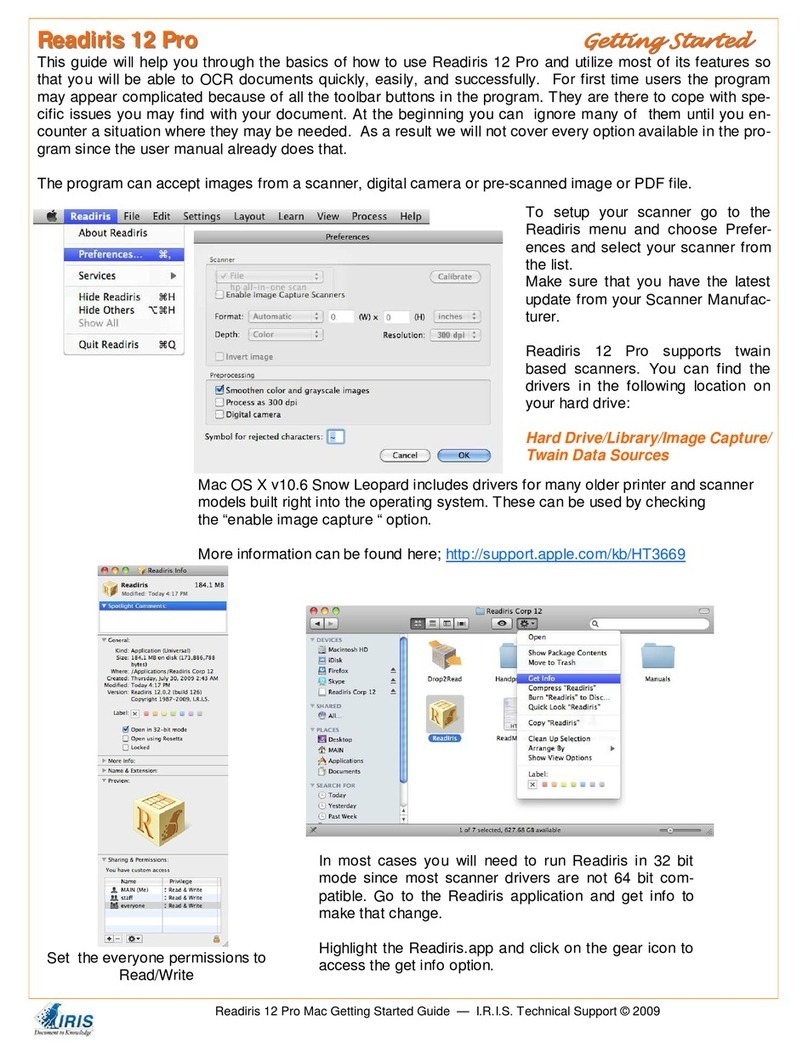
IRIS BR600-CARDIRIS User manual

1
GETTING STARTED
GETTING
STARTED
manual.PMD 29/08/2003, 14:551

2
© 2003 I.R.I.S. All rights reserved
OCR technology by I.R.I.S.
Connectionist, Linguistic and Field Analysis technology by I.R.I.S.
© 2003 I.R.I.S. All rights reserved
manual.PMD 29/08/2003, 14:552

3
GETTING STARTED
IT'STHE BUSINESS YOU WANT, NOT THE CARDS!©
Cardiris is the unbeatable productivity tool for your business cards. This busi-
ness card organizer allows you to archive, index and OCR business cards
from around the world.
In our information age, all ey corporate information is contained in data-
bases. With information being the ey, Cardiris gives a comprehensive answer to
the need to manage your business contacts: Cardiris goes the full circle from
archiving scanned business cards to contact management. After all, isnt it the
business you want, and not the cards?
ONE, CARDIRIS GIVES YOU GREAT IMAGES
Cardiris improves the everyday operation of your office by getting rid of all
business cards. Enter any office and youll find the des and drawers of the
employees crowded with business cards of all types and places. Business cards
suffer more than other documents from the nown disadvantages of the paper
world: they get lost easily, arent available to your colleagues, cant be searched
or sorted etc.
Cardiris, the electronic Rolodex©, puts a final end to all this. You begin by
scanning the business cards, thus putting images in a database. Use this manage-
ment tool to file your business cards and no more stac s of business cards will be
lying around in your office!
So, all business cards can be thrown away or returned to the owner as soon as
they have been archived. This means that you never lose any information con-
tained on a card, not even the companys colorful logo or slogan, the contacts
photograph or still a second telephone number or e-mail address which you dont
usually encode in your traditional contact manager or database.
When you are dealing with exotic business cards - in, say, Vietnamese or
Arabic - which you simply cannot enter in a database, the advantage is all the
more prominent: as you first archive the card images, Cardiris offers a unique
manual.PMD 29/08/2003, 14:553

4
solution here. Even if a business card cant be read by OCR, the color image is
there to be consulted!
As a wide range of dedicated business card scanners, flatbed scanners and
all-in-one devices or MFPs (multifunctional peripherals) is supported, what-
ever scanner you may already own is fine by us.
Your Cardiris software may be bundled with a business card scanner. Dedi-
cated business card scanners are optimized for scanning business cards and have
many advantages over other scanner types: they hardly ta e up any space on
your des , swiftly cope with calling cards of varying paper and printing qualities
and you never have to wonder about selecting the correct card format.
The images are saved compressed to limit the use of space on your hard dis .
The scanned business cards are prominently displayed so as to ma e them legible
without having to zoom. Optimal legibility is ensured, even on low-end 14" moni-
tors and the LCD screens of noteboo computers!
As Cardiris also allows you to add comments, it suffices to scan every busi-
ness card you come across and add some notes and youll never lose any infor-
mation again!
TWO, OCR BRINGS YOU EDITABLE TEXT
Once the cards are archived, you can convert images into data by indexing
and OCRing them. Indexing means that a business card is sorted by a primary
search ey - the company name is filled out and chec ed -, OCR means that the
cards data is extracted automatically from the image.
OCR stands for two things here: character recognition to convert the
scanned image into editable text and field analysis. Optical character recognition
(OCR) allows to encode business cards without the time-consuming tas of re-
typing them. Thin of your last exhibition when you came bac with an entire
stac of business cards and it too your secretary two days to encode them!
Cardiris incorporates specialized recognition technology, optimized for tiny
characters, and supports up to 49 countries! The major countries of all conti-
manual.PMD 29/08/2003, 14:554

5
GETTING STARTED
nents are supported: North and South American business cards and business
cards from the European countries, including the Eastern-European nations.
Fieldanalysisassigns the recognized data to specific database fields. Cardiris
extensively uses a nowledge database, thus acquiring the necessary intelligence
to discriminate the first and last name, a city and its state, a telephone and a fax
number etc.
At this stage, Cardiris ta es the layout of a business card into account. Each
country has a different style of composing business cards, Americans com-
pose an address differently than the French do etc. In this way, Cardiris can
process correctly business cards of all designs and countries: business cards with
an American or European loo , vertical cards as well as horizontal cards etc.
When a country is not supported, you can draw a frame around the informa-
tion and drag the frame to a database field - say, the city: the OCR gets done on
the fly.
The recognition accuracy depends on the printing quality, whether or not a too
stylized font or exotic layout has been used etc. Cutting and pasting is available
to edit and correct the recognized data, but so are drag-and-drop operations
for maximal ease of use.
Interestingly, the scanning, indexing and recognition are separate phases. In-
dexing and OCR can be deferred, performed later on at any moment. Sales
executives at an info des or on the company booth at a trade show, secretaries
at a reception des may be too busy to perform the complete cycle of indexing
and OCRing business cards, but surely they can quic ly scan the business card of
their visitors... When they do, Cardiris will eep trace of every single contact
they come across with a minimal effort.
THREE, IT’SA DATABASE
Once your business cards are converted into text placed in data fields, you
have a real address database, similar to a cardfile system: the data is directly
searchable by any field. Loo ing up a company, client or prospect is a cinch.
manual.PMD 29/08/2003, 14:555

6
Even with very little to go on, say, no more than the first characters of a company
name, you are sure to find your contact again instantly.
The resulting data is available for export. Cardiris smoothly complements
such applications as contact managers, personal information managers (PIMs),
general databases or even word processors whose mail merge function allows to
print letters, envelopes and labels. Or synchronize your Cardiris database with
the contacts stored on your PDA - your Palm organizer, your Poc et PC handheld
device etc.
Some other clearcut advantages of Cardiris over the paper world are all too
obvious: as you are dealing with a database, the information is centralized and
available to all your colleagues. Also, databases are easily transportable on CD-
ROM etc.
ABOUT THIS GUIDE
This guide gives a short introduction to Cardiris. It contains all you need to
now to get started with this I.R.I.S. product successfully.
However, this guide does not intend to be a complete user documentation of
Cardiris. To ma e full use of the many advanced capabilities of this software
pac age, it is mandatory that you study the on-line help information closely.
SYSTEM REQUIREMENTS
This is the minimal system configuration required to use Cardiris:
qa Pentium based Intel PC or compatible.
q64 MB RAM.
q85 MB free dis space.
qthe Windows XP, Windows ME, Windows 2000 or Windows 98 operat-
ing system.
Your Cardiris software may be bundled with a business card scanner. It ta es
a USB port to connect this scanner.
manual.PMD 29/08/2003, 14:556

7
GETTING STARTED
INSTALLING THE CARDIRIS SOFTWARE
The Cardiris software is delivered exclusively on an autorunning CD-ROM.
To install, simply insert the CD-ROM in your CD-ROM drive and wait for the
installation program to start running. Follow the on-screen instructions.
REGISTER TO VOTE!
Dont forget to register your Cardiris licence! Doing so will allow us to eep
you informed of future product developments and related I.R.I.S. products. The
registration benefits, including free product support and special offers, are strictly
limited to registered users.
manual.PMD 29/08/2003, 14:557

8
You can register in many ways: by sending in your registration card or faxing
its electronic counterpart, by calling I.R.I.S. during wor ing hours and by filling
out a registration form on the I.R.I.S. home page!
manual.PMD 29/08/2003, 14:558

9
GETTING STARTED
STARTING THE SOFTWARE UP
Clic on the Cardiris application in the submenu "I.R.I.S. Applications - Cardiris"
or clic on the shortcut to the Cardiris application on your des top.
ITTAKES TWO TO TANGO
The Cardiris application window is displayed. Use the command "Open" un-
der the "File" menu and load the sample database SAMPLE.DAT. (You can
access the databases last loaded directly under the "File" menu.)
Cardiris starts up in the card album view mode: it displays eight business
cards in an album-li e presentation. Only the major data fields - company name,
first name and name, job title and e-mail address - are listed.
manual.PMD 29/08/2003, 14:559

10
A color code indicates the card status of each business card: new cards are
yellow, indexed cards are green and verified cards are blue. The card status is a
crucial concept and well discuss it in depth later.
Clic the arrow buttons below to navigate through the business cards: youll
turn the pages of the album.
Double-clic a card to open the card view mode (or clic the "Card" button
on the Cardiris toolbar). The card view is limited to a single business card. It
displays the card image, the card data or business contact, and the personal notes
and additional information. Clic the browse buttons to navigate through the busi-
ness cards.
manual.PMD 29/08/2003, 14:5510
This manual suits for next models
1
Other IRIS Software manuals