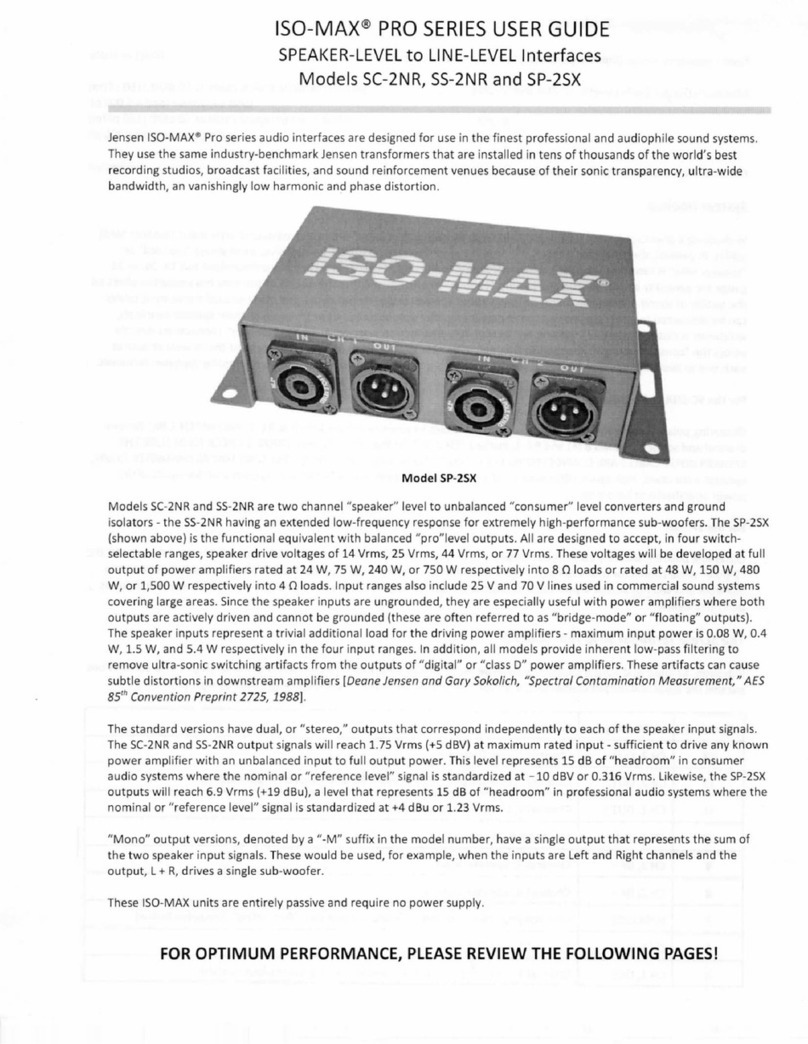
All models are designed to accept, in four switch-selectable ranges, speaker drive voltages of 14 Vrms, 25 Vrms, 44 Vrms, or
77 Vrms. These voltages will be developed at full output of power ampliers rated at 24 W, 75 W, 240 W, or 750 W
respecvely into 8Ω loads or rated at 48 W, 150 W, 480 W, or 1,500 W respecvely into 4Ω loads. Input ranges also include
25 V and 70 V lines used in commercial sound systems covering large areas. Since the speaker inputs are ungrounded, they
are especially useful with power ampliers where both outputs are acvely driven and cannot be grounded (these are oen
referred to as “bridge-mode” or “oang” outputs). The speaker inputs represent a trivial addional load for the driving
power ampliers - maximum input power is 0.08 W, 0.4 W, 1.5 W, and 5.4 W respecvely in the four input ranges. In
addion, all models provide inherent low-pass ltering to remove ultra-sonic switching arfacts from the outputs of
“digital” or “class D” power ampliers. These arfacts can cause subtle distorons in downstream ampliers [Deane Jensen
and Gary Sokolich, “Spectral Contaminaon Measurement,” AES 85th Convenon Preprint 2725, 1988].
The SC-2NR, SS-1SR and SS-2NR output signals will reach 1.75 Vrms (+5 dBV) at maximum rated input - sucient to drive
any known power amplier with an unbalanced input to full output power. This level represents 15 dB of “headroom” in
consumer audio systems where the nominal or “reference level” signal is standardized at !10 dBV or 0.316 Vrms.
SP-2SX and SS-2SX outputs will reach 6.9 Vrms (+19 dBu), a level that represents 15 dB of “headroom” in professional audio
systems where the nominal or “reference level” signal is standardized at +4 dBu or 1.23 Vrms.
[not menoned in the specs, but while the SS models are intended for “extended low-frequency response for extremely
high-performance sub-woofers” only, the full-bandwidth models are also excellent for subwoofer applicaons, with only
decimals of a dB dierence at the low end.]
These ISO-MAX units are enrely passive and require no power supply.
FOR OPTIMUM PERFORMANCE, PLEASE REVIEW THE FOLLOWING PAGES!
General Applicaon Guidelines
Load Impedance Range (input impedance of device the unit drives) . . . . . . . . . . . . . . . . . . . . . . . . . . . . . . . . . . . 10 kÙ or more
Maximum Output Cable Length
SC-2NR, SS-2RR, and SS-2NR:
60 feet (18 m) of typical cable at 50 pF/ (160 pF/m) total capacive load < 3,000 pF
SP-2SX and SS-2SX:
3 feet (1 m) of typical cable at 50 pF/ (160 pF/m) total capacive load < 200 pF
Maximum Input Cable (amplier/speaker to ISO-MAX) Length. . . . . . . . . . . . . . . . . . . . . . . . . . . . . . . . . . . . . . . . . . . . unlimited
System Hookup
In choosing a physical locaon for the ISO-MAX unit, shorter output cables are preferred over shorter input (speaker feed)
cables. In general, the beer locaon will be near the amplier(s) to be driven. Inexpensive, small-gauge “zip cord” or
“speaker wire” is recommended for the speaker inputs to the unit. Its gauge is technically unimportant but 18, 20, or 22
gauge are generally easiest to strip and handle. It should be emphasized that the quality of this wire will have a negligible
eect on the quality of sound - normal technical concerns about speaker cables do not apply. The other ends of these input
cables can be connected to either the main-channel power amplier output terminals or the main-channel speaker
terminals, whichever is closer or more convenient. For 25 V or 70 V distribuon systems, make the “speaker” connecons
directly across the “constant voltage” distribuon line. Again, be sure to observe polarity and ghtly twist the strands of
wire at each end to avoid strands that “stray” beyond the clamp area of either the screw terminals or amplier/speaker
terminals.
For the SC-2NR, SS-1SR, or SS-2RR
Observing polarity, securely aach the speaker input cables to screw terminals 1 (+) and 2 (-), marked “CH 1 IN,” for one
channel and screw terminals 8 (+) and 9 (-), marked “CH 2 IN,” for the other channel. DOUBLE CHECK TO BE SURE THE
SPEAKER INPUT CABLES ARE CONNECTED TO THE CORRECT TERMINALS - OTHERWISE, THE UNIT MAY BE DAMAGED! Finally,