manuals.online logo
Brands
  1. Home
  2. •
  3. Brands
  4. •
  5. ITW
  6. •
  7. Construction Equipment
  8. •
  9. ITW ACME DTPN-250 Instruction Manual

ITW ACME DTPN-250 Instruction Manual

Popular Construction Equipment manuals by other brands

Ammann AV23-2 manual

Ammann

Ammann AV23-2 manual

stellar labs Model 7628 owner's manual

stellar labs

stellar labs Model 7628 owner's manual

Hailo H-50 manual

Hailo

Hailo H-50 manual

Graco LineLazer ES 1000 Operation - repair - parts

Graco

Graco LineLazer ES 1000 Operation - repair - parts

Greenlee 555RSC instruction manual

Greenlee

Greenlee 555RSC instruction manual

Manitowoc Grove CD3340B Service manual

Manitowoc

Manitowoc Grove CD3340B Service manual

Lux Tools A-FMR-20 Set manual

Lux Tools

Lux Tools A-FMR-20 Set manual

SIP 03683 manual

SIP

SIP 03683 manual

Volvo L30G Operator's manual

Volvo

Volvo L30G Operator's manual

Grizzly G8712 instruction sheet

Grizzly

Grizzly G8712 instruction sheet

Case DV201 Service manual

Case

Case DV201 Service manual

Wacker Neuson DT05 Operator's manual

Wacker Neuson

Wacker Neuson DT05 Operator's manual

HYVA AMCO VEBA 81 Series WARNING, OPERATING AND MAINTENANCE MANUAL

HYVA

HYVA AMCO VEBA 81 Series WARNING, OPERATING AND MAINTENANCE MANUAL

Atlas Copco Dynapac V5100TV manual

Atlas Copco

Atlas Copco Dynapac V5100TV manual

Manitowoc National Crane 1400A Operator's manual

Manitowoc

Manitowoc National Crane 1400A Operator's manual

SGS EC1500 owner's manual

SGS

SGS EC1500 owner's manual

Turbosol BM 30 Use and maintenance manual

Turbosol

Turbosol BM 30 Use and maintenance manual

Fayat CC424CHF instruction manual

Fayat

Fayat CC424CHF instruction manual

manuals.online logo
manuals.online logoBrands
  • About & Mission
  • Contact us
  • Privacy Policy
  • Terms and Conditions

Copyright 2025 Manuals.Online. All Rights Reserved.

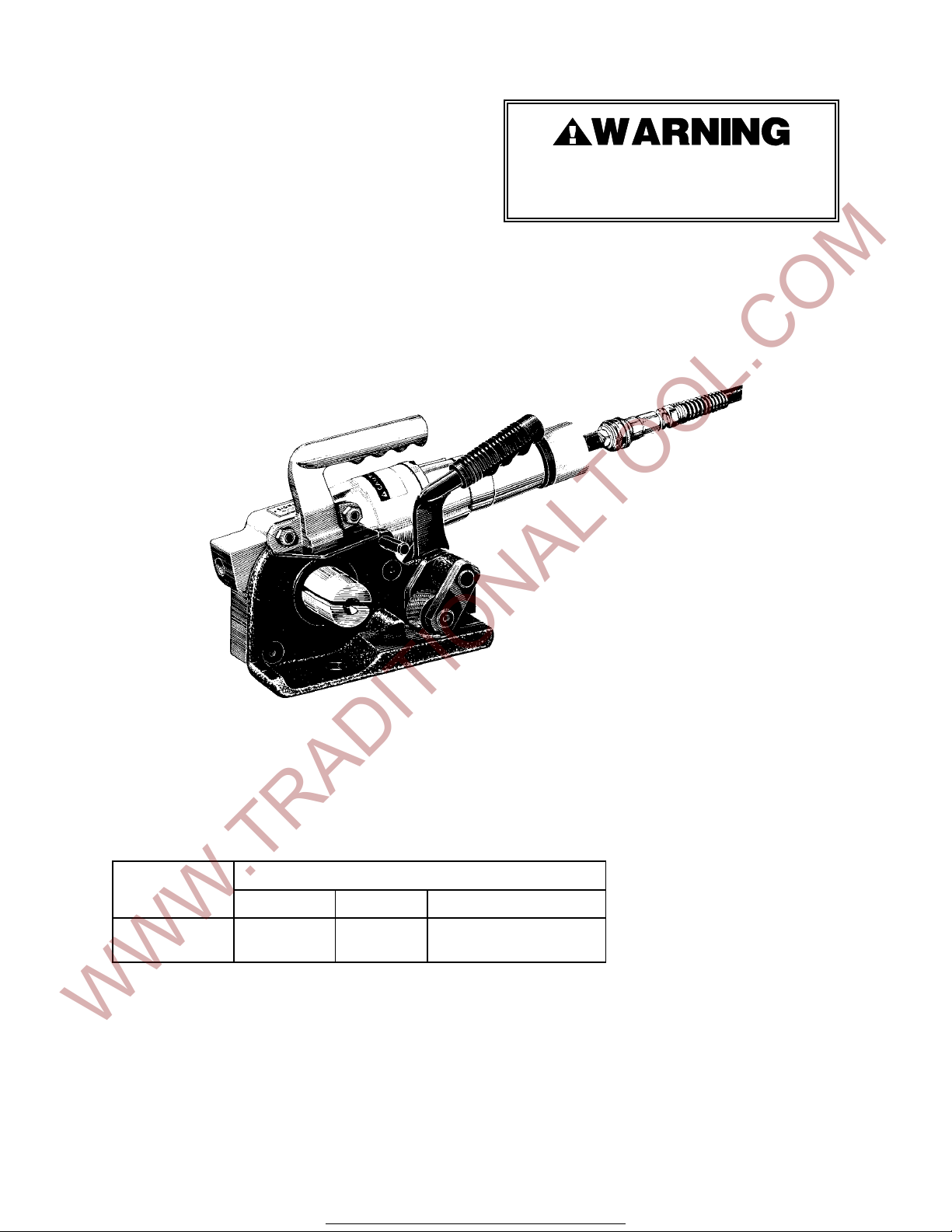
DTPN-250
AIR POWERED TENSIONER
Part No. 306240
For Parts & Service 1-877-862-6699
WWW.TRADITIONALTOOL.COM
READ THESE INSTRUCTIONS CAREFULLY.
FAILURE TO FOLLOW THESE INSTRUCTIONS CAN RESULT IN SEVERE PERSONAL INJURY.
GENERAL SAFETY CONSIDERATIONS
1. STRAP BREAKAGE HAZARD.
Improper operation of the tool or sharp corners on the load can result in strap breakage
during tensioning, which could result in the following:
!
!!
!A sudden loss of balance causing you to fall.
!
!!
!Both tool and strap flying violently towards your face.
Failure to place the strap properly around the load or an unstable or shifted load could result
in a sudden loss of strap tension during tensioning. This could result in a sudden loss of
balance causing you to fall.
Read the tool's operating instructions. If the load corners are sharp use edge protectors.
Place the strap correctly around a properly positioned load.
!
!!
!Positioning yourself in-line with the strap, during tensioning and sealing, can result in
severe personal injury from flying strap or tool. When tensioning or sealing, position
yourself to one side of the strap and keep all bystanders away.
!
!!
!Using strap not recommended for this tensioner can result in strap breakage during
tensioning. Use the correct Acme products for your application.
2. TRAINING.
This tool must not be used by persons not properly trained in its use. Be certain that you
receive proper training from your employer. If you have any questions contact your Acme
Representative.
3. EYE INJURY HAZARD.
Failure to wear safety glasses with side shields can result in severe eye injury or
blindness. Always wear safety glasses with side shields which conform to ANSI
Standard Z87.1 or EN 166.
4. FALL HAZARD.
Maintaining improper footing and/or balance when operating the tool can cause you to fall.
Do not use the tool when you are in an awkward position.
5. CUT HAZARD.
Handling strap or sharp parts could result in cut hands or fingers. Wear
protective gloves.
For Parts & Service 1-877-862-6699
WWW.TRADITIONALTOOL.COM
6. TOOL CARE, MAINTENANCE & PARTS REPLACEMENT
!
!
!
!Take good care of the tool. Inspect and clean it daily, lubricate it weekly and adjust
when necessary. Replace any worn or broken parts.
!
!!
!ALWAYS disconnect the pneumatic connection to the tool when performing part
removal and/or replacement procedures. NEVER connect a pneumatic source to a
disassembled tool unless otherwise specified.
7. WORK AREA.
Keep work areas uncluttered and well lighted.
Several combinations of strap, seals and tools can be used with this tensioner. Use the correct
Acme products for your application. If you need help contact your Acme Representative.
SAFETY PROCEDURES FOR TOOL OPERATION
Before using this tool, read its Operation and Safety instructions.
!
!!
!Do not exceed the operating air pressures stated elsewhere in the manual.
!
!!
!Use a Acme approved filter-regulator-lubricator unit.
!
!!
!Never operate a pneumatic tool with a bottled air or gas source.
!
!!
!For tension adjustments, follow instructions in this manual. For all other adjustments,
repairs or cleaning of the tool, disconnect air supply.
!
!!
!Properly crimp or notch the seal(s).
!
!!
!Tuck strap end back into the dispenser when not in use.
CUTTING TENSIONED STRAP
Use only cutters designed for cutting strap; never use claw hammers, crowbars, chisels, axes or
similar tools. Such tools will cause the strap to fly apart with hazardous force. Before using any
Acme product, read its Operation and Safety Manual.
For Parts & Service 1-877-862-6699
WWW.TRADITIONALTOOL.COM
TABLE OF CONTENTS
General Safety Instructions 2
Specifications 4
Pneumatic Information 5
Tool Installation 7
Tool Operation 8
Parts List & Exploded View 10
Repair Instructions 14
Maintenance 15
Maximum operating pressure
is 90 psig (6.2 bar).
DTPN-250 TENSIONER
SPECIFICATIONS
MODEL
(Part No.)
STRAP
TYPE WIDTH THICKNESS
DTPN-250
(306240)
Steel 2" .044" to .050"
For Parts & Service 1-877-862-6699
WWW.TRADITIONALTOOL.COM
PNEUMATIC INFORMATION
AIR SUPPLY INSTALLATION
If compressor has a good dryer unit, use black pickled pipe. When a dryer unit is not installed,
use galvanized or copper pipe. To perform reliably, a pneumatic tool requires a continuous
source of clean, water-free air at adequate pressure.
Never operate this tool using a bottled air or gas source.
Bottled air/gas sources do not provide consistent operating pressure
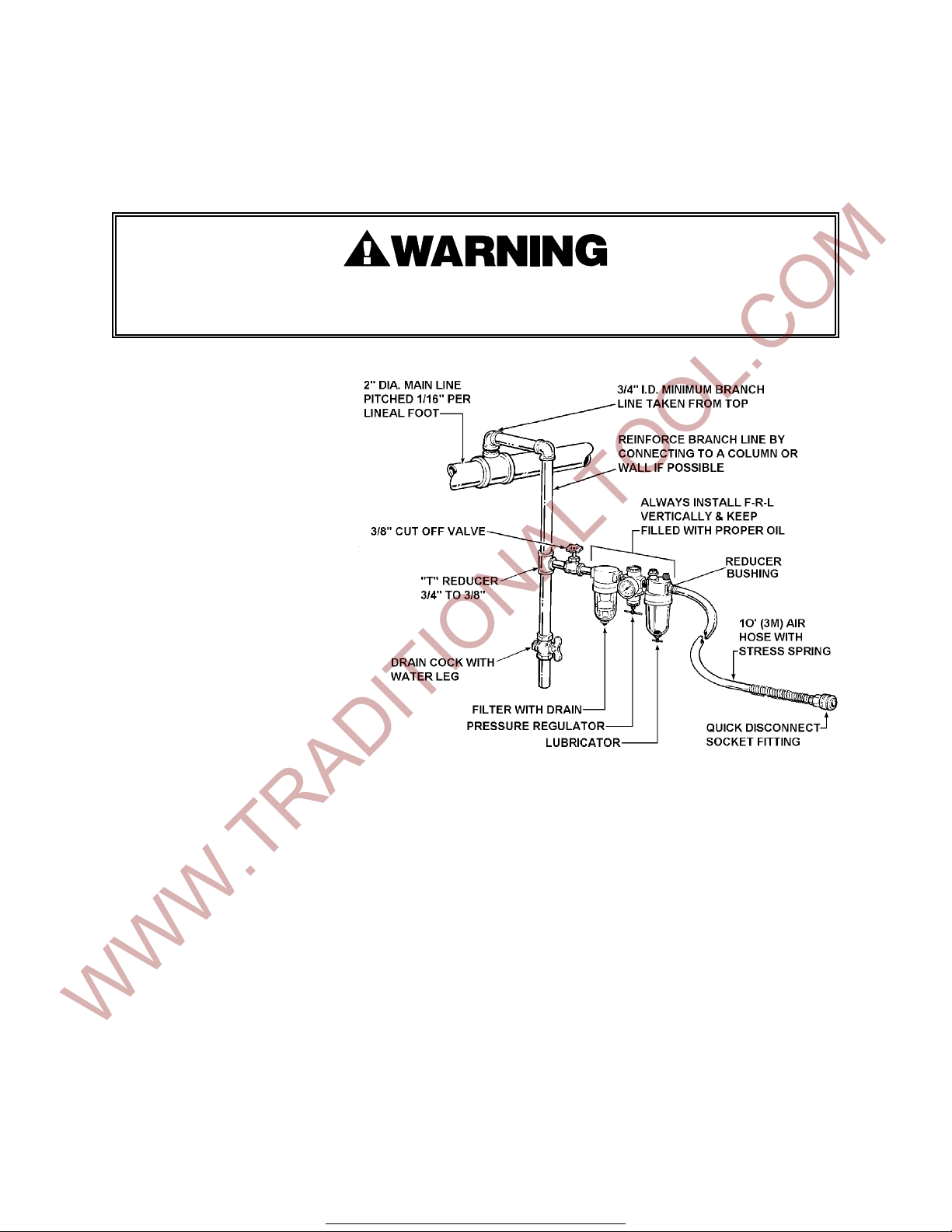
A filter-regulator-lubricator
(FRL) unit must be installed as
close to the air tool as possible,
preferably within 10 feet. It
should be placed in a
convenient location where it
can easily be drained, adjusted,
and filled with oil. The air hose
must have at least a 3/8" I.D. A
quick disconnect socket fitting
is installed on the stress spring
end of the hose for convenient
hookup to the air tool.
Filter-Regulator-Lubricator Unit
(Acme Part No. 008559 or 173111)
FRL Mounting Bracket
(Acme Part No. 071982)
Air Hose, 3/8" ID, 1/4" Fittings
(Acme Part No. 008558)
Reducer Bushing, 3/8" to 1/4"
(Acme Part No. 008478)
Quick Disconnect, 1/4" Fitting
(Acme Part No. 020706)
Filter and lubricator bowls are made of polycarbonate material. Do not install where bowls may
be exposed to materials incompatible with polycarbonate. Certain oils, solvents, and chemicals
or their fumes can weaken these bowls and possibly cause them to burst. Clean only with warm
water. A cut-off valve placed ahead of the filter will be useful when cleaning the filter or
replenishing the lubricator.
For Parts & Service 1-877-862-6699
WWW.TRADITIONALTOOL.COM
PNEUMATIC INFORMATION, Continued
MOISTURE
Moisture is always present in air lines due to condensation within the lines as the air cools.
Steps must be taken to remove this moisture and to keep it from the air tool. This is because
water tends to wash away lubricants and cause corrosion, sticking and failure of internal parts.
The main line should be pitched so the far end terminates in a water leg. Branch lines are taken
from the top of the main, never off the bottom. Every branch should have a water leg at its
lowest point, with a drain cock which is drained daily.
If these precautions are taken and water is still present, an after cooler and a moisture separator
are required between the compressor and the air receiver tank. A large air line separator can be
installed in the air tool line, but precautions must be taken to insure that it will be drained daily,
before the air tool is operated.
Water in air lines is a constant threat to the proper operation of air tools. Even near freezing
operating conditions, a good refrigerant type dryer is essential. A good dryer will remove 95%
or more of water right at the compressor. The remaining moisture is removed at the water leg in
the piping system or in the filter.
LUBRICATION
The air tool must be properly lubricated. This is achieved by keeping the air line lubricator filled
with oil and correctly adjusted. Without proper lubrication, the tool will become sticky and will
be difficult to release from the strap.
Install the lubricator as close to the air tool as possible. The arrow on the lubricator's top
surface must point in the direction of air flow.
For proper operation, oil must drop through the lubricator sight glass at a rate of 4 to 10 drops
per minute. This rate is checked while the air tool is running free. Only 20% of this oil is actually
delivered to the tool. The remaining oil drops back into the oil reservoir. The unit is factory set
and should require no adjustment. If an adjustment is required, the adjusting screw on top of
the lubricator may be turned as marked to reduce or increase the flow of oil.
The correct grade of oil must be used in the lubricator; too heavy an oil will not provide sufficient
lubrication and will cause sticking and sluggish operation of the air tool.
Recommended oils are any good grade of rust and oxidation inhibiting oil with a viscosity of 80-
120 S.U.S. at 100 degrees Fahrenheit. (0.15 to 0.25 cm2/sec. at 38 degrees Celsius), such as:
Non Fluid Oil Co., grade #LS-1236
If necessary, use SAE #5 or SAE #10 non-detergent, cut 1 to 1 with kerosene.
NOTE: Some oils contain anti-wear additives which may disable the tool. Be certain to use
recommended oil.
Several drops of lubricator oil added to the inlet of the air line each day will help insure good
operation. A noticeable reduction of performance can usually be corrected by squirting a few
drops of oil into the air line.
For Parts & Service 1-877-862-6699

WWW.TRADITIONALTOOL.COM
COLD WEATHER OPERATION
If a tool does not operate satisfactorily in freezing temperatures, certain steps can correct the
problem. The following steps can be taken to improve cold weather operation of the tool:
a. An air line dryer adjacent to the compressor.
b. Use lubricant recommended by Acme. Acme has tested the use of anti-freezes, none work
well in air tools; the tool will gum up when anti-freezes are introduced and will not function
properly. The best lubricant for freezing weather is the 1 to 1 oil and kerosene combination.
c. If possible, run the air supply line to a indoor located Filter-Regulator-Lubricator or relocate
the F-L-R to a warmer operating area.
AIR PRESSURE VS. APPROXIMATE STRAP TENSION
Air Line Pressure (psig) Strap Tension (lbs.)
50 psig (345 kPa) 4,000 lb. (17800 N)
60 psig (415 kPa) 5,000 lb. (22200 N)
70 psig (485 kPa) 6,000 lb. (26700 N)
80 psig (550 kPa) 7,000 lb. (31100 N)
90 psig (620 kPa) 8,000 lb. (35600 N)
Recommended Recommended air
strap sizes pressure (psig)
2" x .044 50 to 90 psig
2" x .050 50 to 90 psig
Strap breakage hazard. Strap can break during tensioning if inlet air
pressure to the tool exceeds 90 psig. Strap breakage can result in
severe personal injury. Maximum operating pressure is 90 psig.
TOOL INSTALLATION
To operate effectively, your tool must be installed properly. This installation includes proper
suspension of the tool over the package to be strapped, correct placement of a strapping
dispenser to provide a continuous easy supply of strap for the application, and a satisfactory air
supply with air line pressures being maintained within the specified range.
For Parts & Service 1-877-862-6699
WWW.TRADITIONALTOOL.COM
TOOL OPERATION
Wear safety glasses which conform to
ANSI standard Z87.1 or EN 166. Stand to
one side of the strap while tensioning.
Make sure all bystanders are clear before
proceeding.
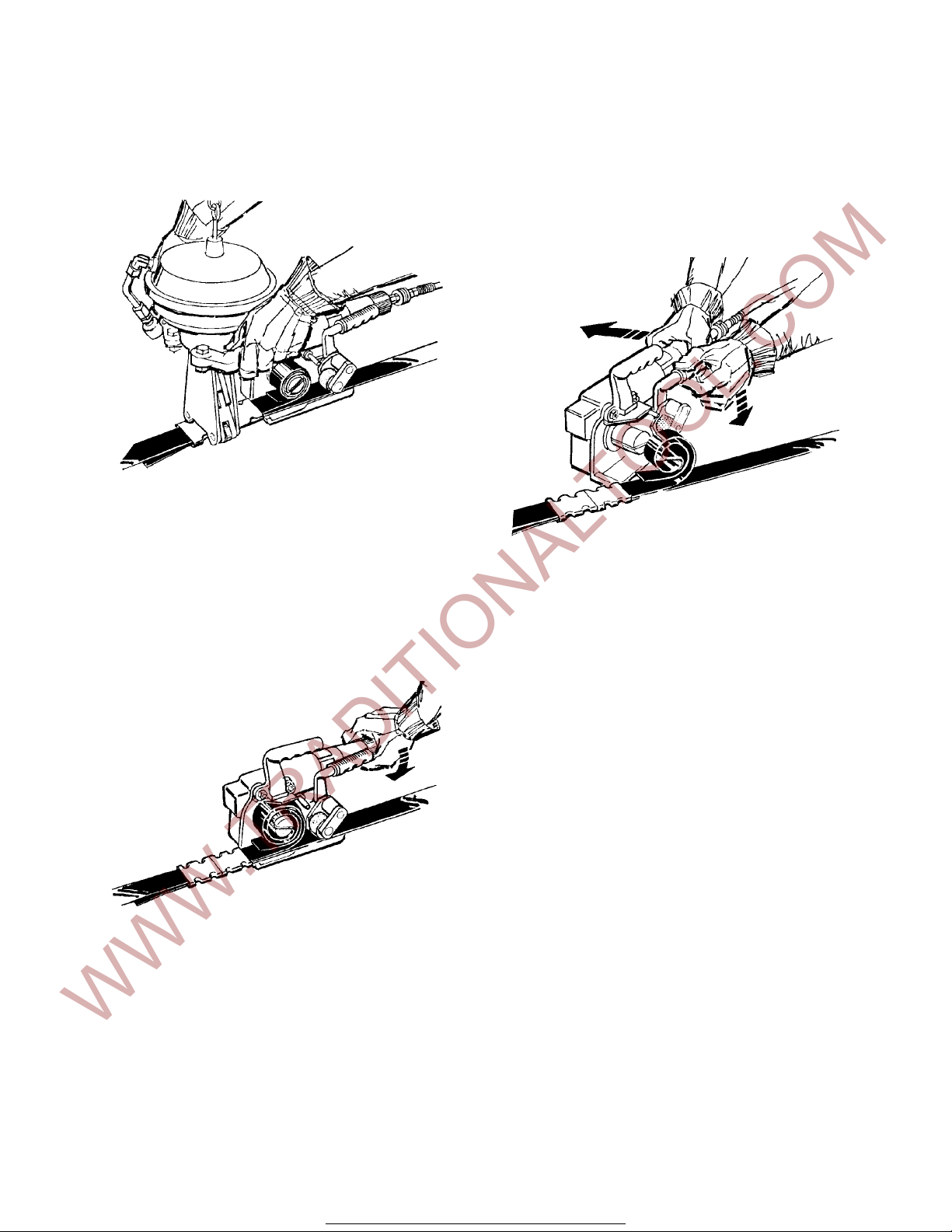
1. Raise the gripper wheel by pressing
down on the pawl handle. Insert the
bottom strap and release the pawl
handle. Allow one foot of strap to extend
beyond the front of the tool.
2. Thread seals properly on to upper strap.
3. Thread strap in to the windlass and
under the strap pin. Strap should extend
4" - 8" beyond the windlass.
NOTE: Make sure straps are fully seated
against the base.
4. Pull out slack, turn valve clockwise to
rotate windlass about 1/2 turn to secure
strap in the windlass.
5. Thread seals properly on to bottom
strap.
For Parts & Service 1-877-862-6699
WWW.TRADITIONALTOOL.COM
6. While standing to one side of the strap
line, rotate the valve collar clockwise to
tension strap allowing motor to stall out
at desired tension.
If for some reason the gripper will not
energize, do not try to energize using the
pawl handle, as this will result in
disengagement of the ratchet wheel.
Apply light machine oil to the pivot pin
(5), until the lever moves freely.
7. At the end of the tensioning cycle, use
sealing tool to notch or crimp seals.
8. After sealing the strap, rotate the valve
collar counterclockwise to unwind the
windlass. Note tab end of strap in
windlass. When this becomes loose, the
tool will be easily removed. The valve
collar is spring loaded to the reverse
direction so that when released, the
valve will return to neutral.
Lift the pawl handle thereby disengaging
the ratchet wheel. Then press down on
the pawl handle and rotate the tool off
the strap in a counterclockwise
direction.
For Parts & Service 1-877-862-6699
WWW.TRADITIONALTOOL.COM
PARTS LIST, TOOL
KEY QTY PART # DESCRIPTION
1 1 160479 Bearing shim
2 1 002481 Name plate
3 3 005211 Flexlock nut 3/16-18
4 2 005214 Roll pin 1/4 dia. x 3/4
5 2 004939 Drive screw
6 1 008154 FHSCS, 3/16-18 x 1
7 3 008531 Stud
8 6 008731 SHCS, 10-24 x 3/4
9 1 008774 Key, Woodruff #3
10 3 008815A Idler gear assembly
11 1 008825 Spacer
121 008826 Key
13 1 008827 Idler plate
14 1 008829 Ring gear
15 1 008148 Roll pin, 1/8 x 7/16
16 1 008854 Ball bearing 7304W
17 1 023053 Base
18 1 023054 Gear housing
19 1 023055A Motor
20 1 023056 Spiriod gear
21 1 023057 Spiriod worm
22 1 023058 Pawl handle
23 1 023059 Windlass
24 1 023063 Gripper
25 1 023064 Front link
26 1 023065 Rear link
27 1 023066 Ratchet gear
28 1 023067 Gripper shaft
29 1 023068 Support pin
30 1 023069 Center link
31 1 023071 Spacer
32 1 023072 Key, Woodruff #21
33 1 023073 Gripper spring
34 1 023074 Strap pin
35 1 023075 Pawl spring
36 1 023076 Tool handle
37 1 023077 Wear pad
38 2 023080 Roll pin 3/16 x 7/8
39 1 023668 Plastic grip
40 1 008645 Bearing,Fafnir 205KDD
41 1 023742 Bearing,Fafnir 210PP
42 1 023743 Bearing,Torr. M-871
43 1 023744 Oil Seal
44 2 023745 SHCS,5/16-18x2-3/4
45 1 023746 FHSCS,5/16-18x2-1/4
50 1 023272 Handel protector
51 1 003132 Danger Sign
NOTES
1. Use large quick disconnect fittings: Socket P/N 020706, Plug P/N 020704
2. Assemble wear pad with "B" side down.
!
!!
!When ordering parts please show tool model, part number and name.
!
!!
!Standard hardware parts may be obtained from your local hardware supplier.
!
!!
!Recommended spare parts are underlined and should be stocked.
For Parts & Service 1-877-862-6699
WWW.TRADITIONALTOOL.COM