1
1.0 INTRODUCTION
1.1 Safety and Caution Notes
Always wear protective clothing, eye protection and gloves before working on or near a
metering pump. Follow all recommendations of the supplier of the solution being pumped.
Refer to the MSDS from the solution supplier for additional precautions.
Iwaki America EH Series metering pumps should be installed where ambient temperatures
do not exceed 122°F (50°C) or do not fall below 32°F (0°C), or where pump or tubing are
directly exposed to sunlight.
WARNING Risk of electrical shock! This pump is supplied with a grounding
conductor and grounding-type attachment plug. To reduce the risk of electrical shock, be
certain that it is connected only to a properly grounded, grounding type receptacle with
ratings conforming to the data on the pump data plate. Prior to performing any
maintenance on a pump, disconnect the pump from the electrical power source.
Plumbing Precautions
All piping must be securely attached to the fittings prior to starting the pump (see Section
2.2). Always adhere to local plumbing codes and requirements. Be sure that the
installation does not constitute a cross connection. Iwaki America is not responsible for
improper installations. Prior to performing any maintenance on a pump, depressurize the
discharge tubing.
If you are pumping downhill or into little or no system pressure, a back pressure/anti-
syphon device must be installed to prevent over-pumping. Contact your Iwaki America
distributor for additional information.
Solution Compatibility
CAUTION! This pump has been tested by Underwriters Laboratories Inc. using water
only. The suitability of this pump for use with liquids other than water is the responsibility
of the user. For liquids other than water, select the best-suited liquid end material
combination using a chemical compatibility chart.
1.2 Principle of Operation
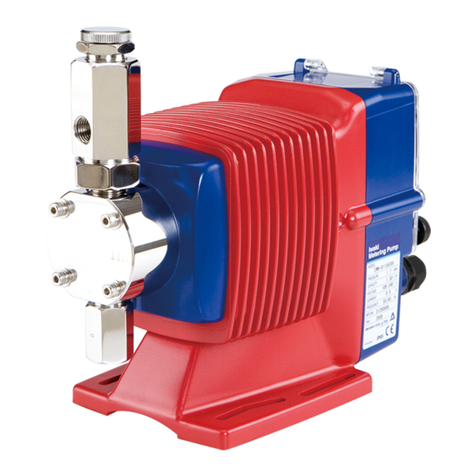
The EH series electronic metering pump consists of a pump unit, a drive unit, and a control
unit. The drive unit is an electromagnetic solenoid. When the solenoid coil is energized by
the control unit the armature shaft moves forward due to the magnetic force of the solenoid.
The shaft is attached to a PTFE faced diaphragm which is part of the pump unit. The
diaphragm is forced into the pump head cavity decreasing volume and increasing pressure
which forces liquid in the pump head out through the discharge check valves. When the
solenoid coil is de-energized, a spring returns the armature to its starting position. This
action pulls the diaphragm out of the head cavity increasing volume and decreasing
pressure. Atmospheric pressure then pushes liquid from the supply tank through the
suction check valves to refill the pump head.