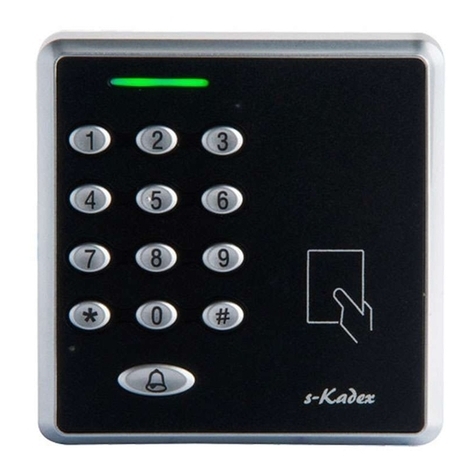
POPULUS A-1-NET and POPULUS A-3-NET –Access controller
POPULUS A-1-NET and POPULUS A-3-NET –
ACCESS CONTROLLER
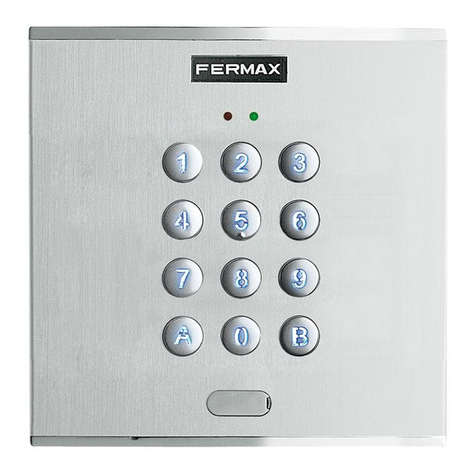
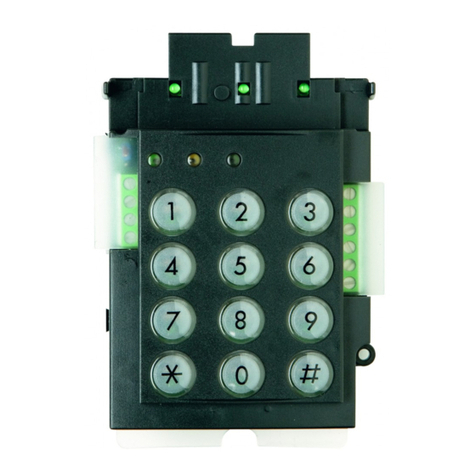
The Populus A is an access controller with built-in proximity card
reader. It is designed for residential and business buildings, offices,
shops, etc. The controller can have 125kHz or 13.56MHz reading
frequency.
The entire set-up procedure is carried out with the software. The
controller allows access for up to 30000 users and saves 100000
events. It is intended for controlling entries, exits and passes of
users in the system and controlling sliding doors, ramp, el. strike,
turning alarm on/off… It needs to be set with CODEKS software.
The SDK is also available for this controller. If a user or software
producer wants to develop its own application, please contact us.
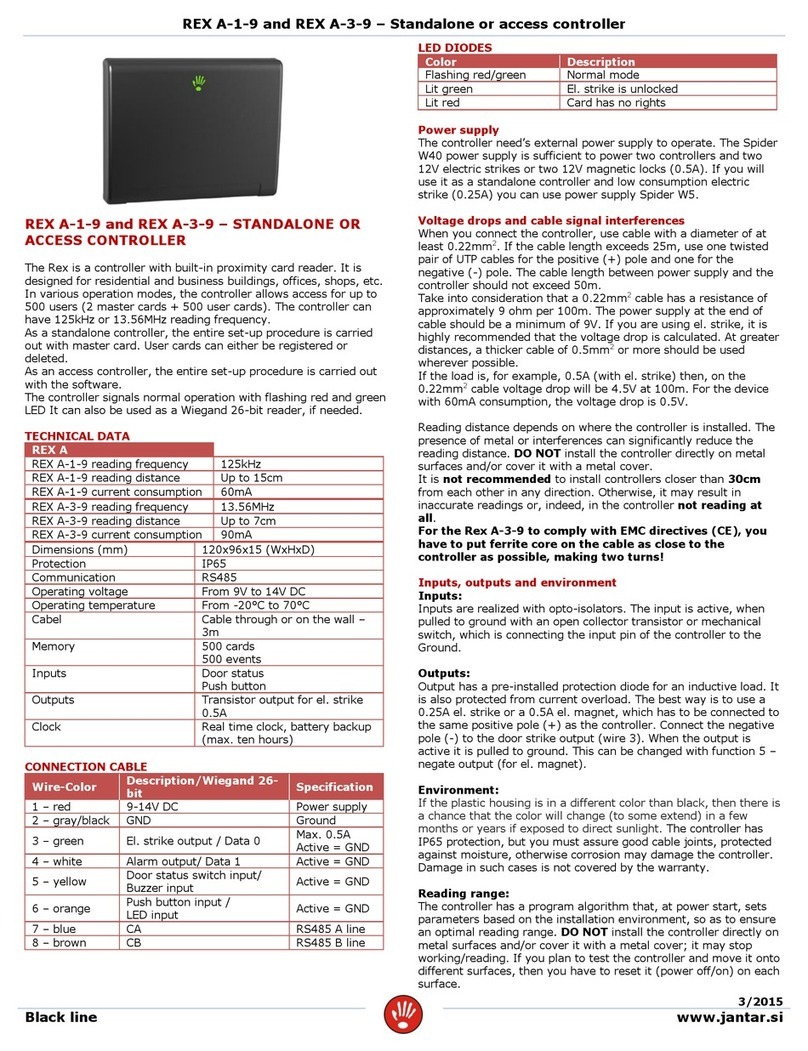
TECHNICAL DATA
A-1-NET reading frequency
A-1-NET current consumption
A-3-NET reading frequency
A-3-NET current consumption
30000 cards or codes
100000 events
Transistor output for el. strike
0.5A
Real time clock, battery backup
(max. ten hours)
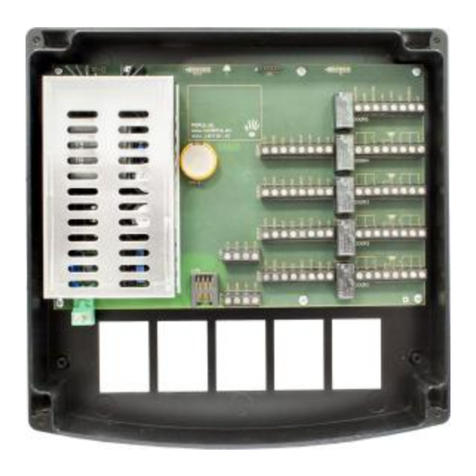
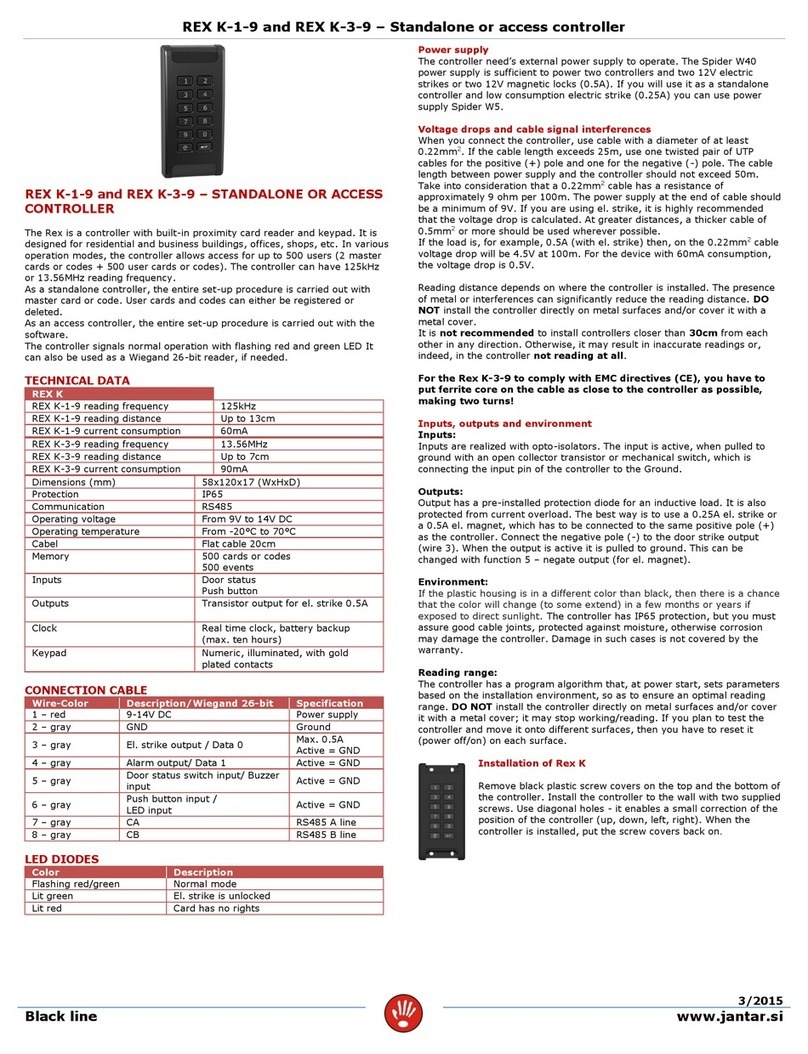
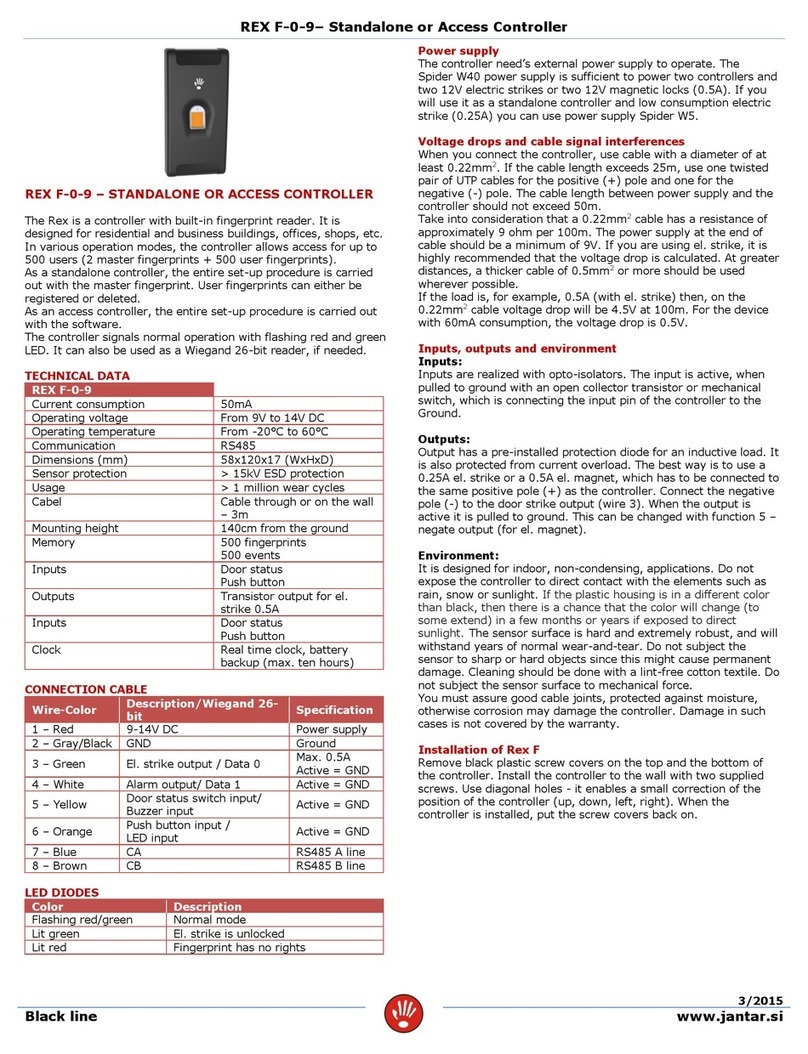
CONNECTION WIRES
ETHERNET WIRES
POWER SUPPLY
The controller need’s external power supply to operate.
The Spider W40 power supply is sufficient to power two controllers
and two 12V electric strikes or two 12V magnetic locks (0.5A).
The Spider W5 power supply is sufficient to power one controller
and one 12V electric strike (0.25A).
VOLTAGE DROPS and SIGNAL INTERFERENCES
When you connect the controller, use cable with a diameter of at
least 0.22mm2. If the cable length exceeds 25m, use one twisted
pair of UTP cables for the positive (+) pole and one for the
negative (-) pole. The cable length between power supply and the
controller should not exceed 50m.
Take into consideration that a 0.22mm2cable has a resistance of
approximately 9 ohm per 100m. The power supply at the end of
cable should be a minimum of 11V. If you are using el. strike, it is
highly recommended that the voltage drop is calculated. At greater
distances, a thicker cable of 0.5mm2or more should be used
wherever possible.
If the load is, for example, 0.5A (with el. strike) then, on the
0.22mm2cable voltage drop will be 4.5V at 100m. For the device
with 60mA consumption, the voltage drop is 0.5V.
Reading distance depends on where the controller is installed. The
presence of metal or interferences can significantly reduce the
reading distance. DO NOT install the controller directly on metal
surfaces and/or cover it with a metal cover.
It is not recommended to install controllers closer than 30cm
from each other in any direction. Otherwise, it may result in
inaccurate readings or, indeed, in the controller not reading at
all.
For Populus A-3-NET to comply with EMC directives (CE),
you have to put ferrite core on the cable as close to the
reader as possible, making two turns!
INPUTS
Inputs are realized with opto-isolators. The input is active, when
pulled to ground with an open collector transistor or mechanical
switch, which is connecting the input pin of the controller to the
Ground.
OUTPUTS
Output has a pre-installed protection diode for an inductive load. It
is also protected from current overload. The best way is to use a
0.25A el. strike or a 0.5A el. magnet, which has to be connected to
the same positive pole (+) as the controller. Connect the negative
pole (-) to the door strike output (wire 3). When the output is
active it is pulled to ground. This can be changed with function 5 –
negate output (for el. magnet).
ENVIROMENT
Do not install the controller on/in a place, where it can come in
contact with water. You must assure good cable joints, protected
against moisture, otherwise corrosion may damage the controller.
Damage in such cases is not covered by the warranty.
READING RANGE
The controller has a program algorithm that, at power start, sets
parameters based on the installation environment, so as to ensure
an optimal reading range. DO NOT install the controller directly on
metal surfaces and/or cover it with a metal cover; it may stop
working/reading. If you plan to test the controller and move it onto
different surfaces, then you have to reset it (power off/on) on each
surface.