DDeeaarrCCuussttoommeerr
The Quartz mechanism you have purchased is a delicate and precise piece of equipment
which can easily be damaged if mistreated. If it is assembled carefully, following the
instructions below, it will give years of accurate, trouble-free use.
Assembly
There are certain things to be considered when assembling the mechanism.
When assembled, the gap between the rubber washer and the fixing nut is 6 to 10mm.
Depending on the thickness of your clockface, you may need to add an extra washer
behind the clockface to get the mechanism to fit properly.
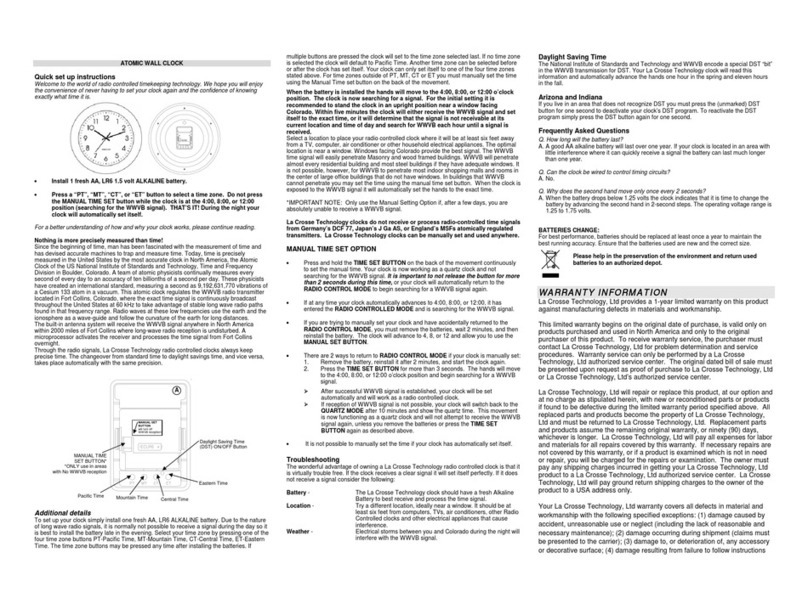
Assembly of the clock should follow the sequence of the illustration below. The rubber
washer is fitted on the spindle first, followed in sequence by: the clockface, brass washer,
securing nut. Do not over-tighten the securing nut.
The hands can now be fitted to the spindle, as per the following sequence: hour hand,
minute hand, second hand. To achieve initial alignment, fit the hour hand pointing to 6 and
the minute hand pointing to 12. Turn the mechanism over and rotate the hands using the
friction wheel located on the back of the movement. If alignment is incorrect, re-position
the hands individually until a satisfactory result is obtained.
Finally, add the second hand. The position of this is not critical.
Assembly should now be complete. To operate the mechanism, insert an AA size, 1.5v
battery (which can be of the re-chargeable or non-rechargeable type) and the clock
mechanism should now start. In the event that the mechanism does not start, check that
the battery is inserted the correct way round.
IMPORTANT: to set the correct time, use the friction wheel previously mentioned to
move the hands. Do not attempt to adjust the time by directly moving the hands as
this is likely to strain the mechanism and damage it.
Hanging
bracket
Quartz
movement
Spindle Rubber spacer
washer
Brass washer
Minute hand
Clockface
Hour hand
Second hand
Securing nut
DDeeaarrCCuussttoommeerr
The Quartz mechanism you have purchased is a delicate and precise piece of equipment
which can easily be damaged if mistreated. If it is assembled carefully, following the
instructions below, it will give years of accurate, trouble-free use.
Assembly
There are certain things to be considered when assembling the mechanism.
When assembled, the gap between the rubber washer and the fixing nut is 6 to 10mm.
Depending on the thickness of your clockface, you may need to add an extra washer
behind the clockface to get the mechanism to fit properly.
Assembly of the clock should follow the sequence of the illustration below. The rubber
washer is fitted on the spindle first, followed in sequence by: the clockface, brass washer,
securing nut. Do not over-tighten the securing nut.
The hands can now be fitted to the spindle, as per the following sequence: hour hand,
minute hand, second hand. To achieve initial alignment, fit the hour hand pointing to 6 and
the minute hand pointing to 12. Turn the mechanism over and rotate the hands using the
friction wheel located on the back of the movement. If alignment is incorrect, re-position
the hands individually until a satisfactory result is obtained.
Finally, add the second hand. The position of this is not critical.
Assembly should now be complete. To operate the mechanism, insert an AA size, 1.5v
battery (which can be of the re-chargeable or non-rechargeable type) and the clock
mechanism should now start. In the event that the mechanism does not start, check that
the battery is inserted the correct way round.
IMPORTANT: to set the correct time, use the friction wheel previously mentioned to
move the hands. Do not attempt to adjust the time by directly moving the hands as
this is likely to strain the mechanism and damage it.
Hanging
bracket
Quartz
movement
Spindle Rubber spacer
washer
Brass washer
Minute hand
Clockface
Hour hand
Second hand
Securing nut