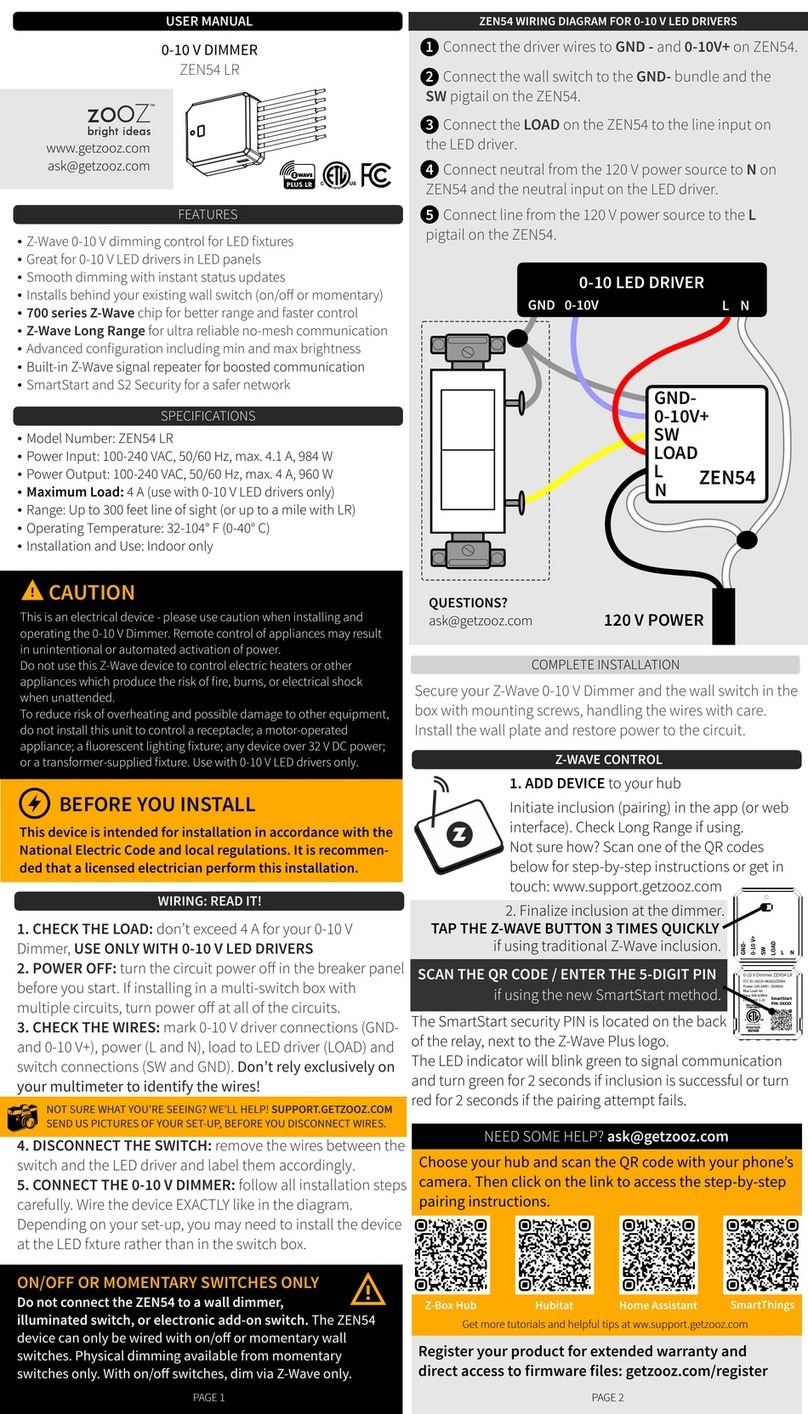
(10) Changeover switch
o Connect the dimmer (1) and the changeover switch (10) according to the connection
diagram (figure 3).
5.2 Commissioning
Adjusting basic brightness
If necessary, the basic brightness can be set by an electrically skilled person.
DANGER!
Electrical shock when live parts are touched.
Electrical shocks can be fatal.
Use only insulated tools to set the basic brightness. Cover up live parts in the
working environment.
The device is connected as described above and fitted in an appliance box. The frame, central
plate and adjusting knob are not fitted.
o Switch on mains voltage.
o Press the rotary axle to switch on the lighting and turn it left to the minimum brightness.
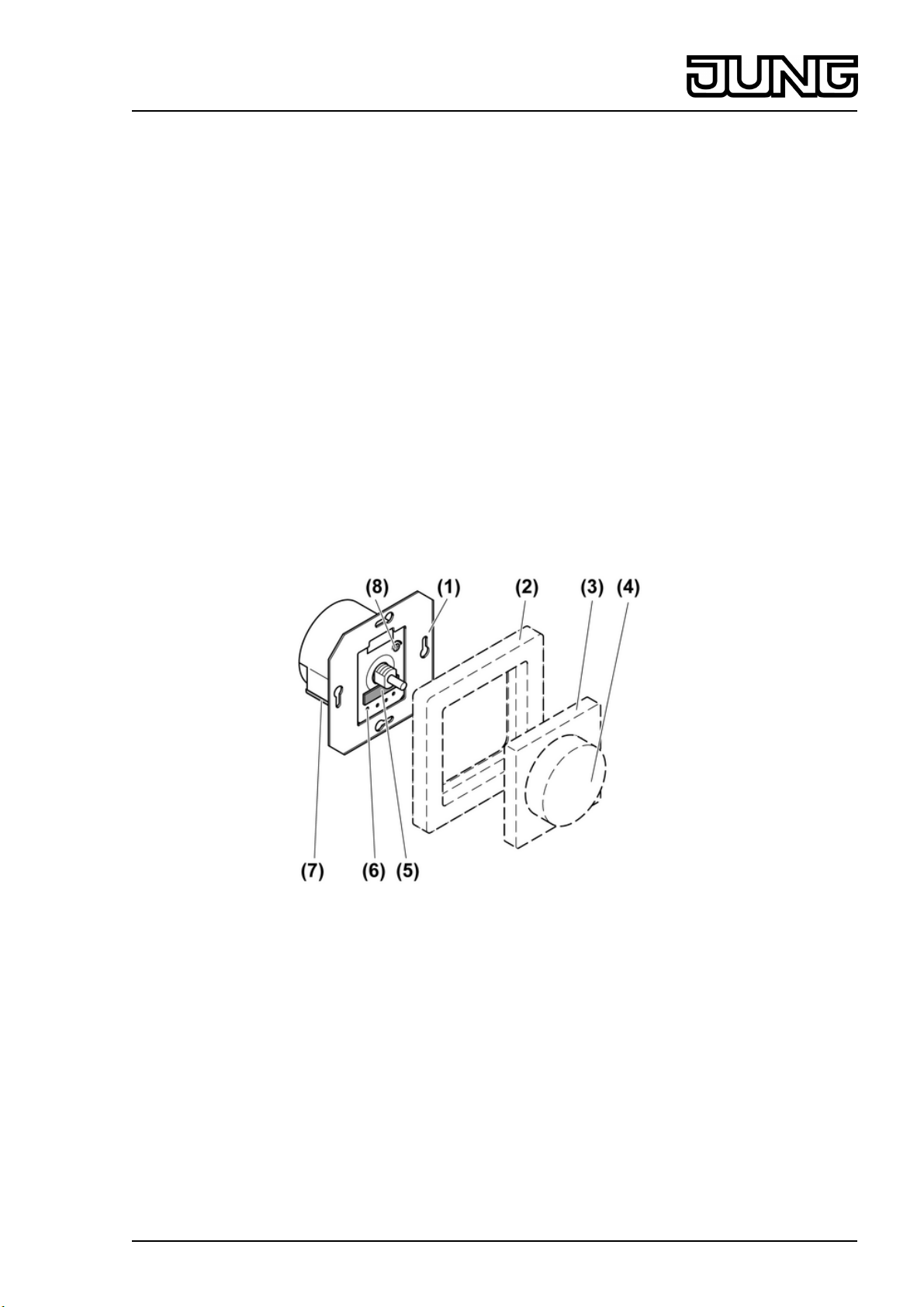
o Set the basic brightness by turning the adjuster (8) (figure 1).
i According to EN 60669-2-1 (01.2000), lamp brightness should be detectable over the
whole load area, with darkness at – 10 % rated voltage.
o Switch on the mains voltage.
o Mount the frame and the central plate.
o Attach the adjusting knob.
o Switch on mains voltage again.
6 Appendix
6.1 Technical data
Rated voltage AC 230 / 240 V ~
Mains frequency 50 Hz
Ambient temperature +5 ... +25 °C
Connected load at 25 °C
i Power specifications including transformer power dissipation.
Incandescent lamps
Art. No. 225 NV DE 20 ... 500W
Art. No. 823 NV DW 20 ... 375W
HV halogen lamps
Art. No. 225 NV DE 20 ... 500W
Art. No. 823 NV DW 20 ... 375W
Inductive transformers
Art. No. 225 NV DE 20 ... 500VA
Art. No. 823 NV DW 20 ... 375VA
i Operate inductive transformers with at least 85% nominal load.
ohmic-inductive
Art. No. 225 NV DE 20 ... 500VA
Art. No. 823 NV DW 20 ... 375VA
Power reduction
when surface-mounted
Art. No. 225 NV DE 20 ... 450W/VA
Art. No. 823 NV DW 20 ... 375W/VA
per 5°C in excess of 25°C -10 %
when installed in wooden or dry construction
walls
-15 %
when installed in multiple combinations -20 %
Connection
4/5
32534523
J:0082534523 30.10.2013
Light Management
Rotary dimmer