12
Room Acoustics
A good listening room has just the right amount of reflec-
tion and absorption. The performance of any loudspeaker
depends upon the speaker’s location in the room and the
acoustical conditions in that part of the room. Furnishing,
size and proportions all effect tonal balance, imaging and
bass characteristics.
In order to test the sonic balance of your room, stand in
the location where the loudspeaker will be installed and
clap your hands two or three times. If the room is rever-
berant, you will hear a sharpness or echo. If the room is
dull, the sound of the clap will decay rapidly and there
will be little or no echo. Large areas of glass, mirrors and
wood-paneling will reflect sound waves and often result in
brittleness and extreme brightness.
You can correct this by breaking these sound-waves with
softer surfaces; for instance, draperies or wall hangings. In
general try to create random reflections.
Positioning
We recommend experimenting with loudspeaker place-
ment in order to obtain the best spectral balance, open-
ness and perception of depth. For good results, the
loudspeakers should be no closer than 45 cm from the
rear wall with at least 70 cm to the side walls. The space
between the loudspeakers should be free. Ideally the
space should be symmetrical in the area around your
loudspeakers.
Moving the system towards a wall will increase bass level
while generally reducing openness. Moving loudspeakers
too far into the room can result in a “thin” overall presen-
tation with loss of bass foundation. The loudspeakers will
normally work well straight out and not angled toward the
listener for accurate sound staging. The wide dispersion of
the Enigma Veyron loudspeaker makes this possible.
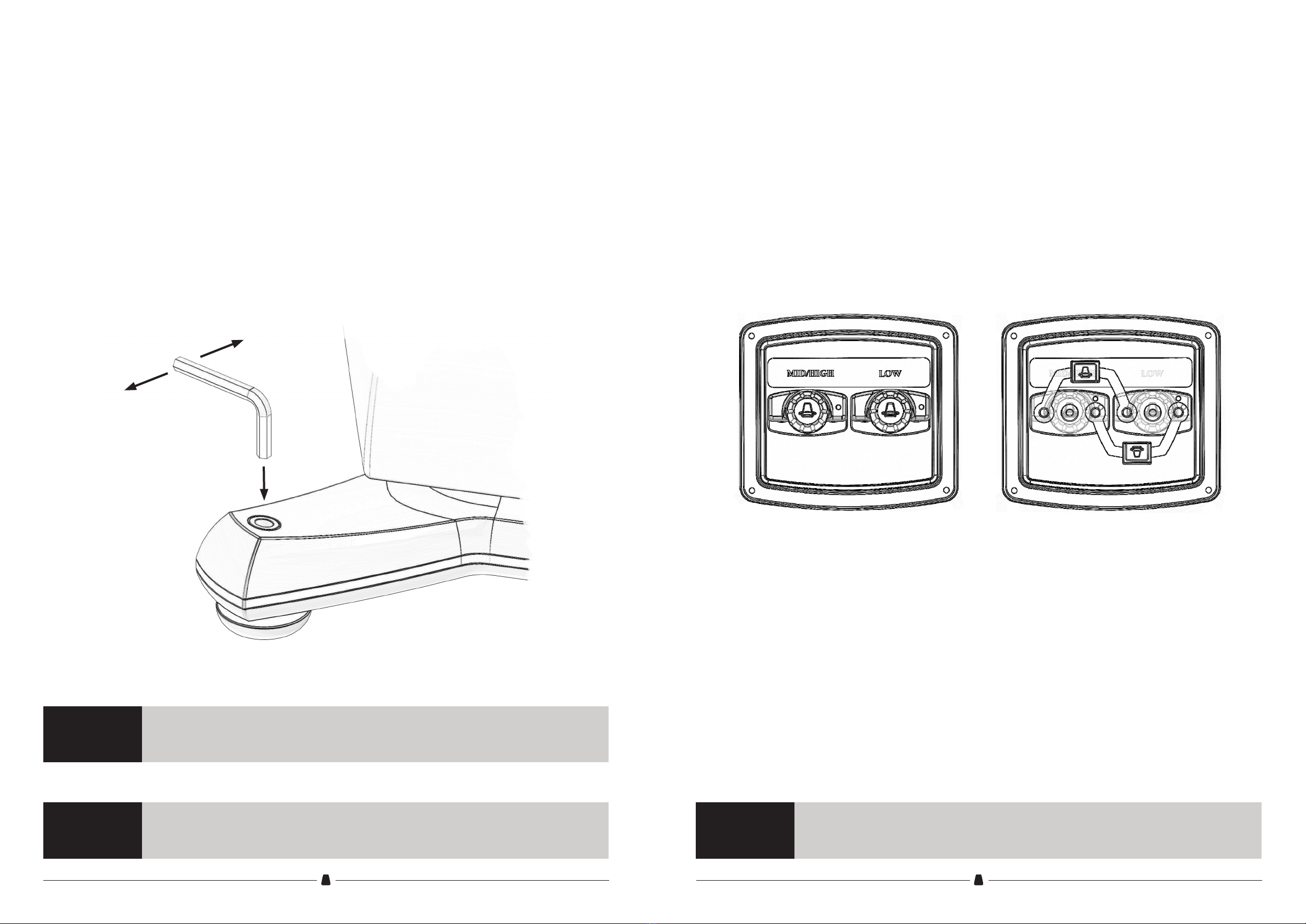
It is easier to carry out room changes before installing the
cone feet which thread into the base.
Many have found the best room position to be along an
undraped longer wall, with the loudspeakers as far apart
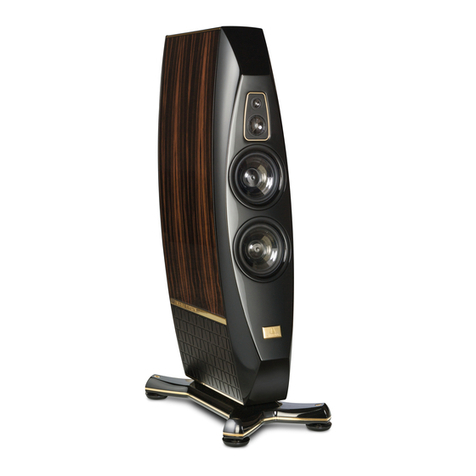
as the listener is for them. The stand under your Enigma
Veyron loudspeaker can be adjusted so that the speaker
will not “rock” as you push it from side to side.
POSITIONING YOUR SPEAKERS
13
Advice on cabling
Mixing different types and/or lengths of speaker cable can
upset the precise timing and balance of your speaker.
We recommend use of our own Kharma Enigma Veyron
pure silver-gold loudspeaker cable for maximum result.
It’s important to connect your speakers in phase, which
means that the drivers are moving in and out in the same
direction and at the same time, in order to obtain the
best localization of instruments and voices as well as the
deepest, most natural bass.
Advice on amplifier
Your Engima Veyron loudspeaker is a high-performance
system, using ultra high quality drivers. Like all loud-
speakers they will reproduce distortion as well as music.
Therefore the choice of other audio components is critical
and should be made with care. When a speaker system
is as revealing as your Engima Veyron loudspeaker is,
musical colorations and other forms of distortion become
more noticeable because these aberrations are no longer
masked by the speaker.
We recommend using an amplifier with sufficient power,
typically a minimum of 50 Watt. Better use a high-power
amplifier instead of an underpowered amplifier that can
cause driver damage due to clipping distortion. This kind
of damage is considered and will not be covered under
warranty.
Use common sense
If you hear distortion or loud “cracking” sounds, the
amplifier or loudspeaker is being overdriven, turn the
volume down immediately.
Burn-in
Your Enigma Veyron loudspeaker system needs quite
a bit of playing time to reach maximum result. The use
of a Burn-in test-CD is recommended to speed up this
process. With a “burn-in” test CD, burn-in time is reduced
to approximately 50 hours. After burning-in your system,
you can play demagnetizing tracks for maximum clarity.
Your system will then be optimized and sound more open,
more detailed and display more natural musical warmth.
USING YOUR KHARMA SPEAKERS