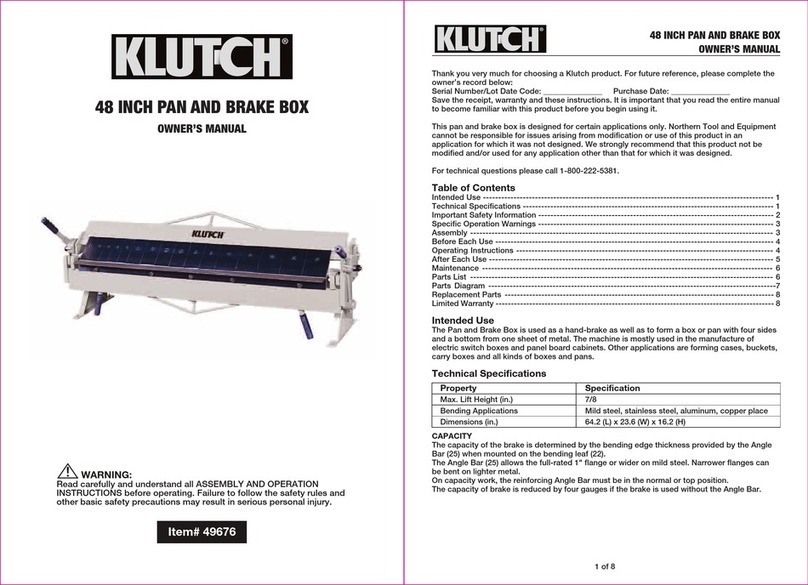
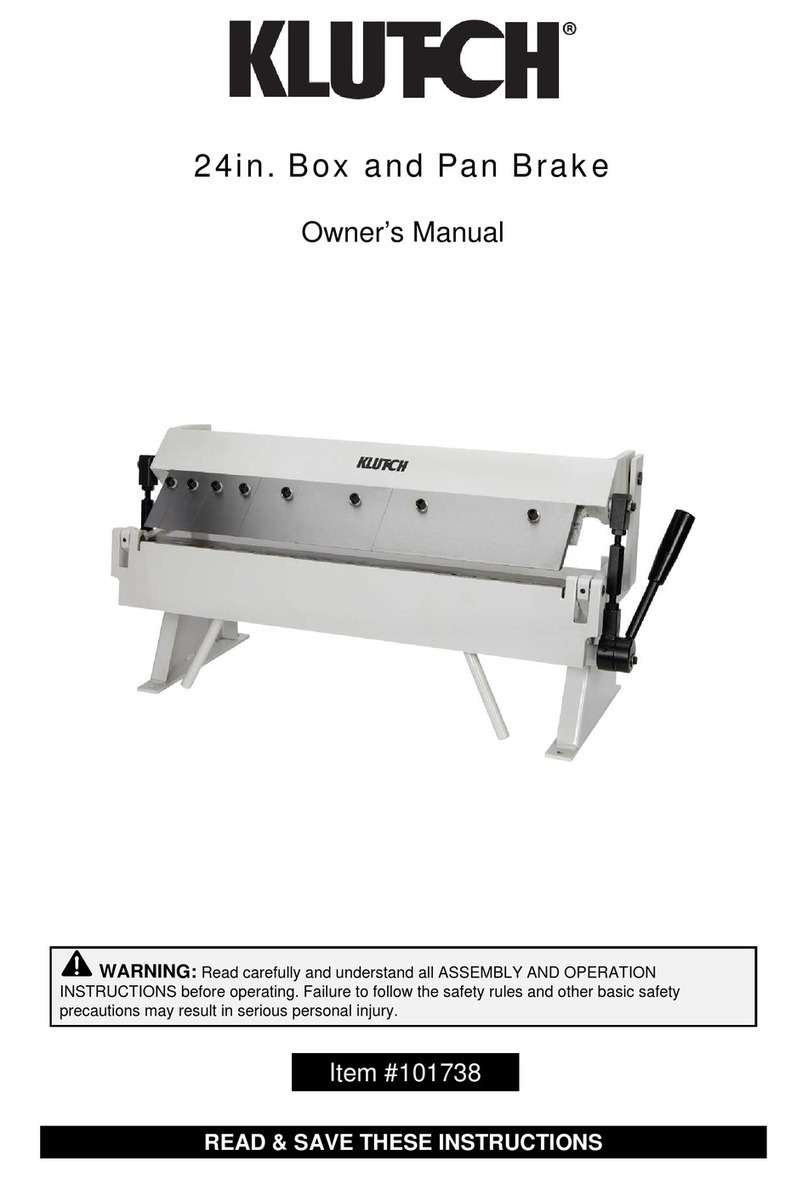
30in. Brake
OWNER’S MANUAL
30in. Brake
OWNER’S MANUAL
• Use the right tool for the job. DO NOT attempt to force small equipment to do the work of
larger industrial equipment. There are certain applications for which this equipment was
designed. It will do the job better and more safely at the capacity for which it was intended.
DO NOT use this equipment for a purpose for which it was not intended.
• Industrial or commercial applications must follow OSHA requirements.
WARNING:
• This product may contain chemicals known to the State of California to cause cancer, birth
defects or other reproductive harm.
WARNING:
WORK AREA SAFETY
• Inspect the work area before each use. Keep work area clean, dry, free of clutter, and well lit.
Cluttered, wet, or dark work areas can result in injury. Using the tool in confined work areas
may put you dangerously close to other cutting tools and rotating parts.
• Do not use the tool where there is a risk of causing a fire or an explosion; e.g., in the
presence of flammable liquids, gases, or dust. The tool can create sparks, which may ignite
the dust or fumes.
• Do not allow the tool to come into contact with an electrical source. The tool is not insulated
and contact will cause electrical shock.
• Keep children and bystanders away from the work area while operating the tool. Do not
allow children to handle the tool.
• Be aware of all power lines, electrical circuits, water pipes, and other mechanical hazards in
your work area. Some of these hazards may be below the work surface hidden from your
view and may cause personal harm or property damage if unintentionally contacted.
PERSONAL SAFETY
• Stay alert, watch what you are doing, and use common sense when operating the tool. Do
not use the tool while you are tired or under the influence of drugs, alcohol, or medication. A
moment of inattention while operating the tool may result in serious personal injury.
• Dress properly. Do not wear loose clothing, dangling objects, or jewelry. Keep your hair,
clothing and gloves away from moving parts. Loose clothes, jewelry, or long hair can be
caught in moving parts. Air vents on the tool often cover moving parts and should be
avoided.
• Use safety apparel and equipment. Use ANSI-Z 87.1 compliant safety goggles or safety
glasses with side shields, or when needed, a face shield. Use a dust mask in dusty work
conditions. Also use non-skid safety shoes, hardhat, gloves, dust collection systems, and
hearing protection when appropriate. This applies to all persons in the work area.
• Do not overreach. Keep proper footing and balance at all times.
• Secure the work with clamps or a vise instead of your hand when practical. This safety
precaution allows for proper tool operation using both hands.
CAUTION:
TOOL USE AND CARE
• Do not force the tool. Tools do a better and safer job when used in the manner for which they
are designed. Plan your work, and use the correct tool for the job.
• Check for damaged parts before each use. Carefully check that the tool will operate properly
and perform its intended function. Replace damaged or worn parts immediately. Never
operate the tool with a damaged part.
• Store the tool when it is not in use. Store it in a dry, secure place out of the reach of children.
Inspect the tool for good working condition prior to storage and before re-use.
• Use only accessories that are recommended by the manufacturer for use with your tool.
Accessories that may be suitable for one tool may create a risk of injury when used with
another tool. Never use an accessory that has a lower operating speed or operating pressure
than the tool itself.
• Keep guards in place and in working order. Never operate the product without the guards in place.
• Do not leave the tool running unattended.
Specific Operation Warnings
WARNING:
• Pinch point hazard. Keep hands clear of roller.
• Do not exceed the maximum bending capacity.
Assembly
The 30in. Bending Brake requires some minor assembly as described below. Please refer to the
parts diagram and the parts list shown below when reading this instruction.
1. The Stand (#1) should be secured to a work bench using the mounting holes and 4 bolts
(3/8in. diameter).
2. Each Handle Ball (#7) should be attached to the Handle Lever (#6) and the Levers should be
placed into the Pins (#5).
Operating Instructions
1. To use the Bending Brake, lower the Handle Lever until the Moving Plate is parallel to the
work bench. Position the material to be bent on the Supporting Plate (#2) and the moving
Plate and properly align with the edge to be bent up against the back edge of the Supporting
Plate.
2. Place and secure the Pressing Plate (#3) on top of the Supporting Plate with the back edge of
Pressing Plate aligned with back edge of Supporting Plate.
3. Raise the two Handle Levers to bend the material to the desired angle.
4. When the Bending Brake is not in use, it should be covered and stored in a dry location.
Maintenance
Maintain your tool. It is recommended that the general condition of any tool be examined before
it is used. Keep your tool in good repair by adopting a program of conscientious repair and
maintenance in accordance with the recommended procedures found in this manual. Keep all
cutting tools sharp and clean. Properly maintained cutting tools with sharp cutting edges are
less likely to bind and are easier to control. Keep handles dry, clean, and free from oil and
grease.
2 of 4 3 of 4