Lemon Telemetry Instructions 10-Feb-16 5
Additional Information
Detailed'information'about'the'Lemon'Telemetry'Unit'
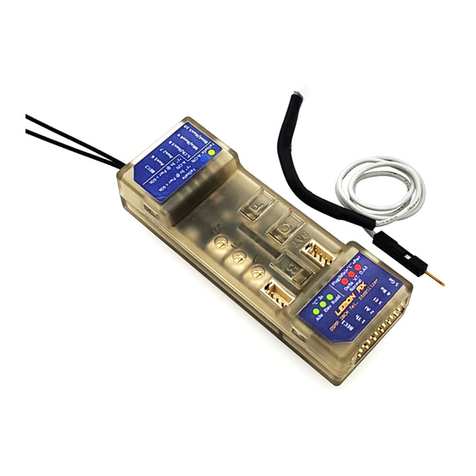
The Lemon Telemetry unit is not a copy of anything made by Spektrum, but an original design that
conforms to the Spektrum data transmission protocol and the DSM2/DSMX radio protocols.
The Lemon unit differs from the Spektrum TM1000 2telemetry unit; both in construction and in the way it
provides certain data. Most obvious is that there is no display of the Fields H and F (Holds and Frame
loss), nor are there packet loss indicators for the four possible receivers: A, B, L and R. These features
are unique to Spektrum systems. In their place Lemon provide a general “Signal Indicator”, displayed in
the “A” field that provides roughly similar data on the strength and reliability of the radio link.
The unit is significantly smaller than the Spektrum one and about half the weight. It operates over an input
voltage range of 3.45 to 7.2v. (Despite the “5.5V max” written on the label.)
Specifics'
The Lemon Telemetry unit uses an ATmega 88PA microprocessor and a 2.4Ghz transmitter to send data
signals to your transmitter. It synchronizes with the receiver via the bind connector so that it cannot
interfere with the radio control link. It reads the receiver voltage and the number of data packets
successfully arriving at the receiver, combines those with its own data from sensors, and sends the whole
lot to be displayed on the transmitter telemetry screen. Without any additional sensors it will display
receiver voltage (RxV), signal indicator (A), accurate height above ground level (Alt), and the internal
temperature of the unit (Temp).
The unit is supplied with two plug-in sensors. The first is an accurate external temperature probe, which
automatically replaces the internal temperature when connected and can be used to monitor LiPo pack or
ESC temperature in flight.
The external temperature sensor also includes a sensor wire for measuring RPM from one of the motor
wires. Before using the RPM function, please review its limitations, as discussed on page 7.
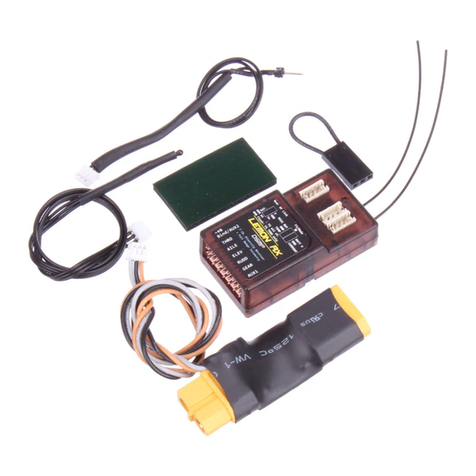
The second plug-in sensor (available with either Deans-style T-connectors or XT60 connectors) measures
flight power pack current and voltage. The instantaneous readings are displayed on screen in the Amps
and Volts fields. In addition, on Spektrum transmitters that provide a PowerBox display, the cumulative
number of mAh drawn from the flight pack and the pack voltage at higher resolution are displayed. The
displays may vary depending on the fields chosen in Telemetry Setup in the transmitter menu and on the
capability of the transmitter itself (for example, the DX6 and DX7s do not display PowerBox).
The telemetry unit works with any Lemon DSM2 or DSMX protocol receiver that has bind connector pins.
This includes the 7-channel Stabilizer, as well as the 6-channel DSMX protocol compatible receiver, the
10-channel DSM2 protocol compatible receiver and most others. Various Spektrum and Orange receivers
have also been tested and found to work with the Lemon unit. Lemon also states that their satellites are
plug-compatible with Spektrum, but it is sensible to test the correct operation of receivers and satellites of
different brands.
The connection lead plugs into the data socket of the Lemon Telemetry unit (labeled “To Receiver Bind”)
and the bind port of the receiver, just as the Spektrum TM1000 unit does. A Y-cable can be used on the
bind pins of a Lemon stabilizer if that connector is also used for Aux2; the telemetry unit will not interfere
with the Aux2 output.
2Spektrum also make a limited range TM1100 unit without an X-BUS port but the TM1000 is the closest comparable one to
the Lemon.