8
dc2042af
DEMO MANUAL DC2042A
APPLICATION INFORMATION
JUMPER FUNCTIONS
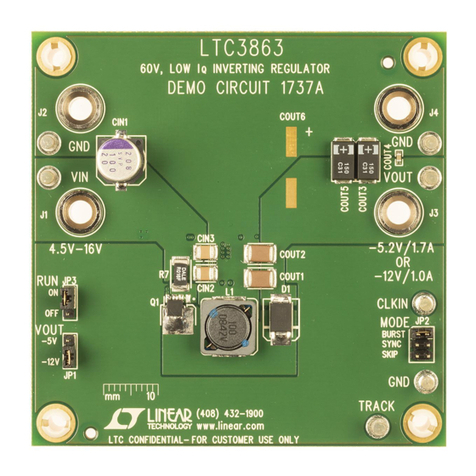
JP1: Powerselection jumperusedtoselect theLTC3588-1,
piezoelectric energy harvesting power supply.
JP2: Power selection jumper used to select the LTC3108,
TEG-powered energy harvester.
JP3: Power selection jumper used to select the LTC3105,
powered by a diode voltage drop in a 4mA to 20mA loop.
JP4: Power selection jumper used to select the LTC3459,
powered by a solar panel
JP5: Routes the LTC3588-1 PGOOD signal to the Dust
HeaderPGOODoutput.TheLTC3588-1PGOOD comparator
produces a logic high referenced to VOUT on the PGOOD
pin the first time the converter reaches the sleep threshold
of the programmed VOUT, signaling that the output is in
regulation. The PGOOD pin will remain high until VOUT
falls to 92% of the desired regulation voltage. Addition-
ally, if PGOOD is high and VIN falls below the UVLO falling
threshold, PGOOD will remain high until VOUT falls to 92%
of the desired regulation point. This allows output energy
to be used even if the input is lost.
JP6: Routes the LTC3108 PGOOD signal to the Dust
Header PGOOD output.
JP7: Routes the LTC3105 PGOOD signal to the Dust
Header PGOOD output.
JP8: Routes the LTC3459 PGOOD signal to the Dust
Header PGOOD output.
JP9: Connects the fifteen optional energy storage capaci-
tors directly to VOUT (VSUPPLY of the Dust Header) to be
used by the load to store energy at the output voltage level.
The 100μF capacitors have a voltage coefficient of 0.61
of their labeled value at 3.3V and 0.47 at 5.25V. Caution:
Only JP9 or JP10 may be connected at any one time.
Do not populate both JP9 AND JP10.
JP10: Connects the fifteen optional energy storage ca-
pacitors directly to VSTORE of the LTC3108 TEG-powered
energy harvester circuit, which is the output for the Stor-
age capacitor or battery. A large capacitor may be con-
nected from VSTORE to GND for powering the system in
the event the input voltage is lost. It will be charged up
to the maximum VAUX clamp voltage, typically 5.25V.
The 100µF capacitors have a voltage coefficient of 0.47
at 5.25V. Caution: Only JP9 or JP10 may be connected
at any one time. Do not populate both JP9 and JP10.
Note: For this board to properly interface with a Dust
Mote (DC9003A-B) or aManager (DC9003A-A) board and
switch the power from the battery to the energy harvest-
ing source, resistor R3 on the Dust Mote board must be
changed to 750kΩ and R4 must be changed to 5.1MΩ.
TURRET FUNCTIONS
PZ1 (E1): Input connection for piezoelectric element or
other AC source (used in conjunction with PZ2). A high
impedance DC source may be applied between this pin
and BGND to power the LTC3588-1 circuit. Caution:The
maximum current into this pin is 50mA.
PZ2 (E2): Input connection for piezoelectric element or
other AC source (used in conjunction with PZ1). A high
impedance DC source may be applied between this pin
and BGND to power the LTC3588-1 circuit. Caution: The
maximum current into this pin is 50mA.
VIN, 20mV to 400mV (E3): Input to the LTC3108, TEG-
powered energy harvester. The input impedance of the
LTC3108 power circuit is approximately 3Ω, so the source
impedance of the TEG should be less than 10Ω to have
good power transfer. TEGs with approximately 3Ω will
have the best power transfer. The input voltage range is
20mV to 400mV.
BGND (E4, E6, E8, E11, E14): This is the board ground.
BGND is connected to all the circuits on the board except
the headers. BGND and HGND, the header ground, are
connected through Q3 when the VMCU voltage with
respect to BGND reaches the rising RESET threshold of
U2 and disconnected when VMCU falls to the falling reset
threshold. The board is configured from the factory to
connect BGND and HGND when VMCU equals 3.15V and
disconnect them when VMCU equals 2.25V.
+VIN, 4mA to 20mA Loop (E5): Input to the LTC3105
supplied by a diode voltage drop. The current into this
terminal must be limited to between 4mA and 20mA. The
current into this turret flows through diode D1 to gener-
ate the diode voltage drop and into the LTC3105 power
management circuit.