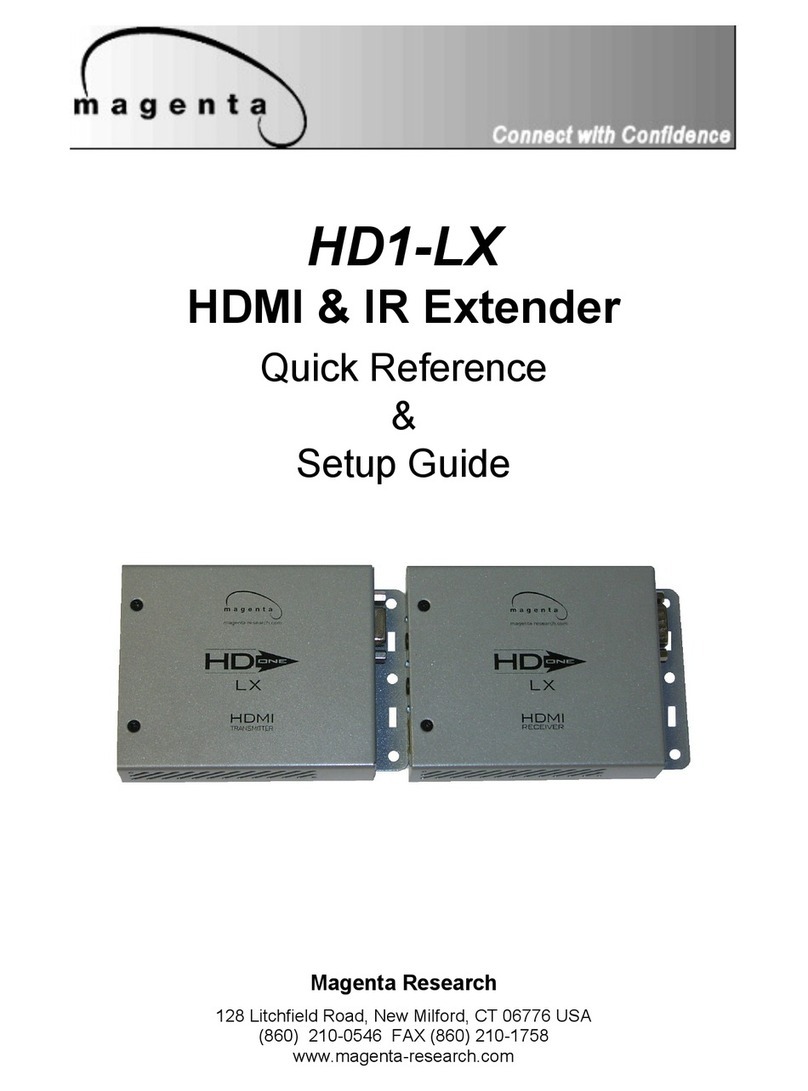
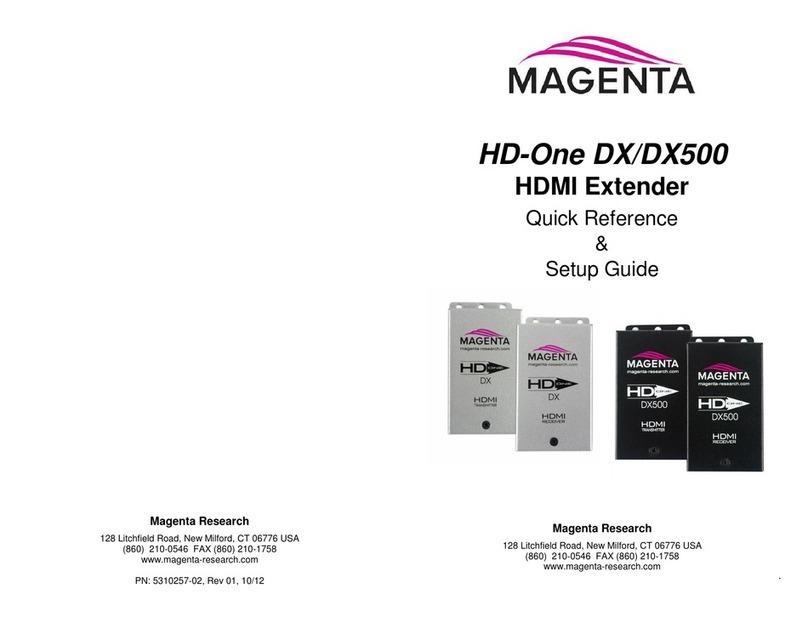
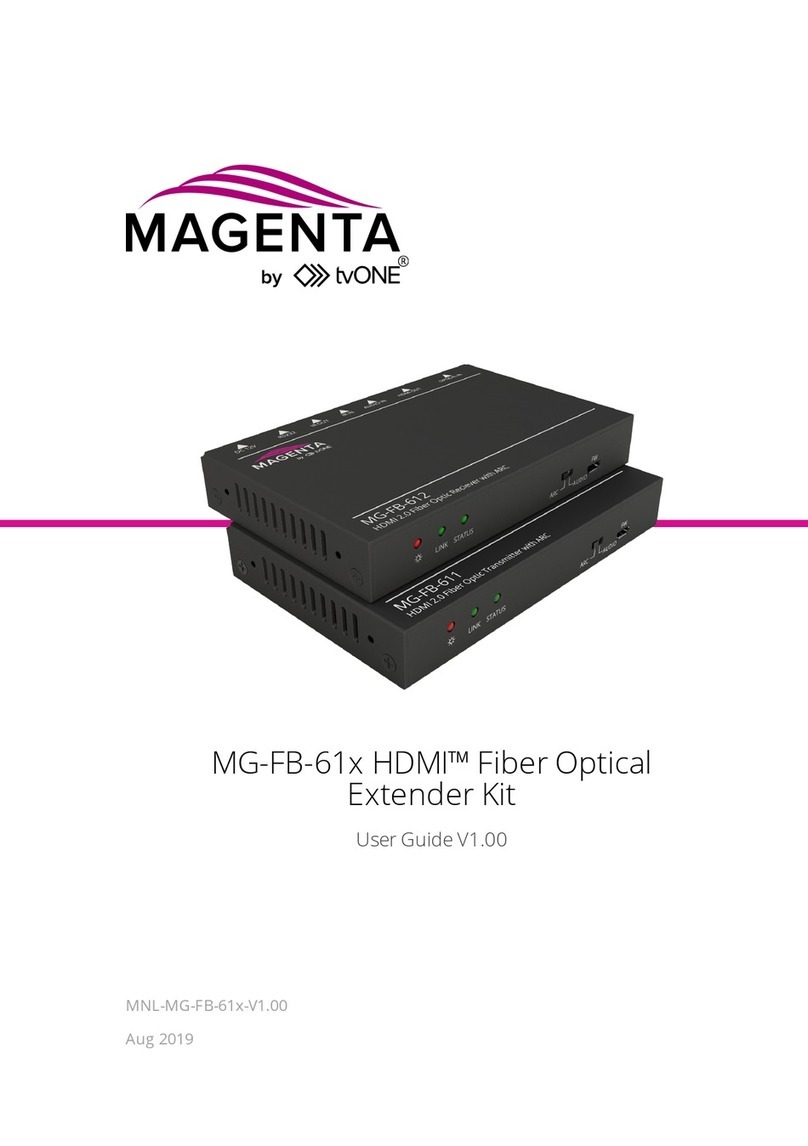
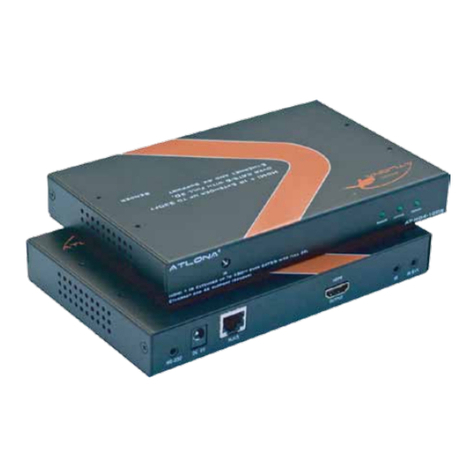
MAGENTA HD-ONE LX/LX500 HDMI, SERIAL & IR EXTENDER
Contents
Chapter Page
1. Specifications...................................................................................................2
2. Introduction ........................................….........................................................3
2.1 Overview................................................................................….................3
2.2 Equipment You May Also Need..........................................................…....3
2.3 Compatible Cabling ........................................................................…...….3
3. Setup and Installation.......................................… ......................................….4
3.1 Cabling Considerations...............................................................................4
3.2 Making the Connections.....................................................................…....5
3.2.1 Connections and Setup in General .......................................……......5
3.2.2 Connections on the Transmitter and Receiver…..............………..…..5
4. Troubleshooting...........................................................................................…6
4.1 Common Problems ....................................................................................6
Appendix A. Cabling Pinouts.........................................….....................................6
© 2012 by Magenta Research All rights reserved.
Magenta Research
128 Litchfield Rd
New Milford, CT. 06776 USA
This document and the Magenta Research products to which it relates, and the copyright in each, is the
property of Magenta Research. Neither the document nor the products may be reproduced by any
means, in whole or in part, without the prior written permission of Magenta Research. Magenta Research
makes no warranty or representation, either express or implied, with respect to this software or
documentation, including their quality, performance, merchantability, or fitness for a particular purpose.
As a result, this software or documentation are licensed "as is" and you, the licensee, are assuming the
entire risk as to their quality and performance.
In no event will Magenta Research be liable for direct, indirect, special, incidental, or consequential
damages arising out of the use of or inability to use the software or documentation.
Magenta Research and the Magenta Research logo are trademarks of Magenta Research.
All other brands, product names, and trademarks are the property of their respective owners
1
.CHAPTER 4: Troubleshooting
4. Troubleshooting
4.1 Common Problems
Most issues with the HD-One LX/LX500 Series can be resolved by checking the
Category cable terminations and ensuring that they are pinned to the T568B wiring
specification. However, other problems may arise. Below are solutions to the most
common issues:
Problem:
No video.
Solution:
• Check that both units are powered.
• Power units in the sequence noted in section 3.2.1.
• Ensure the Category cable is terminated to the T568B wiring standard.
• Some HDMI sources can take up to 5 minutes to initialize and will
not output video signals during this time.
• Cell phones may cause interference at close range and cause
the video to be interrupted or lost. All devices may need to be
power cycled if video is lost.
• If using protected content, ensure all connected devices are HDCP
compliant.
• Ensure the maximum distance has not been exceeded.
• Other troubleshooting tips include trying a better quality Category
cable, disabling deep color at the source and reducing the resolution.
Problem:
Poor video quality.
Solution:
• Ensure the Category cable is terminated to the T568B wiring standard.
• Check for faulty or poor quality HDMI cables.
• Ensure the display is compatible with the source.
• Other troubleshooting tips include using an alternative source and
reducing the resolution.
Appendix A. Cabling Pinouts
MAGENTA HD-ONE LX/LX500 HDMI, SERIAL & IR EXTENDER
5
3.2.2 C
ONNECTIONS ON THE
HD-One LX/LX500
Figure 3-1 shows the HD-One LX/LX500 transmitter connections, and Figure 3-2
shows the HD-One LX/LX500 receiver connections.
Figure 3-1. Connections on the Transmitter
Figure 3-2. Connections on the Receiver
Figure 3-3. LED Status Indicators
UTP Output HDMI Input
IR Emitter
IR Receiver
Power RS-232
UTP Input HDMI Output
IR Emitter
IR Receiver
Power RS-232
Power Indicator
ON = Power present
IR TX Indicator
FLASHING = IR Emitter activity
Data Link Indicator
ON = UTP link present
IR RX Indicator
FLASHING = IR Receiver activity
Video Status Indicator
ON = HDMI content w/HDCP present
BLINKING = HDMI content w/o HDCP present
.
1.Specifications
Required Cable: CAT5e, CAT6, CAT6a, CAT6e, Cat7 UTP / STP or FTP
(CAT6 or better is recommended)
Video Support: HDMI 1.4, HDCP Compliant
DVI Video modes
Maximum WUXGA (1920x1200) @ 60 Hz**
Resolution and 100 meter (328 feet) for LX**
Distance: 152 meters (500 feet) for LX500**
Bandwidth: 3.4 Gbps
Serial Baud rate: Up to 115200 bps; Full Duplex
IR Support: 36.7, 38.0, or 56.8 kHz modulated emitter output;
Bi-directional
Connectors: Tx: (1) HDMI type A, (1) RJ-45, (1) DC power
(1) DB9F, (2) 3.5mm-jack
Rx: (1) HDMI type A, (1) RJ-45, (1) DC power
(1) DB9F, (2) 3.5mm-jack
Temperature Operating: 32 to 131°F (0 to 55°C);
Tolerance: Storage: -4 to +185°F (-20 to 85°C)
Humidity
Tolerance: Up to 95% noncondensing
Enclosure: Metal
Power: +5 VDC @ 2.6 A max each unit
Consumption: Tx: 600mA
Rx: 1200mA
Size: 5.1” x 3.5” x 1.2” (130mm x 88 mm x 30mm)
Weight: 0.6 lbs. (280 g)
Compliance: RoHS, CE, FCC Class A
**NOTE: To achieve maximum resolution and/or distance, Magenta strongly
recommends the use of standard network CAT6 or better cable with solid 24 AWG
copper wire. The use of lower quality cables will lower overall performance. Please
contact Magenta for cable recommendations.
Specifications
2
MAGENTA HD-ONE LX/LX500 HDMI, SERIAL & IR EXTENDER
Contents
Chapter Page
1. Specifications...................................................................................................2
2. Introduction ........................................….........................................................3
2.1 Overview................................................................................….................3
2.2 Equipment You May Also Need..........................................................…....3
2.3 Compatible Cabling ........................................................................…...….3
3. Setup and Installation.......................................… ......................................….4
3.1 Cabling Considerations...............................................................................4
3.2 Making the Connections.....................................................................…....5
3.2.1 Connections and Setup in General .......................................……......5
3.2.2 Connections on the Transmitter and Receiver…..............………..…..5
4. Troubleshooting...........................................................................................…6
4.1 Common Problems ....................................................................................6
Appendix A. Cabling Pinouts.........................................….....................................6
© 2012 by Magenta Research All rights reserved.
Magenta Research
128 Litchfield Rd
New Milford, CT. 06776 USA
This document and the Magenta Research products to which it relates, and the copyright in each, is the
property of Magenta Research. Neither the document nor the products may be reproduced by any
means, in whole or in part, without the prior written permission of Magenta Research. Magenta Research
makes no warranty or representation, either express or implied, with respect to this software or
documentation, including their quality, performance, merchantability, or fitness for a particular purpose.
As a result, this software or documentation are licensed "as is" and you, the licensee, are assuming the
entire risk as to their quality and performance.
In no event will Magenta Research be liable for direct, indirect, special, incidental, or consequential
damages arising out of the use of or inability to use the software or documentation.
Magenta Research and the Magenta Research logo are trademarks of Magenta Research.
All other brands, product names, and trademarks are the property of their respective owners
1
.CHAPTER 4: Troubleshooting
6
4. Troubleshooting
4.1 Common Problems
Most issues with the HD-One LX/LX500 Series can be resolved by checking the
Category cable terminations and ensuring that they are pinned to the T568B wiring
specification. However, other problems may arise. Below are solutions to the most
common issues:
Problem:
No video.
Solution:
• Check that both units are powered.
• Power units in the sequence noted in section 3.2.1.
• Ensure the Category cable is terminated to the T568B wiring standard.
• Some HDMI sources can take up to 5 minutes to initialize and will
not output video signals during this time.
• Cell phones may cause interference at close range and cause
the video to be interrupted or lost. All devices may need to be
power cycled if video is lost.
• If using protected content, ensure all connected devices are HDCP
compliant.
• Ensure the maximum distance has not been exceeded.
• Other troubleshooting tips include trying a better quality Category
cable, disabling deep color at the source and reducing the resolution.
Problem:
Poor video quality.
Solution:
• Ensure the Category cable is terminated to the T568B wiring standard.
• Check for faulty or poor quality HDMI cables.
• Ensure the display is compatible with the source.
• Other troubleshooting tips include using an alternative source and
reducing the resolution.
Appendix A. Cabling Pinouts
MAGENTA HD-ONE LX/LX500 HDMI, SERIAL & IR EXTENDER
5
3.2.2 C
ONNECTIONS ON THE
HD-One LX/LX500
Figure 3-1 shows the HD-One LX/LX500 transmitter connections, and Figure 3-2
shows the HD-One LX/LX500 receiver connections.
Figure 3-1. Connections on the Transmitter
Figure 3-2. Connections on the Receiver
Figure 3-3. LED Status Indicators
UTP Output HDMI Input
IR Emitter
IR Receiver
Power RS-232
UTP Input HDMI Output
IR Emitter
IR Receiver
Power RS-232
Power Indicator
ON = Power present
IR TX Indicator
FLASHING = IR Emitter activity
Data Link Indicator
ON = UTP link present
IR RX Indicator
FLASHING = IR Receiver activity
Video Status Indicator
ON = HDMI content w/HDCP present
BLINKING = HDMI content w/o HDCP present
.
1.Specifications
Required Cable: CAT5e, CAT6, CAT6a, CAT6e, Cat7 UTP / STP or FTP
(CAT6 or better is recommended)
Video Support: HDMI 1.4, HDCP Compliant
DVI Video modes
Maximum WUXGA (1920x1200) @ 60 Hz**
Resolution and 100 meter (328 feet) for LX**
Distance: 152 meters (500 feet) for LX500**
Bandwidth: 3.4 Gbps
Serial Baud rate: Up to 115200 bps; Full Duplex
IR Support: 36.7, 38.0, or 56.8 kHz modulated emitter output;
Bi-directional
Connectors: Tx: (1) HDMI type A, (1) RJ-45, (1) DC power
(1) DB9F, (2) 3.5mm-jack
Rx: (1) HDMI type A, (1) RJ-45, (1) DC power
(1) DB9F, (2) 3.5mm-jack
Temperature Operating: 32 to 131°F (0 to 55°C);
Tolerance: Storage: -4 to +185°F (-20 to 85°C)
Humidity
Tolerance: Up to 95% noncondensing
Enclosure: Metal
Power: +5 VDC @ 2.6 A max each unit
Consumption: Tx: 600mA
Rx: 1200mA
Size: 5.1” x 3.5” x 1.2” (130mm x 88 mm x 30mm)
Weight: 0.6 lbs. (280 g)
Compliance: RoHS, CE, FCC Class A
**NOTE: To achieve maximum resolution and/or distance, Magenta strongly
recommends the use of standard network CAT6 or better cable with solid 24 AWG
copper wire. The use of lower quality cables will lower overall performance. Please
contact Magenta for cable recommendations.
Specifications
2
MAGENTA HD-ONE LX/LX500 HDMI, SERIAL & IR EXTENDER
Contents
Chapter Page
1. Specifications...................................................................................................2
2. Introduction ........................................….........................................................3
2.1 Overview................................................................................….................3
2.2 Equipment You May Also Need..........................................................…....3
2.3 Compatible Cabling ........................................................................…...….3
3. Setup and Installation.......................................… ......................................….4
3.1 Cabling Considerations...............................................................................4
3.2 Making the Connections.....................................................................…....5
3.2.1 Connections and Setup in General .......................................……......5
3.2.2 Connections on the Transmitter and Receiver…..............………..…..5
4. Troubleshooting...........................................................................................…6
4.1 Common Problems ....................................................................................6
Appendix A. Cabling Pinouts.........................................….....................................6
© 2012 by Magenta Research All rights reserved.
Magenta Research
128 Litchfield Rd
New Milford, CT. 06776 USA
This document and the Magenta Research products to which it relates, and the copyright in each, is the
property of Magenta Research. Neither the document nor the products may be reproduced by any
means, in whole or in part, without the prior written permission of Magenta Research. Magenta Research
makes no warranty or representation, either express or implied, with respect to this software or
documentation, including their quality, performance, merchantability, or fitness for a particular purpose.
As a result, this software or documentation are licensed "as is" and you, the licensee, are assuming the
entire risk as to their quality and performance.
In no event will Magenta Research be liable for direct, indirect, special, incidental, or consequential
damages arising out of the use of or inability to use the software or documentation.
Magenta Research and the Magenta Research logo are trademarks of Magenta Research.
All other brands, product names, and trademarks are the property of their respective owners
1
.CHAPTER 4: Troubleshooting
6
4. Troubleshooting
4.1 Common Problems
Most issues with the HD-One LX/LX500 Series can be resolved by checking the
Category cable terminations and ensuring that they are pinned to the T568B wiring
specification. However, other problems may arise. Below are solutions to the most
common issues:
Problem:
No video.
Solution:
• Check that both units are powered.
• Power units in the sequence noted in section 3.2.1.
• Ensure the Category cable is terminated to the T568B wiring standard.
• Some HDMI sources can take up to 5 minutes to initialize and will
not output video signals during this time.
• Cell phones may cause interference at close range and cause
the video to be interrupted or lost. All devices may need to be
power cycled if video is lost.
• If using protected content, ensure all connected devices are HDCP
compliant.
• Ensure the maximum distance has not been exceeded.
• Other troubleshooting tips include trying a better quality Category
cable, disabling deep color at the source and reducing the resolution.
Problem:
Poor video quality.
Solution:
• Ensure the Category cable is terminated to the T568B wiring standard.
• Check for faulty or poor quality HDMI cables.
• Ensure the display is compatible with the source.
• Other troubleshooting tips include using an alternative source and
reducing the resolution.
Appendix A. Cabling Pinouts
MAGENTA HD-ONE LX/LX500 HDMI, SERIAL & IR EXTENDER
5
3.2.2 C
ONNECTIONS ON THE
HD-One LX/LX500
Figure 3-1 shows the HD-One LX/LX500 transmitter connections, and Figure 3-2
shows the HD-One LX/LX500 receiver connections.
Figure 3-1. Connections on the Transmitter
Figure 3-2. Connections on the Receiver
Figure 3-3. LED Status Indicators
UTP Output HDMI Input
IR Emitter
IR Receiver
Power RS-232
UTP Input HDMI Output
IR Emitter
IR Receiver
Power RS-232
Power Indicator
ON = Power present
IR TX Indicator
FLASHING = IR Emitter activity
Data Link Indicator
ON = UTP link present
IR RX Indicator
FLASHING = IR Receiver activity
Video Status Indicator
ON = HDMI content w/HDCP present
BLINKING = HDMI content w/o HDCP present
.
1.Specifications
Required Cable: CAT5e, CAT6, CAT6a, CAT6e, Cat7 UTP / STP or FTP
(CAT6 or better is recommended)
Video Support: HDMI 1.4, HDCP Compliant
DVI Video modes
Maximum WUXGA (1920x1200) @ 60 Hz**
Resolution and 100 meter (328 feet) for LX**
Distance: 152 meters (500 feet) for LX500**
Bandwidth: 3.4 Gbps
Serial Baud rate: Up to 115200 bps; Full Duplex
IR Support: 36.7, 38.0, or 56.8 kHz modulated emitter output;
Bi-directional
Connectors: Tx: (1) HDMI type A, (1) RJ-45, (1) DC power
(1) DB9F, (2) 3.5mm-jack
Rx: (1) HDMI type A, (1) RJ-45, (1) DC power
(1) DB9F, (2) 3.5mm-jack
Temperature Operating: 32 to 131°F (0 to 55°C);
Tolerance: Storage: -4 to +185°F (-20 to 85°C)
Humidity
Tolerance: Up to 95% noncondensing
Enclosure: Metal
Power: +5 VDC @ 2.6 A max each unit
Consumption: Tx: 600mA
Rx: 1200mA
Size: 5.1” x 3.5” x 1.2” (130mm x 88 mm x 30mm)
Weight: 0.6 lbs. (280 g)
Compliance: RoHS, CE, FCC Class A
**NOTE: To achieve maximum resolution and/or distance, Magenta strongly
recommends the use of standard network CAT6 or better cable with solid 24 AWG
copper wire. The use of lower quality cables will lower overall performance. Please
contact Magenta for cable recommendations.
Specifications
2