manuals.online logo
Brands
  1. Home
  2. •
  3. Brands
  4. •
  5. Matsushita Electric
  6. •
  7. Measuring Instrument
  8. •
  9. Matsushita Electric NATIONAL RQ-152S User manual

Matsushita Electric NATIONAL RQ-152S User manual

Other manuals for NATIONAL RQ-152S

1

Other Matsushita Electric Measuring Instrument manuals

Matsushita Electric NATIONAL RQ-152S User manual

Matsushita Electric

Matsushita Electric NATIONAL RQ-152S User manual

Matsushita Electric NATIONAL RQ-158S User manual

Matsushita Electric

Matsushita Electric NATIONAL RQ-158S User manual

Popular Measuring Instrument manuals by other brands

Powerfix Profi 278296 Operation and safety notes

Powerfix Profi

Powerfix Profi 278296 Operation and safety notes

Test Equipment Depot GVT-427B user manual

Test Equipment Depot

Test Equipment Depot GVT-427B user manual

Fieldpiece ACH Operator's manual

Fieldpiece

Fieldpiece ACH Operator's manual

FLYSURFER VIRON3 user manual

FLYSURFER

FLYSURFER VIRON3 user manual

GMW TG uni 1 operating manual

GMW

GMW TG uni 1 operating manual

Downeaster Wind & Weather Medallion Series instruction manual

Downeaster

Downeaster Wind & Weather Medallion Series instruction manual

Hanna Instruments HI96725C instruction manual

Hanna Instruments

Hanna Instruments HI96725C instruction manual

Nokeval KMR260 quick guide

Nokeval

Nokeval KMR260 quick guide

HOKUYO AUTOMATIC UBG-05LN instruction manual

HOKUYO AUTOMATIC

HOKUYO AUTOMATIC UBG-05LN instruction manual

Fluke 96000 Series Operator's manual

Fluke

Fluke 96000 Series Operator's manual

Test Products International SP565 user manual

Test Products International

Test Products International SP565 user manual

General Sleep Zmachine Insight+ DT-200 Service manual

General Sleep

General Sleep Zmachine Insight+ DT-200 Service manual

Sensa Core Lacto Spark user manual

Sensa Core

Sensa Core Lacto Spark user manual

VOLTCRAFT UTS-1980 operating instructions

VOLTCRAFT

VOLTCRAFT UTS-1980 operating instructions

EBCHQ 94915 Operation manual

EBCHQ

EBCHQ 94915 Operation manual

Balluff BIP LD2-T017-01-EP-S4 Series user guide

Balluff

Balluff BIP LD2-T017-01-EP-S4 Series user guide

Pulsar IMP Lite Series instruction manual

Pulsar

Pulsar IMP Lite Series instruction manual

ETCR 6800 user manual

ETCR

ETCR 6800 user manual

manuals.online logo
manuals.online logoBrands
  • About & Mission
  • Contact us
  • Privacy Policy
  • Terms and Conditions

Copyright 2025 Manuals.Online. All Rights Reserved.

NATIONAL
TAPE
RECORDER
SERVICE
MANUAL
Sea
ase
ae
eae
rGsicat
a
eee
7
MODEL
RQ-152S8
A.C D.C
2
SOURCE
TAPE
RECORDER
CONTENTS
SPECIFICATIONS:
a2c2.roseen
tcc
cnien
crnets:
asaen
eure
coi
ae
uatinentscensnouresenmnsaeisess
PARTS
LOCATION
xtacsesecces
cess
cconsesremensents
usa
saescncenenemslansinminamedetesn
cc
BLOCK
DIAGRAM
OF
ELECTRICAL
CIRCUITS
........-.eeeeesee
eee
eee
eee
eee
eee
ees
DISASSEMBLY]
INSTRUCTION)
sizccses-tecssnnssccunomcesscrecenonsienemmecenesses
se
MECHANICAL
OPERATING
CONTROLG.............::ccecee
eee
eeecee
tence
eens
nee
een
ens
TAPE
TRANSPORT
OPERATION:
eticcescuss.crcore
esuacioscsssnsesanascinrenecencnss
MECHANICAL
ADJUSTMENTS)
ann.
socacsceces
cnsscsnaneccstearereesentctinecererssr
anes
AMPLIFIER
ADJUSTMENTS
05.4
-ler-ciscenessssaciymossuesncnoscacmemnseoreenrtaiaecois:
TROUBLE
“SHOOTING:
GUIDE.
-.cca-crens
ccc
ceeanenceacanesbecaeaeuemenenenceneanee
REPLACEMENT
PARES
LISI
c2ec.c5iee.s2-c:csesecscnsn
ssasseennece
sss
seeeeamee
ree
stese
CIRCUIT
ABOARD
wees
ecco
secrecccanesancecnicea
ee
aanssea:
a
cslgansosusow
anacus
vseeeeviemmaines
GABINEN:
PARTSic-ceececaescct
strcess
ete
n
eace
sec
acenunia
swan
gscueee-manecienare
sevietsesen
EXPLODED
VIEWS:
ccc
csececee
us
otaecer
cnteeu
neice
ace
cacosameeesuie
mana
ara
euenmeneencsees
WIRING
CONNECTION
DIAGRAM
.............:.sccccnseeeeseeeeeeee
tea
eeeoeeecesunens
SCHEMATIG
‘CIRCUIT
DIAGRAM)
cizs.ae
ese
sosceccecac
ties
Sos
coca
ectonecen
estes
oecsien’
ELECTRICAL
PARTS:
LOCATION
sisecnt
siocivcseccesasesa.n
se
oceeecmemeceneneecenneess
AGGESSORIES),
Secccneseesooace
to
semencectsceeuns
sens
cates
ceniccatecieueunagiscsscee
COMPONENTEPAGKING
sxe
tosses
eens
tte
eens
enere
te
ememnae
se
colecetaaetar
ers
MATSUSHITA
ELECTRIC
JAPAN

Supply
Reel
Operating
Lever
Counter
Reset
Button
Index
Counter
V.U
Meter
Record
Button
Fast
Forward
Button
SPECIFICATIONS
Power
Source:
Audio
Output:
Transistors:
Recording
System:
Erasure
System:
Track
System:
Monitor
Systen:
Tape
Speeds:
Frequency
Response:
Input
Impedance:
Output
Impedance:
Playing
Time:
Battery
Life:
Recording
Level
Indicator:
Built-in
Speaker:
Dimensions:
Weight:
PARTS
LOCATION
Volume
Control
Knob
Tone
Control
and
Monitor
Switch
Knob
A.C.
or
Battery
Powered
A.C.
110V,
220V
Battery
9V
6
Batteries
700
mW
(1W
maximum)
2SB-173(1)
2SB-175(2)
A.C.
Bias
35
K
Cycles
D.C.
Erase
2
Track
System
Sound
Monitor
System
3-3/4
i.p.s.
and
1-7/8
i.p.s.
100~7,000
c/s
at
3-3/4i.p.s.
100~4,000c/s
at
1-7/8i.p.s.
Microphone
20
KQ
Auxiliary
“RADIO”
100
KQ
Extension
Speaker
Jack
“EXT.SP”
8
1
hour
at
3-3/4
i.p.s.
with
5”
Tape
(600
ft)
2
hour
at
1-7/8i.p.s.
with
5”
Tape
(600
ft)
More
than
30
hours
(using
NATIONAL
“‘Hi-Top”
Batteries)
V.U
Meter
3-5/8”
Dynamic
Speaker
11-3/4”
(W)
x
10”
(D)
x
3-1/2”
(H)
6-3/4
Ibs.
without
Butteries
2SB-178(2)
2SB-172(1)
Takeup
Reel
Capstan
Rest
Capstan
External
Speaker
Output
Jack
Radio
Jack
Microphone
&
Remote
Control
Jack
BLOCK
DIAGRAM
OF
ELECTRICAL
CIRCUITS
RECORDING
CIRCUIT
MONITOR
Sound
Monitor
SW.
SPEAKER
Negative
Feedback
Feedback
Devel
Control
irs
re
Lote
2SB-175
2SB-173
2SB-175
Output
~~
Transformer
Tr5
Transformer
2SB-178
“B”
Transistor
Tr6
Power
Source
2SB-172
Erase
A.C
Power
Source
PLAYBACK
CIRCUIT
Negative
Feedback
Tr4
Equalization
Tone
Control
MONITOR
©
Volume
Playback
Control
Head
SPEAKER
Tri
r
2SB-173
2SB-175
*
Input
Out
put
Transformer
Trd5
Transformer
2SB-178
A.C
Power
Source
“B”
Transistor
Power
Source
L.------Q
DISASSEMBLY
INSTRUCTIONS
BOTTOM
COVER
A.C
Power
Cord
Compurtment
Cover
Battery
Compartment
Cover
1.
Turn
the
set
upside
down.
2.
Undo
the
fixing
screws
3
pcs.
(A)
of
the
Bottom
Cover
and
the
fixing
screws
2
pcs.
(B)
inside
of
the
Battery
Case.
3.
If
it
is
lifted
from
the
hinge
side,
the
Bottom
Cover
can
be
removed.
Note:
Attention
must
be
paid
to
lead
wire
from
Battery.
MAIN
CABINET
BODY
CASE
Headcover
Ds
Sleeve
3-3/4
i.p.s.
COUNTER
‘cool
Operating
Lever
1.
Remove
the
operating
Lever
and
the
capstan
sleeve
3-3/4
i.p.s.
2.
Remove
the
Bottom
Cover.
.
Undo
chassis
fixing
screws
6
pcs.
(C).
4.
Ho!d
the
Flywheel
of
chassis,
and
pull
it
up
slopewise
from
Reel
Table
side.
Ww
Note:
Attention
must
be
paid
to
lead
wire
from
speaker.
MOTOR
Position
of
Indentifying
Mark
8
|
.
Remove
the
Motor
Spring
from
the
Motor.
.
Remove
the
3
Motor
Lead
wires
(Yellow,
Red
and
Blue.)
.
Remove
2
screws
(D)
holding
Motor
Holder.
.
In
doing
so
mark
the
original
position
of
the
Holder
first.
When
replacing
the
Motor,
fit
it
to
the
position
marked
When
removing
the
old
Motor,
then
test
the
tape
speed.
BWNEH
FLYWHEEL
(5)
Paper
Washer
1.
Remove
Paper
Washer
and
Stop
Ring
on
the
Flywheel
Shaft(Capstan).
Takeup
Reel
Table
Takeup
Belt
Guide
Pulley-A
2.
Remove
the
Rubber
Belt
from
the
Guide
Pulley-A.
(E)
Sub
Base
Plate
:
<r
@e
@
AL
ae
:
oy
\u
ol
pS
SS
‘|
ce
|
PS
oe
Clutch
Lever
Spring
Catch
Lever
Spring
3.
Remove
the
Catch
Lever
Spring
and
the
Clutch
Lever
Spring.
4.
Remove
the
3
screws
(E)
holding
the
Sub
Base
Plate.
oO
.
Remove
the
Sub
Base
Plate.
6.
Pull
the
Flywheel
upward.
When
replacing
the
Flywheel,
always
install
new
Flywheel.
Thrust
Ball
and
Paper
Washers
on
the
Flywheel
Shaft
Flywheel
Thrust
Ball
MECHANICAL
OPERATING
CONTROLS
SINGLE
LEVER
CONTROL
All
electrical
and
mechanical
functions
are
performed
by
the
single,
4
position
Operating
Lever.
The
batteries
are
disconnected
in
the
STOP
position.
a
Turning
the
Operating
Lever
counter-clockwise
to
the
PLAYBACK
position
switches
the
Amplifier
ON
and
actuates
the
tape
transport
mechanism
to
properly
Playback
a
recorded
tape.
.
Turning
the
Operating
Lever
counter-clockwise
to
the
REWIND
position
switches
the
Amplifier
OFF
and
actuates
the
mechanism
to
cause
transport
of
the
tape
onto
the
supply
reel.
.
Pressing
the
Record/Lock
Button
and
turning
the
Operating
Lever
to
RECORD
actuates
the
tape
transport
mechanism
and
switches
the
electrical
circuits,
to
enable
the
signal
from
the
microphone
to
be
recorded.
Record/Lock
Button
is
a
safety
locking
device
to
prevent
accidental
erasure.
.
Volume
Control
is
used
to
adjust
the
recording
level
and
volume
of
the
reproduced
sound.
It
is
not
connected
to
the
Power
Switch.
.
V.U-
Meter/Battery
Voltmeter
functions
as
a
dual
purpose
meter.
With
the
Operating
Lever
in
the
RECORD
position,
the
meter
functions
as
a
V.U
Meter
and
indicates
the
recording
level.
In
the
PLAYBACK
position,
the
meter
functions
as
a
Voltmeter
and
measures
the
Voltage
output
of
the
batteries.
.
The
Model
RQ-152S
is
equipped
with
a
self-contained
AC
power
supply
and
a
unique
relay
circuit
which
allows
automatic
switching
from
AC
to
Battery
power
and
vica-versa.
S4
is
the
AC
to
Battery
switch
contacts
and
normally
is
in
the
Battery
position.
When
AC
power
is
applied,
S4
contacts
are
switched
to
the
AC
position
by
the
Relay.
TAPE
TRANSPORT
OPERATION
PLAYBACK
(Takeup
Reel
Reel
Table)
Guide
Pulley(L
Guide
Pulley(S))
Pinch
Roller
Lever
an)
Clutch
Lever
(
¢
am
Plate
Supply
Reel
Table
Rubber
of
Belt
Return
Stopper
Lever
Rewind
Belt
Rewind
Pulley
)—.
Sub_F.F.Lever
When
the
operator
is
adjusted
to
playback
condition
by
turning
the
Operating
Lever,
the
following
movements
occur
at
one
time
to
feed
tape
at
a
constant
speed
for
obtaining playback.
1.
Clutch
Lever
acts,
power
source
is
switched
on,
Motor
Lifter
is
freed
from
suppression,
Motor
is
pressed
on
Flywheel,
and
motor
rotation
is
transmitted
to
Flywheel.
2.
Rotation
transmitted
to
Flywheel
turns
Takeup
Reel
Table
by
Takeup
Belt
and
Sub
Takeup
Belt.
3.
Pinch
Roller
Lever
acts
and
makes
Pinch
Roller
stuck
to
Capstan
Shaft.
With
rotation
of
Capastan
Shaft
which
is
conjointly
shaft
of
Flywheel,
Pinch
Roller
is
rotated
to
feed
tape
at
a
constant
speed.
4
Pinch
Roller
Lever
moves
pad
arm
and
Pinch
pad
to
Head.
5.
Pinch
Roller
Lever
moves
Sub
F.F.
Lever
and
F.F.
Roller
Lever,
and
separates
F.F.
Roller
from
Takeup
Reel
Teble.
6.
Rewind
Lever
is
actuated,
Rewind
Pulley
is
separated
from
Flywheel,
and
playback
circuit
is
switched
on.
7.
Sub
Clutch
Lever
operates,
moves
Belt
Return
Stopper
Lever
and
separates
rubber
of
Belt
Return
Stopper
Lever
from
Supply
Reel
Teble.
8.
Catch
Lever
operates
and
fixes
operator.
RECORD
{Oca
Cam)
eens
|
Recording
(Record
Button
ee
)
Cl
Recording
Lever
Recording
Cam
Push
the
Button
for
recording,
turn
the
Operating
Lever,
and
adjust
the
operator
to
recording
position.
Then,
same
operations
as
in
playback
begin
simultaneously
and
tape
is
fed
at
a
constant
speed.
At
the
same
time,
Recording
Lever
is
moved
with
Recording
Cam,
Slide
Switch
is
actuated,
electric
circuit
is
changed
over
to
recording
condition,
and
thus
recording
is
obtained.
FAST
FORWARD
Guide
Pulley
L_)
(E-F-Rolter)
F.F.Roller
Lever
Guide
Pulley
(S)
Takeup
Reel
Table
Friction
Pulley:
FF.
Pulley
(Sub
Takeup
Belt)
Belt
Y
—
(Takeun
Belt)
—.
(ier
Pulley
(Fivwheet)
>
Gutch
Lever)
{Clutch
Lever)
(Cam
Plate)
Takeup
Reel
Table
=n
F.F.Roller
eal
Sub
Takeup
Belt
Friction
Pulley
Push
the
F.F.
Button,
turn
the
operating
Lever,
and
adjust
the
operator
to
Fast
Forward
condition.
Then
the
following
operations
begin
simultaneously
for
F.F.
of
tape.
1.
Clutch
Lever
operates,
power
source
is
switched
on,
Motor
Lifter
is
freed
from
suppression,
Motor
is
pressed
on
Flywheel
and
motor
rotation
is
transmitted
to
Fly
wheel.
2.
Rotation
transmitted
to
Flywheel
turns
Friction
Pulley
under
Takeup
Reel
Table
by
Belt,
the
rotation
is
transmitted
to
F.F.
Roller
and
its
rotation
to
F.F.
Pulley.
As
F.F.
Pulley
is
fixed
at
Takeup
Reel
Table,
the
Reel
Table
quickly
rotates.
3.
Sub
Clutch
Lever
operates,
moves
Beit
Return
Stopper
Lever,
and
separates
Rubber
of
Belt
Return
Stopper
Lever
from
Supply
Reel
Table.
4.
Catch
Lever
works
and
fixes
operator.
REWIND
Rewind
Belt
Supply
Reel
Table
Rewind
Pulley
(Rewind
Lever
Takeup
Lever
Clutch
Lever
Takeup
Reel
Table
(ub
Clutch
Lever
Flywheel
(Takeup
Lever)
Catch
Lever
"(Cam
Plate)
Turn
the
Operating
Lever
for
putting
the
operator
to
rewinding
condition.
Then
the
following
operations
simultaneously
occur,
and
the
tape
is
quickly
rewound.
1.
Catch
Lever
operates,
power
source
is
switched
on,
Motor
Lifter
is
freed
from
suppression,
Motor
is
pressed
on
Flywheel,
and
Motor
rotation
is
transmitted
to
Fly
wheel.
2.
Rotation
transmitted
to
Flywheel
is
further
transmitted
to
Rewind
Pulley
which
is
pressed
on
Flywheel,
and
Supply
Reel
Table
is
turned
to
rewinding
direction
by
Rewind
Belt.
3.
Takeup
Lever
operates,
separates
Sub
Takeup
Lever,
F.F.
Roller
Lever
and
push
F.F.
Roller
from
Takeup
Reel
Teble,
putting
the
Takeup
Reel
Table
in
freed
condition.
4.
Sub
Clutch
Lever
operates,
moves
Belt
Return
Stopper
Lever,
and
separates
Rubber
of
Belt
Return
Stopper
from
Supply
Reel
Teble.
5.
Catch
Lever
operates
and
fixes
operator.
STOP
Supply
Reel
Table
F.F
Roller
Lever
Belt
Return
Stopper
Lever
(Takeup
Reel
Table
—
(Sub
Takeup
Belt)
Rewind
Belt)
~
:
aa
_—
(idler
Pulley)
(Rewind
Pulley’.
4
\
:
Takeup
Belt)
=F
Whee)
Rewind
Lever).
:
Sub
Clutch
Lever\
~
Spring
Sub
Clutch
Lever
(
Pinch
Rollet
Motor
Lifter
Sub
F.F.Lever)
Pinch
Roller
___Spring/
:
Takeup
Lever
\
Sprin,
(
Ll
Soe
)
4)
~
(Chutch
Lever
Spring
<=
(Catch
Lever
Spring)
(FF
Lever)
Pinch
Roller
Lever_
=
——
(Catch Lever)
(Rewind
Lever
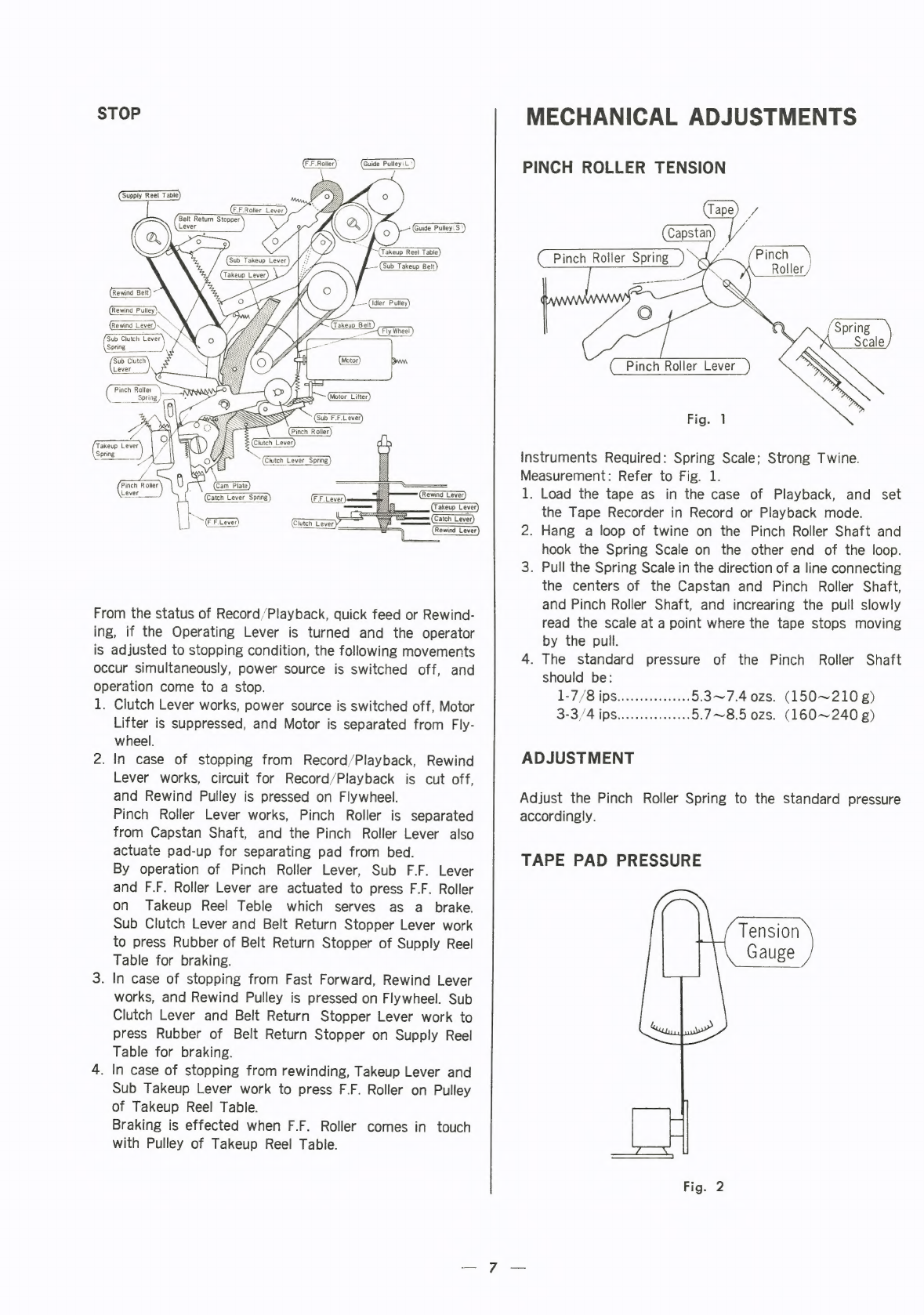
From
the
status
of
Record/Playback,
quick
feed
or
Rewind-
ing,
if
the
Operating
Lever
is
turned
and
the
operator
is
adjusted
to
stopping
condition,
the
following
movements
occur
simultaneously,
power
source
is
switched
off,
and
operation
come
to
a
stop.
1.
Clutch
Lever
works,
power
source
is
switched
off,
Motor
Lifter
is
suppressed,
and
Motor
is
separated
from
Fly-
wheel.
2.
In
case
of
stopping
from
Record/Playback,
Rewind
Lever
works,
circuit
for
Record/Playback
is
cut
off,
and
Rewind
Pulley
is
pressed
on
Flywheel.
Pinch
Roller
Lever
works,
Pinch
Roller
is
separated
from
Capstan
Shaft,
and
the
Pinch
Roller
Lever
also
actuate
pad-up
for
separating
pad
from
bed.
By
operation
of
Pinch
Roller
Lever,
Sub
F.F.
Lever
and
F.F.
Roller
Lever
are
actuated
to
press
F.F.
Roller
on
Takeup
Reel
Teble
which
serves
as
a_
brake.
Sub
Clutch
Lever
and
Belt
Return
Stopper
Lever
work
to
press
Rubber
of
Belt
Return
Stopper
of
Supply
Reel
Table
for
braking.
3.
In
case
of
stopping
from
Fast
Forward,
Rewind
Lever
works,
and
Rewind
Pulley
is
pressed
on
Flywheel.
Sub
Clutch
Lever
and
Belt
Return
Stopper
Lever
work
to
press
Rubber
of
Belt
Return
Stopper
on
Supply
Reel
Table
for
braking.
4.
In
case
of
stopping
from
rewinding,
Takeup
Lever
and
Sub
Takeup
Lever
work
to
press
F.F.
Roller
on
Pulley
of
Takeup
Reel
Table.
Braking
is
effected
when
F.F.
Roller
comes
in
touch
with
Pulley
of
Takeup
Reel
Table.
MECHANICAL
ADJUSTMENTS
PINCH
ROLLER
TENSION
Pinch
\
Roller
/
Pinch
Roller
Lever
Fig:
1
Instruments
Required:
Spring
Scale;
Strong
Twine.
Measurement:
Refer
to
Fig.
1.
1.
Load
the
tape
as
in
the
case
of
Playback,
and
set
the
Tape
Recorder
in
Record
or
Playback
mode.
2.
Hang
a
loop
of
twine
on
the
Pinch
Roller
Shaft
and
hook
the
Spring
Scale
on
the
other
end
of
the
loop.
3.
Pull
the
Spring
Scale
in
the
direction
of
a
line
connecting
the
centers
of
the
Capstan
and
Pinch
Roller
Shaft,
and
Pinch
Roller
Shaft,
and
increaring
the
pull
slowly
read
the
scale
at
a
point
where
the
tape
stops
moving
by
the
pull.
4.
The
standard
pressure
of
the
Pinch
Roller
Shaft
should
be:
Ve
7/BADS
was
sctesseacces
5.3~7.40zs.
(150~210
g)
323)
4iIDSiseccseonneee
5.7~8.5
0zs.
(160~240
g)
ADJUSTMENT
Adjust
the
Pinch
Roller
Spring
to
the
standard
pressure
accordingly.
TAPE
PAD
PRESSURE
Tension
Gauge
Fig.
2
Tension
Gauge
Fig.
3
Instrument
Required:
Tention
Gauge
Measurement:
Refer
to
Fig.
2.
and
3.
1.
Set
the
Tape
Recorder
in
Playback
mode
without
loading
the
tape.
2.
Hook
the
Tension
Gauge
on
the
Tape
Pad
for
the
Record/Playback
Head
at
the
center
and
lightly
pull
the
gauge
so
that
the
pad
parts
from
the
head.
Take
the
reading
just
at
the
point
where
the
pad
parts
from
the
head.
3.
The
standard
pressure
of
the
pad
for
the
Record/
Playback
Head
should
be:
0.2~0.5
ozs.
(6~14
g)
ADJUSTMENT
Adjust
the
Tape
Pad
Arm
Spring
to
the
standard
pressure.
WINDING
TORQUE
FOR
PLAYBACK
AND
FAST
FORWARD
LTape”
—
et
Flywheel)
7
Tape)
(Pressure
Roller
{|
oe
-.
—
pia
=
a
‘Tension
(Splicing
Tape)
A
(~
Gauge
Fig.
4
Instruments
Required:
Tension
Gauge;
Splicing
Tape
Measurement:
Refer
to
Fig.
4.
1.
Make
a
loop
of
the
tape
(5”
reel)
end,
fasten
the
looped
end
with
the
splicing
tape,
and
put
the
reel
on the
Takeup
Reel
Table.
2.
Hook
the
Tension
Gauge
on
the
loop
and
pull
out
6
inches
or
so
of
the
tape
end.
3.
Setin
the
Playback
or
Fast
Forward
mode,
and
pull
the
Tension
Gauge
in
the
direction
of
winding
keeping
the
pace
with
the
moving
tape
until
the
reading
of
the
Tension
Gauge
remains
constant
at
which
point
take
the
reading.
Repeat
this
for
several
times
and
take
the
average
for
a
correct
torque.
4.
The
above
test
should
be
made
with
5”
tape
reel
with
full
load.
5.
The
standard
torque
should
be:
Playbackiscsscsaccen:
0.53~0.7l
ozs.
(15~20g)
Fast
Forward.........
0.71
ozs.
~(20g~)
ADJUSTMENT
Reel
Table
Decorative
Screw
Reel
Table
Spring
Reel
Table)
F.F.Fiber
Washer
Washer
F.F.Pulley
Friction
Washer
Friction
Pulley
Friction
Spring
Friction
Pulley
Nut
Fig.
5
Adjust
the
torque
with
the
Friction
Spring
on
the
Takeup
Reel
Table.
If
the
torque
is
too
strong,
loosen
the
Friction
Spring,
and
if
too
weak
tighten
it.
If
the
Friction
Washer
gets
oily
clean
it
immediately
to
prevent
slip.
If
the
tension
of
the
Takeup
Belt
is
weakened
the
winding
torque
drops.
BACK-TENSION
FOR
PLAYBCK
Fig.
6
Instruments
Required:
Tension
Gauge;
Splicing
Tape
Measurement:
Refer
to
Fig.
6.
1.
Measure
the
back-tension
in
the
manner
similar
to
the
winding
torque
for
Playback,
but
in
this
case
by
pulling
the
tension
gauge
on
the
5”
tape
loaded
on
the
Supply
Reel
Table.
2.
Measure
the
back-tension
for
Playback
with
5”
reel
fully
loaded.
3.
The
standard
back-tension
should
be:
0.05~0.25
ozs.
(1.5~6.5
g)
ADJUSTMENT
Too
strong
back-tension
may
be
caused
by
the
accumu-
lation
of
dust
on
the
turning
parts
of
the
Rewind
Pulley
and
Supply
Reel
Table,
requiring
occasional
cleaning.
Too
weak
back-tension
may
be
due
to
the
weakened
tension
of
the
Rewind
Belt
and
it
should
preferably
be
replaced
then.
MOTOR
SHAFT
PRESSURE
AGAINST
FLYWHEEL
“Motor
‘Spring
}
(Tension
Gauge)
(Flywheel)
Fig.
7
Instrument
Required:
Tension
Gauge
Measurement:
Refer
to
Fig.
7.
1.
Load
the
tape
and
set
the
Tape
Recorder
in
Playback
mode.
Hook
the
Tension
Gauge
on
the
end
of
the
Motor
Spring
attached
to
the
Motor
(see
the
drawing).
2.
Pull
the
Tension
Gauge
opposite
to
the
action
of
the
spring
and
increase
the
pull
until
the
Flywheel
and
the
Motor
Pulley
part
from
each
other
at
which
point
take
the
reading.
The
tape
stops
then.
3.
The
standard
pressure
for
the
Motor:
2.5~3.5
ozs.
(7O~100
g)
ADJUSTMENT
Adjust
the
motor
spring
for
correct
pressure.
HEAD
ADJUSTMENTS
Relative
positions
of
heads
and
tape,
Adjust
the
relative
positions
of
Record/Playback
head
and
Erase
head
as
shown
in
the
drawing.
Improper
relative
positions
of
these
heads
causes
imperfect
erasure
and
cross-talk,
and
the
slightest
displacement
of
the
mounting
may
lead
to
the
lowe
position
of
the
head
in
respect
of
the
tape.
Close
adjustment
is
therefore
necessary.
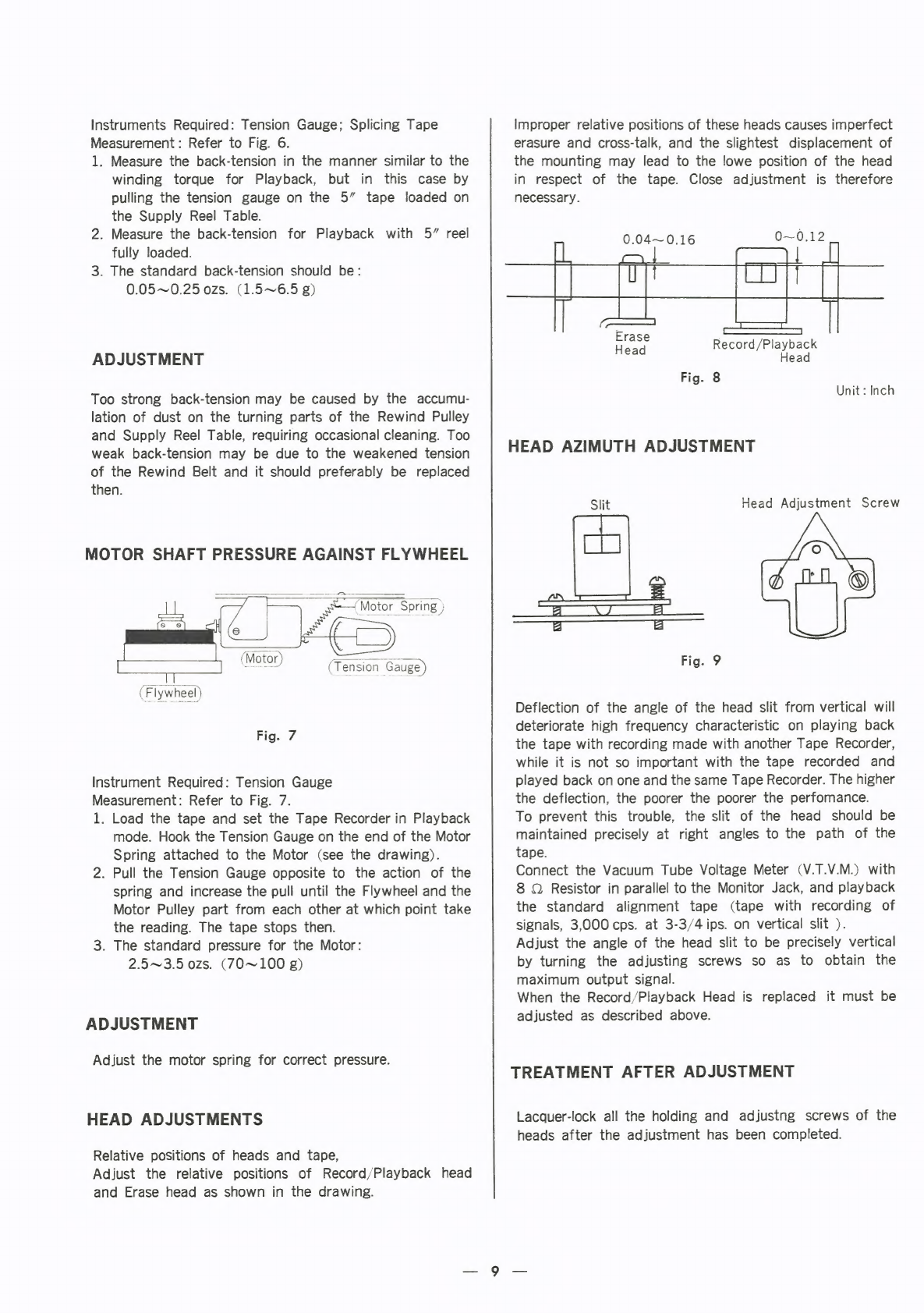
0.04~0.16
0~0.12
Erase
Head
Record/Playback
Head
Fig.
8
Unit:
Inch
HEAD
AZIMUTH
ADJUSTMENT
Slit
Head
Adjustment
Screw
Fig.
9
Deflection
of
the
angle
of
the
head
slit
from
vertical
will
deteriorate
high
frequency
characteristic
on
playing
back
the
tape
with
recording
made
with
another
Tape
Recorder,
while
it
is
not
so
important
with
the
tape
recorded
and
played
back
on
one
and
the
same
Tape
Recorder.
The
higher
the
deflection,
the
poorer
the
poorer
the
perfomance.
To
prevent
this
trouble,
the
slit
of
the
head
should
be
maintained
precisely
at
right
angles
to
the
path
of
the
tape.
Connect
the
Vacuum
Tube
Voltage
Meter
(V.T.V.M.)
with
8
Q
Resistor
in
parallel
to
the
Monitor
Jack,
and
playback
the
standard
alignment
tape
(tape
with
recording
of
signals,
3,000
cps.
at
3-3/4
ips.
on
vertical
slit
).
Adjust
the
angle
of
the
head
slit
to
be
precisely
vertical
by
turning
the
adjusting
screws
so
as
to
obtain
the
maximum
output
signal.
When
the
Record/Playback
Head
is
replaced
it
must
be
adjusted
as
described
above.
TREATMENT
AFTER
ADJUSTMENT
Lacquer-lock
all
the
holding
and
adjustng
screws
of
the
heads
after
the
adjustment
has
been
completed.