MFJ-249D Instruction Manual HF/VHF SWR Analyzer
7
5.0 ADJUSTING SIMPLE ANTENNAS
Most antennas are tuned for operating frequency by varying the element length -- and most homemade verticals and
dipoles are very simple to adjust.
5.1 Dipoles
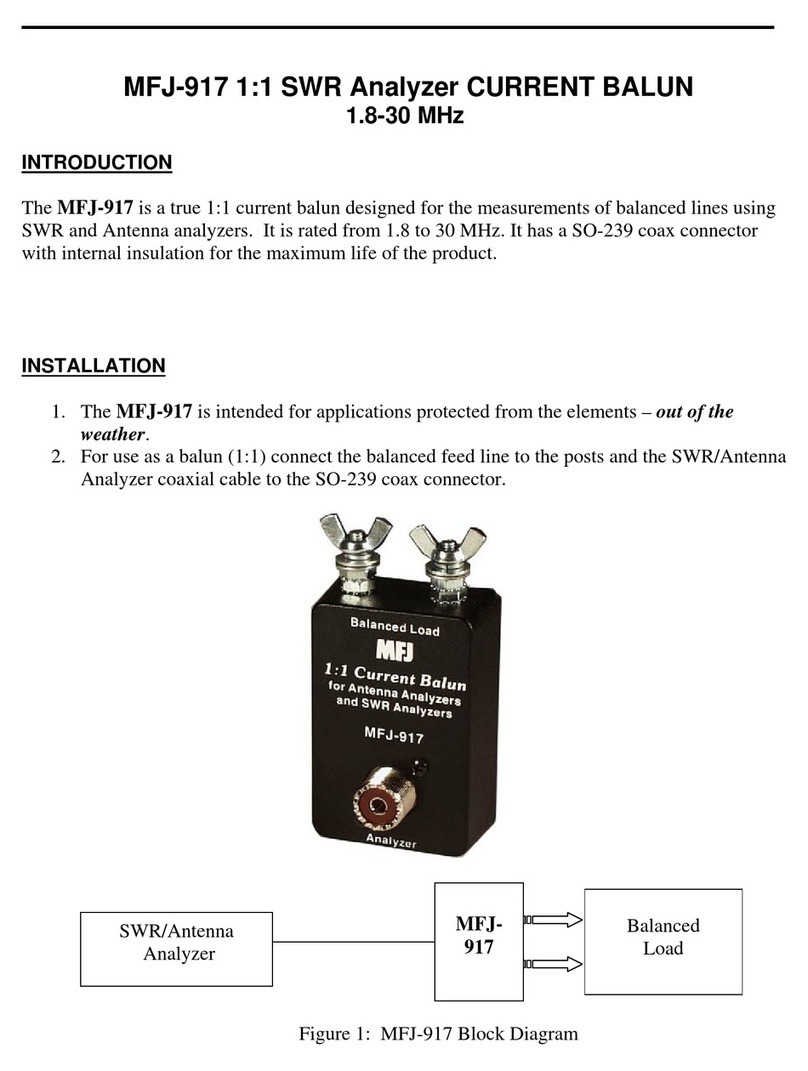
Because the dipole is a balanced antenna, it's always a good idea (and good engineering practice) to install a balun at
the feed point. A balun could be as simple as several turns of coax wrapped several inches in diameter or it could be
a complicated affair with many windings on a ferromagnetic core. A 1:1 Guanella "current" balun wound on a toroid
core made from material with the appropriate permeability is usually the most effective choice.
The height of a dipole above ground, as well as any surrounding objects, will influence the feed point impedance and
SWR. Typical residential heights usually result in minimum SWR readings below 1.5:1 when using 50-ohm coaxial
cable. In general, the only adjustment available for tuning a simple wire dipole is its length. If too long, it resonates
too low in the band. If too short, it resonates high. You may be able to improve the match (SWR) by raising or
lowering the element in relationship to ground. However, doing so may impact other parameters such as the best
take-off angle for distant or local contacts (TOA).
Anytime the antenna impedance and feedline impedance do not precisely match each other (as is usually the case),
the feedline will act like a transformer and modify the Impedance of the load placed at the opposite end. However, if
you use good-quality 50-ohm cable, the SWR should remain constant except for a small reduction caused by resistive
loss as the line is made longer. If changing the coax length by a relatively small amount changes SWR at your test
frequency, the feedline either has common-mode current flowing on the outer surface of the shield that is detuning
the antenna, or the feedline itself is not really 50-ohm cable. Common-mode current caused by conduction typically
occurs when no balun has been installed at the feed point to choke it off. Common-mode induction currents may also
result from other installation errors such as running the feedline parallel rather than perpendicular to the radiating
element. Repositioning the feedline may reduce unwanted inductive coupling.
5.2 Verticals
Verticals in the "monopole" class require a ground plane. To simplify installation and cut costs, manufacturers
sometimes (incorrectly) downplay the importance of an effective radial system. When installed over a good ground,
the impedance of a quarter-wave radiator may be quite low, with SWR running nearly 2:1. Ironically, over a poor
ground, minimum SWR for the same antenna could improve to 1:1. However, if the ground system is poor, antenna
performance will be compromised despite favorable SWR readings. Far better to install the best ground system
possible and configure a matching network at the base of the vertical element to match into a 50-ohm feed system.
Verticals tune the same as dipoles -- add length to lower the operating frequency and shorten to raise it.
Another class of verticals are considered "ground-independent" because they come with a counterpoise or rigid
radial system built into the design. These antennas are usually configured as multiband OCFDs (off-center fed
dipoles) with the longer leg being the dominant vertical radiator. Ground independent verticals tend to work more
efficiently when elevated well above ground rather than when installed in close proximity to it because of reduced
ground losses. Many use multiple resonators or traps and have a matching network at the feed point. Most ground-
independent vertical elements are asymmetrical and require a highly effective baluns to prevent the feedline from
becoming part of the antenna system.
5.3 Tuning a simple antenna
To tune a basic dipole fed with 50-ohm coax, follow the steps outlined below:
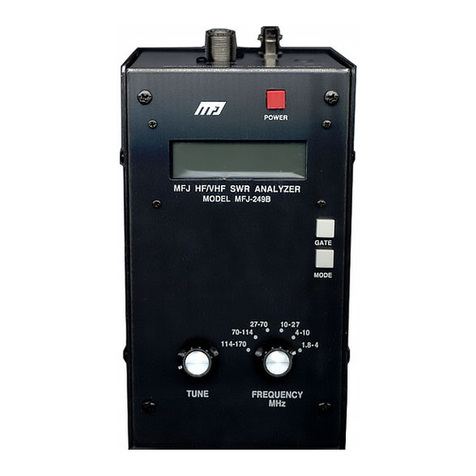
1.) Momentarily short the center conductor and shield to bleed off static, then connect to the Antenna jack.
2.) Set the analyzer's band switches and VFO tuning for the desired band.
3.) Select any analyzer operating mode that will display SWR.
4.) Read the SWR and adjust the VFO tuning for minimum SWR. Write down the frequency.