Milltronics LevelGenie User manual


CONTENTS
SECTION
I
II
III
IV
V
VI
VII
FIG.5b TRANSDUCER DO'S AND DON'TS
FIG. 1
FIG. 2
FIG. 3
FIG. 4
FIG. 5
FIG. 6
FIG. 7
TITLE
GENERAL INFORMATION
SPEICIFCATIONS
THEORY OF OPERATION
INSTALLATION
CALIBRATION AS A:
HI
-
LO ALARM
HI
-
HI ALARM
LO
-
LO ALARM
PUMP CONTROL
MISCELLANEOUS
MAINTENANCE AND OVERHAUL
DRAWINGS
OUTLINE AND MOUNTING DIMENSIONS
TRANSDUCER INSTALLATION
EASILY AVOIDABLE INSTALLATION ERRORS
OUTLINE AND CABLE CONNECTION DIAGRAM
TRANSCEIVER SCHEMATIC
DIGITAL PROCESSING SCHEMATIC
PAGES
l-l
2-1, 2-2
3-1,
3-2,3-3,3-4
4-1,
4-2,4-3
5-1, 5-2,5-3,5-4
5-5
6-l .
7-l
RELAY ACTION

I.
GENERAL INFORMATION
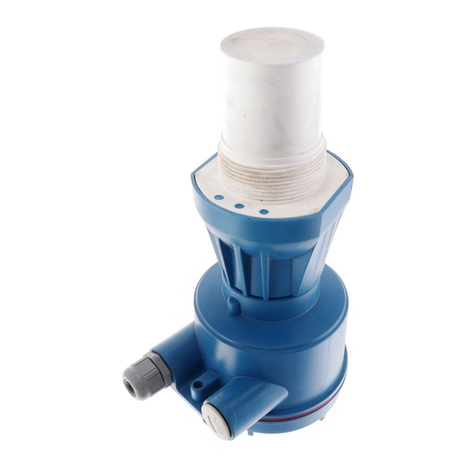
The Milltronics Level Genie Ultrasonic System is an entirely
"Solid State Package",
designed to provide contact closure at
accurately determined levels of liquids and solids up to 10 feet
(3M) from the transducer.
This system consists of only two elements,
ultrasonic transducer and cabineted electronics, neither of which
require contact with the material to be measured.
Seperation be-
tween transducer and electronics may reach 600 feet (183M).
The Level Genie measures the time required for a transmitted
ultrasonic pulse to complete a round trip from the transducer to
the sensed material and back.
This measurement is converted electron-
ically into distance and then compared with the two independently
adjustable set points.
Depending on the programming module employed,
this comparison actuates the output relays whose 10 amp 115 VAC
contacts indicate material level status.
Programming modules,
available in easily changeable plug-in
form,
allow the Level Genie to operate as; an independent high and
low alarm,
as two high alarms,
as two low alarms or as a pump control.
In addition to the normal set point hysterisis, selectable time
delays of 3 or 10 seconds may be introduced via a convenient P.C.B.
mounted switch.
The unique
digital noise rejection circuitry of the Level Genie
allows placement of the electronics in motor control centers and
direct interlocking of primary devices via the contact outputs.
l-l

II.
Power Required
Transducer
Range
output
Set Points
Set Point Hysterisis
Response Time
Time Delay
Repeatability
Temperature Effects
Temperature Range
Separation
SPECIFICATIONS
115 VAC + 10% 40 Hz at 6VA
-
Barium Titanate element C.P.V.C.
outer housing and polyurethane
radiating face.
Optional face materials are
available.
Transducer rated for Class I,
Groups A, B, C, D, &'Class II
Groups F & G.
1.5 to 10.0 feet
0.45 to 3.1 meters
Two (2) Form C,
S.P.D.T. contacts
rated 10A 115VAC non-inductive
Two (2) independently adjustable
throughout the range
0.5 inch per ft.
of range when in
alarm mode
0.5 sec.
without time delay
Selectable 3 or 10 seconds
Better than 0.1% (l/16"' on 5' range
or l/8" on 10' range)
Setpoint varies -0.17% of range/°C
deviation from calibration temperature
Electronics -2OO°C to +60°C
o'+140°F)
Transducer
'-5 t
-40°C to +93°C
(-40 to +200°F)
Maximum distance from transducer to
electronics is 183M (600 ft.) using
RG-62U co-axil cable
2-l

Operating Modes*
Enclosure
Weight
1.
Pump up/down
2.
Hi-Lo alarm
3.
Hi-Hi alarm
4.
Lo-Lo alarm
One programming module supplied
with unit.
Additional modules
available as options.
Nema 12 standard
Nema 4 optional
Transducer - 2 lbs.
Enclosure & Electronics - 12 lbs.
2-2

III.
THEORY OF OPERATION
TRANSCEIVER CIRCUITRY
1.
General Description
The transceiver uses a single tuning section which is
time-shared between the transmitting and receiving functions.
Three co-ordinatinq signals, generated in conjunction with the
repetition rate signal,
control the transceiver switching it
between transmitting and receiving modes.
2.
As a Receiver
Echo signals,
generated when an echo strikes the face of
the transducer,
are presented to the receiver input via R1.
Diodes D1 and D2 protect the receiver input from the out-going
transmit pulse by limiting signals at the receiver input to
plus or minus one diode drop.
Q1 amplifies the echo signal and presents it to the base
of 03 via C3.
(Q2 is associated with the transmit function
and will be discussed later) Q3 provides two receiver functions.
Firstly,
it is a tuned amplifier operating in conjunction with
the tank circuit formed by the inductance of the primary winding
of Tl and C5.
Secondly, Q3 provides time varying gain to over-
come transducer ringing which occurs immediately after trans-
mittinq.
Just after transmitting,
when ringing is most severe, Q3
is driven by very strong signals. These signals cause a buildup
of voltage at the emitter of Q3. R9 and C6 have been chosen so
that the excess voltage at the emitter of Q3 decays away at a
rate which matches the decay of ringing within the transducer.
During the first 1.5 milliseconds after the transmit pulse is
sent,
the receiver is rendered in-operative by a blanking signal.
By the time the blanking signal is removed the decay process is
well under way.
Q3 operates as an amplifier whose gain increases
with time in a way that ensures it is always insensitive to
transducer ringing but still sensitive enough to respond to any
strong echo which may be returned from a nearby target.
3-l

Q6 and Q7 provide additional amplification. Q7 also
serves as a detector charging C9 with the positive half-
cycles of the received signal.
Q8 is turned on during the blanking period to prevent
C9 from accumulating any charge. Thereby precluding any
receiver output during this time period,
When the voltage on C9 reaches about 1 volt, Q9 turns on
and the voltage at the collector of Q9 falls to zero signifying
reception of an echo.
The network formed by D3,
R25, and Cl1 provides a delayed
receiver output which responds only to signals of a half milli-
second duration or longer.
Noise spikes of short duration are
therefore ignored.
3.
As a Transmitter
Q2 and Q5 control the change over from receiver to trans-
mitter.
During transmit time, Q2 is turned on dissabling Q3
and Q5 is turned off releasing Q4 to operate in place of Q3.
Q4 and Q6 are in a closed,
positive feedback loop which
oscillates at the frequency to which the primary of Tl and C5
are tuned ie.
at the receiver's operating frequency.
Two gates of IC-7 form a monostable multivilrator.
During
transmit time,
pin 9 of IC-7 is held low allowing the monostable
to product a string of pulses each a little less than a half
cycle of transmit frequency but spaced exactly a half cycle apart.
QlO, Qll, and Q12 amplify these pulses in class C fashion and
apply them to the primary of transformer T2. T2 increases the
signal to about 350V peak-to-peak to drive the transducer.
3-2

ECHO PROCESSING LOGIC
1.
General Description
The digital echo processor establishes the necessary
timing and limit functions. Coincidently, statistical
techniques are employed to discriminate against response to
spurious noise inputs.
2.
Timing & Limit Generation
IC 3-1,
IC 3-2 and IC l-l form a typical hybrid monstable
multivibrator.
This type of pulse generator is extremely
stable over a wide range of temperature and/or bus variations.
Repetition rate generator ICl-3 triggers the timing
monostables which generate the following functions; pulse
width, blanking, the'NEAR' setpoint, the'FAR'setpoint, and
limit. (Maximum Range)
Switch SWl, the maximum range switch, allows the range
to extend to either 5 feet or 10 feet.
3.
Alarm Point Recognition
IC 5-1,
IC 5-2, IC 6-l and IC 6-2, are C-MOS NOR gates.
Each gate accepts two inputs, the processed echo and one of
the timing functions.
The order in which the timing functions
are connected to the gate inputs determines the mode of operation
of the unit, ie. Hi-Lo alarm, Lo-Lo alarm. Plug-in programming
modules allow easy field modification.
Another toggle on switch SW1 allows introduction of either
a 3 second or 10 second delay on alarm. Moving the third toggle
(SW1) from run to calibrate removes these delays.
Resistors R62 and R65 about IC 2-3 and IC 2-4 provide
alarm point hysterisis of 0.5 in.
(12.5mm) per foot of range.
3-3

4.
Digital Echo Processing
Various digital,
statistically based, processing techniques
are employed to render the Level Genie immune to random noise
inputs.
a.
Echo width detection ignores short duration signals
such as line transients and most SCR noise.
b.
Echo reception logic accepts only one echo per
transmit sequence.
C.
Digital windows are established at the"NEAR'and
'FAR'setpoints and only echoes occurring in these
zones are recognized.
d.
It requires three valid echoes in three successive
transmit sequences in order to trigger an output
response.
3-4
This manual suits for next models
1
Other Milltronics Switch manuals