Mio L130 series User manual

Revision: R01
(06/2014)
Disclaimer
Specifications and documents are subject to change without notice. MiTAC does
not warrant this document is error-free. MiTAC assumes no liability for damage
incurred directly or indirectly from errors, omissions, or discrepancies between the
device and the documents.
Notes
Not all models are available in all regions.
Depending upon the specific model purchased, the color and look of your device
and accessories may not exactly match the graphics shown in this document.
The screenshots and other presentations shown in this document are for reference
only. They may differ from the actual screens and presentations generated by the
actual product.
L130/L135 Series
N R
MiTAC Europe Ltd
www.mio.com
Quick Start Guide en
Schnellstartanleitung de
Guía de inicio rápido es
Guide de mise en route fr
Guida rapida it
Snelstartgids nl
Guia Rápido de Iniciação pt
Instrukcja szybkiego uruchomienia pl
Hızlı Başlangıç Kılavuzu tr

1
en
Welcome
Thank you for purchasing a MioWORK product. This Quick Start Guide guides you through the
successful setup of your device and familiarises you with the basic skills of using the device.
Getting to know your device
1. POWER Button
2. Barcode Reader*
3. LED Indicators
- Left LED:
Battery status
(Green/Amber/Red)
- Right LED:
Barcode reader status
(Green/Red)**
& System notification
4. Light Sensor
5. Front Camera
6. Microphone
7. Programmable Application
Buttons
A: Camera
B: Browser
C: Settings
D: Barcode reader*
8. USB Ports
A: USB Host port
B: Micro-USB port
9. Headphone Socket
10. Power Jack
11. Volume Buttons
12. Flash
13. Rear Camera
14. RESET Button
15. Speakers
16. Battery Cover Latches
17. Dock Connector
* For selected models only.
** Green – successful scan; Red – scan failed.

2
en
3
Getting started
Charging the battery
When charging the battery for the very first time, you should charge it for at least 8 hours (using the
AC charger) with your device turned off.
To charge the battery, plug the supplied power cable into the Power jack ( 1) on the left of the device
and the mains power charger into the power socket* ( 2). While charging, the LED indicator on the
device lights up to indicate the battery charge status: Green – battery full; Amber – battery charging;
Red – battery fault.
* The plug type varies with the region of your purchase.
CAUTION! For optimal performance of the lithium battery, note the following:
• Do not charge the battery where the temperature is high (e.g. in direct sunlight). The battery
will stop charging when the ambient temperature is less than -3ºC (26.6ºF) or more than 55ºC
(131ºF). The device will operate when the ambient temperature is between -10ºC (14ºF) and
50ºC (122ºF).
• Recharge the battery when it is nearly discharged. When recharging, make sure that the battery
is fully charged. Doing so can extend the battery life.
• If the device has not been used for over a month or if you find the discharge/recharge time has
been shortened, be sure to fully discharge the battery first before recharging it. You are also
advised to fully discharge and recharge the battery once every 1~2 months.
• Failure to follow the battery usage instructions can cause damage to your device, battery and
even bodily injury or property damage and will void the warranty.

2
3
en
Replacing the battery
The device contains a replaceable LI-ION polymer battery. Follow the instructions below to replace
the battery:
1. Open the battery cover and remove the battery.
Note: When you remove the battery cover, the system will automatically enter Sleep mode.
The device includes a hot-swap feature allowing the battery to be changed in Sleep mode.
2. Install the battery.
3. Replace the battery cover and turn both latches to the locked position to ensure the battery cover
is securely closed.

4
en
5
Installing the memory card and SAM/SIM card
1. Open the battery cover and remove the battery.
2. Follow the instruction below to install the cards (not supplied):
a. SAM (Secure Access Module) card*
b. MicroSD card
c. Micro SIM (Subscriber Identity Module) card*
a.
b.
c.
* For selected models only.
3. Replace the battery.
4. Replace the battery cover and turn both latches to the locked position to ensure the battery cover
is securely closed.
Notes:
• The device supports up to 32GB MicroSD memory cards. However, it does not guarantee the
device’s compatibility with memory cards from all manufacturers.
• While installing a card, do not apply pressure to the centre of the card. Do not use your finger or
any metal objects to touch and scratch the contact part of the card.
• To remove a card, gently push the top edge of the card inwards to release it and then pull it out
of the slot.

4
5
en
Connecting your device to a computer
Connect the Micro-USB end of the USB cable to your device ( 1) and the other end to a USB port in
your computer ( 2). Once connected, you will be able to transfer the files between your computer
and device easily through MTP*.
* MTP (Media Transfer Protocol) allows media files (including music, pictures, and other files) to
be transferred automatically to and from portable devices. However, for Windows XP users, it is
required to install Windows XP Service Pack 3 and Windows Media Player 10 (or higher).
Connecting the USB device
The USB Host port of the device allows you to connect an external USB storage (e.g. a USB flash
drive) as the additional storage for the system.

6
en
7
Operating basics
Using the POWER button
• To turn on the device
Note: Before turning on the device, make sure that the battery is installed and the battery
cover is closed securely. The device will not power on if the battery cover is missing or open.
Briefly press the POWER button to turn the device on. After the boot up screen, the Home screen
will be displayed and the device is in Lock mode by default.
Drag the Lock icon ( > ) to unlock the system. You can now use your device.
• Sleep mode
Your device will automatically enter Sleep mode after 1 minute (by default) of inactivity. You can
also manually switch to Sleep mode by pressing the POWER button briefly.
To resume from Sleep mode, briefly press the POWER button.
Note: When the battery power is less than 5%, the system will not resume from Sleep mode
after you press the POWER button. Please connect the power cable to charge the battery.
• Aeroplane mode
When you are in an aeroplane or in the area where the use of wireless radio is prohibited, enable
Aeroplane mode. Many of your devices applications will continue to work (e.g. playing games or
listening music) but all wireless radios, including wireless network and Bluetooth, on the device
are turned off – it cannot send or receive data.
To enter Aeroplane mode, press and hold the POWER button and select Aeroplane mode from
the option menu.
• To restart / turn off the device
Press and hold the POWER button and select Restart / Power off from the option menu.
• To shut down the device manually
Press and hold the POWER button for 8 seconds.

6
7
en
Navigating on the screen
To operate your device, touch the screen with your fingertip*. You can perform the following actions:
• Tap
Touch the screen once with your fingertip to open items or select onscreen buttons or options.
• Tap and hold
Tap and hold on the desired item to open the pop-up menu that contains the available options
for the item.
• Drag
Tap and hold on the item and then move it to the target position without releasing your fingertip.
• Slide
Drag to the left/right (or the top/bottom) to switch to the next/previous item on the list.
• Multi-touch gestures
Move your fingertips apart or together on the screen to zoom in or out while viewing a picture or
a web page.
• Rotating the screen
For most applications, you can automatically change the screen orientation (from portrait to
landscape, and vise versa) by turning the device sideways.
* Instead of using your fingertip, the active digitizer stylus lets you enjoy the freedom to write, draw
and navigate on your device without leaving fingerprints or smudges.

8
en
9
Home screen
The Home screen is your starting place for tasks, providing quick access to frequently used
applications and settings.
Status Bar
Desktop
Quick Launcher
All Applications button
Shortcuts/widgets
Soft keys: BACK
HOME
RECENT APPS
Tip: To display the Home screen, tap the HOME button at any time.
Customising your device
You can customise the device through the Settings menu, including personalising the Home screen,
changing the display and sound settings, configuring the connection settings, and more.
From the desktop, do one of the following to access the Settings menu:
• Tap the All Applications button ( ) > Settings.
• Tap from the Quick Launcher.

8
9
en
For more information
Support
For initial support, contact your IT department or your local authorised dealer.
Occasionally, MiTAC may offer free system updates to improve user experience. Please regularly
check the website http://miowork.mio.com/ for more information.
Regulatory information (CE)
For regulatory identification purposes, MioWORK L130/L135 is assigned a model number of N450.
Products with the CE marking comply with Radio & Telecommunication Terminal Equipment
Directive (R&TTE) (1999/5/EC), the Electromagnetic Compatibility Directive (2004/108/EC) and the
Low Voltage Directive (2006/95/EC) - issued by the Commission of the European Community.
2200
Compliance with these directives implies conformity to the following European Standards:
EN 301 489-1: Electronic compatibility and Radio spectrum Matters (ERM), Electromagnetic
Compatibility (EMC) standard for radio equipment and services; Part 1: Common technical
requirements.
EN 301 489-3: Electromagnetic compatibility and Radio spectrum Matters (ERM); ElectroMagnetic
Compatibility (EMC) standard for radio equipment and services; Part 3: Specific conditions for Short-
Range Devices (SRD) operating on frequencies between 9 kHz and 246 GHz
EN301489-17: Electronic compatibility and Radio spectrum Matters (ERM), Electromagnetic
Compatibility (EMC) standard for radio equipment and services; Part 17: Specific conditions for 2.4
GHz wideband transmission systems and 5 GHz high performance RLAN equipment.
EN 300 328: Electromagnetic compatibility and Radio spectrum Matters (ERM); Wideband
Transmission systems; Data transmission equipment operating in the 2.4 GHz ISM band and using
spread spectrum modulation techniques; Harmonized EN covering essential requirements under
article 3.2 of the R&TTE Directive.
EN 301 893: Broadband Radio Access Networks (BRAN); 5 GHz high performance RLAN; Harmonized
EN covering the essential requirements of article 3.2 of the R&TTE Directive
EN 300 440: Electromagnetic compatibility and Radio spectrum Matters (ERM); Short range devices;
Radio equipment to be used in the 1 GHz to 40 GHz frequency range; Part 2: Harmonized EN covering
the essential requirements of article 3.2 of the R&TTE Directive
This manual suits for next models
1
Table of contents
Languages:
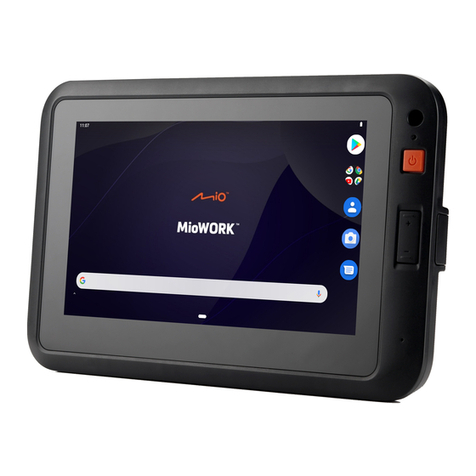
Other Mio Tablet manuals
Popular Tablet manuals by other brands

Laser
Laser MID-1060 Quick operation guide
MUNBYN
MUNBYN IRT09J Easy setup guide
Motorola
Motorola MC3090R - Win CE 5.0 Professional 520 MHz quick start guide
Dell
Dell Latitude ST Setup and features information

Lenovo
Lenovo IdeaTab S6000L Hardware Maintenance Manual
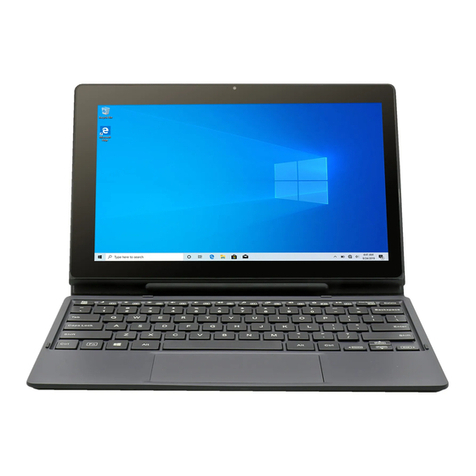
Venturer
Venturer WT9L11 quick start guide