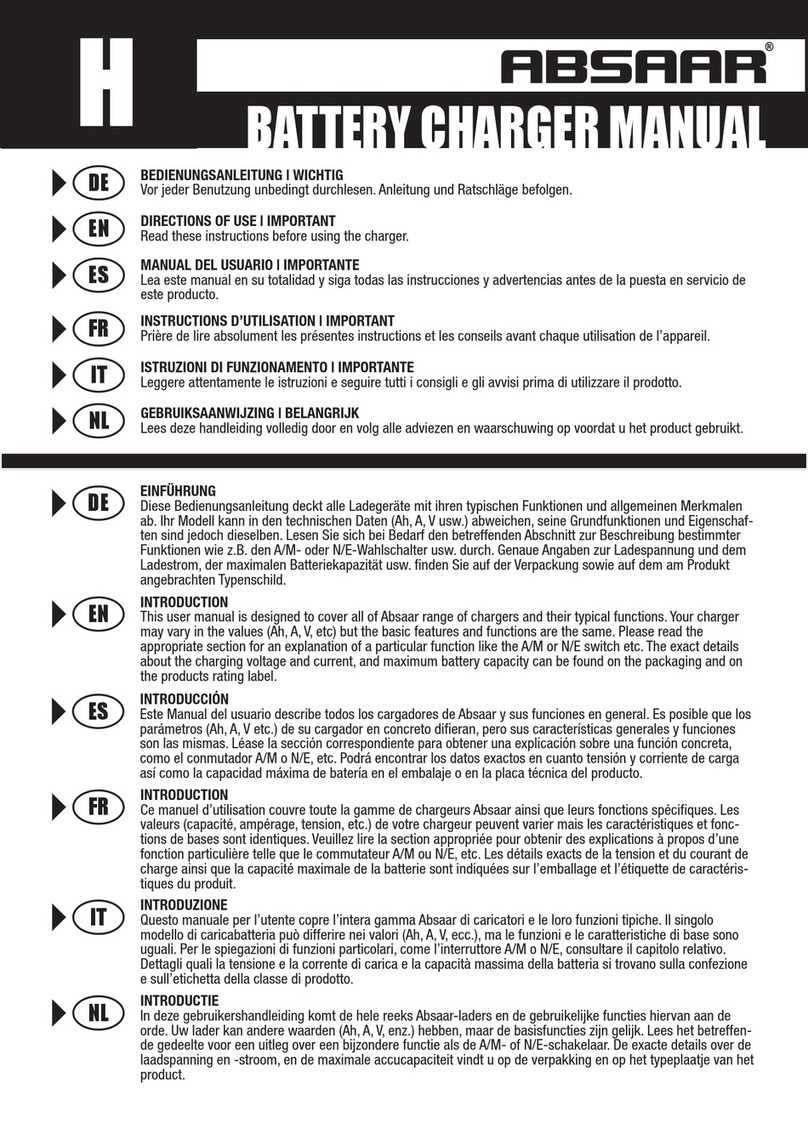
battery chargers, in which case you should follow those.
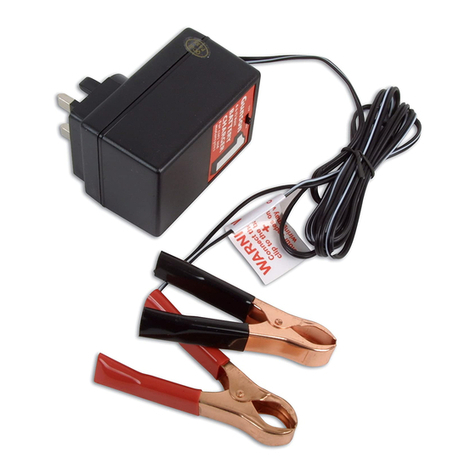
For stand-alone batteries: Connect the charger to the
supply mains. Connect the red clamp to the battery’s
positive (+) pole, and then the black clamp to the
battery’s negative (-) pole.
2. When all 4 charge level indicators are constantly lit, the
battery is fully charged and has entered maintenance
mode. The battery will be kept fully charged as long as
charger is plugged in to the mains.
INSTRUCTIONS
1. Connect the charger as explained in GETTING STARTED,
point 1, above. The 4 LEDs in the battery symbol will
flash for a few seconds. Then it will start to analyze the
battery, and the charge level indicators will start rolling
from “battery empty” to “battery full”. After a little
while, the LEDs will have a steady light indicating the
current battery charge level, and when charging is
finished all 4 LEDs will be lit.
2. If the red light below the level indicators is lit constantly,
it means “FAULT” and indicates wrong connection to
battery (reversed polarity). Disconnect clamps from
battery, and reconnect them correctly as said
mentioned above.
3. When charging, the yellow and green indicators will
show the current charge level of the battery, when
constantly lit.
Lamp lit –Battery not connected
Lamp+Red –wrong polarity to battery
Yellow+Green rolling –Charging
Yellow+Green constant–fully charged
Yellow+Green+red constantly lit -
charging timeout (charge cycle finished
without reaching full charge)
4. After charging, disconnect the battery charger from the
supply mains. Then remove the chassis connection and
then the battery connection.
For stand-alone batteries: After charging, disconnect the
charger from the supply mains. Then remove the black
clamp and then the red clamp.
5. By leaving the clamps on the battery after charging, and
mains plugged in, the charger will automatically switch
to maintenance mode as long as it is connected to the
mains.
6. To stop or interrupt charging, unplug the supply mains,
at any time, and then remove clamps.