Chapter 1 Sept 19996
LONGITUDINAL TRACKS.
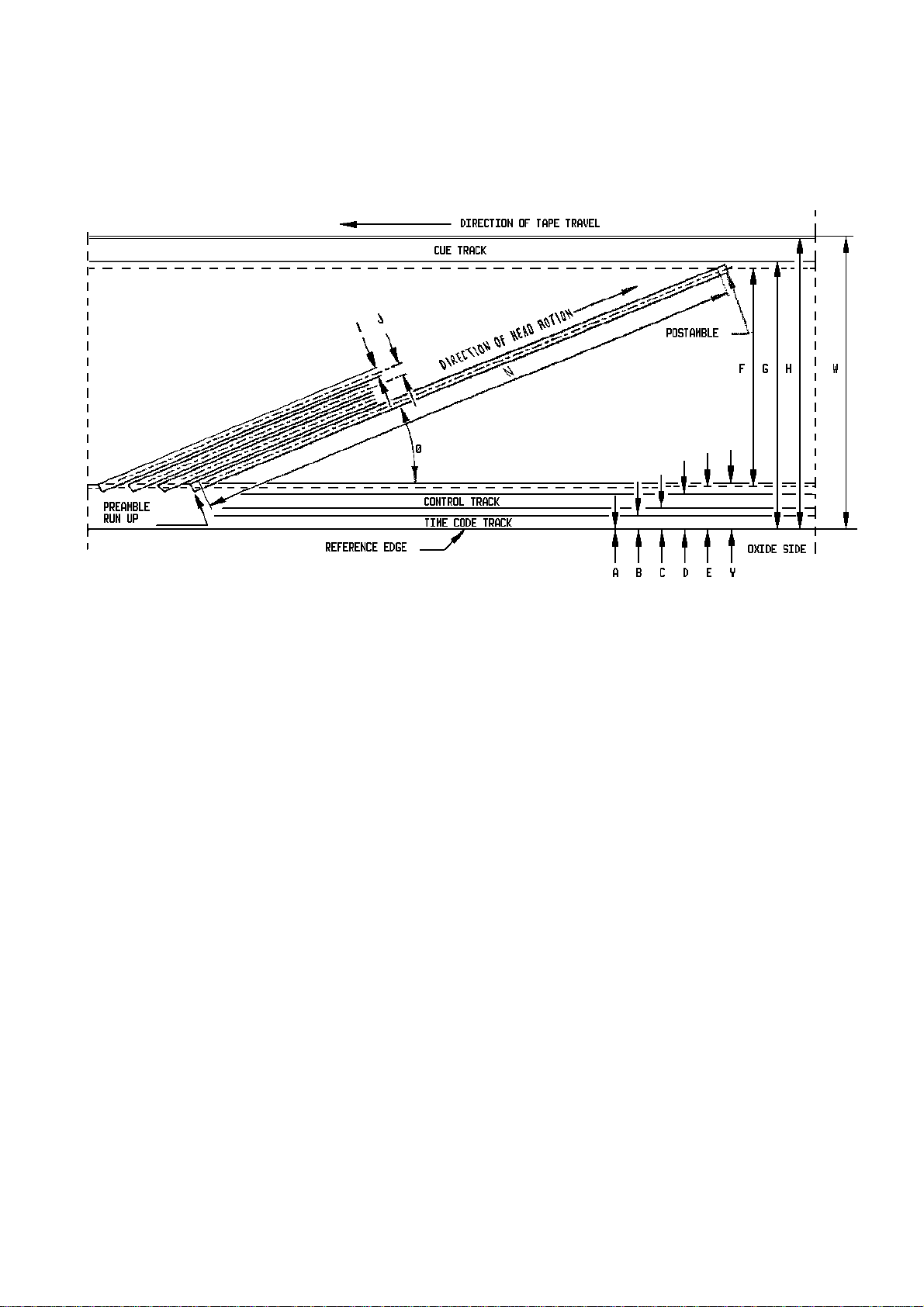
As shown in the diagram on the previous page there are three longitudinal tracks which are:
TIME CODE TRACK
The time code track is only recorded on machines equipped with the ND-TC (#10370) option, and assuming that
the time code lock-out switch is in the ready position.
This is a longitudinal SMPTE/EBU 80 bits time code track recorded using Manchester Bi-phase which allows the
reading of time code at very high speeds. The internal time code system of the NAGRA-D II includes a time code
generator corresponding to all the presently used formats (including drop frame). Time code can be recorded
from the internal generator or an external source. Both the time and user information can be set from the
keyboard or a PC. When in rapid winding (especially at half-speed) the time code passes the head at more than
60 times nominal speed and cannot be correctly read from the tape. In these instances the time code output and
display is updated from the counter roller.
Recording of time code in the INSERT mode is not permitted with software version V3.00.
CONTROL TRACK
This track is similar to the control track of a video recorder. Data is automatically recorded along the tape, which
serves as "markers" indicating the start point of each helical scan. The purpose of these "markers" is to enable
the servo system of the NAGRA-D II to synchronise the position of the heads of the scanner with respect to the
position of the helical scan on the tape. This ensures that the heads track the helical scans accurately and do
not read between the scans. This track cannot be accessed by the user and contains no user data.
If necessary, the alignment of this track can be adjusted using the TRACKING control in the OTHERSET menu.
CUE TRACK
The CUE track of the NAGRA-D II is a low quality analogue track which has two principle functions:
1. In normal operation it will record a mix of the information being recorded on the 4 digital channels, from
either the analogue or digital inputs, allowing rapid audible searching on the tape of a particular point in
the recording. A cue microphone can also be recorded at the same time if desired. This is the normal
mode and will operate as described whenever the machine is put into recording mode and the cue
channel "lock out" switch is in the READY position. The output of the CUE track can only be monitored
on the headphone outputs, if searching is being done at speeds other than nominal then the analogue
and digital outputs of the NAGRA-D II are muted. The Cue track output is automatically switched to the
headphone outputs whenever the tape is not at nominal speed.
2. It can be used to record Cue information by means of a commentary microphone (ND-CM #10530),
connected to the EXTENSION socket on the left-hand side of the machine. A standard dynamic
microphone may be used instead of the ND-CM but an internal selection needs to be made on the CUE
TRACK circuit, located next to the time code input connector.
The switch should be towards the rear of the machine in order to use the ND-CM and towards the front
of the machine for any other standard dynamic microphone.
Recording of the cue track in the INSERT mode is not permitted.