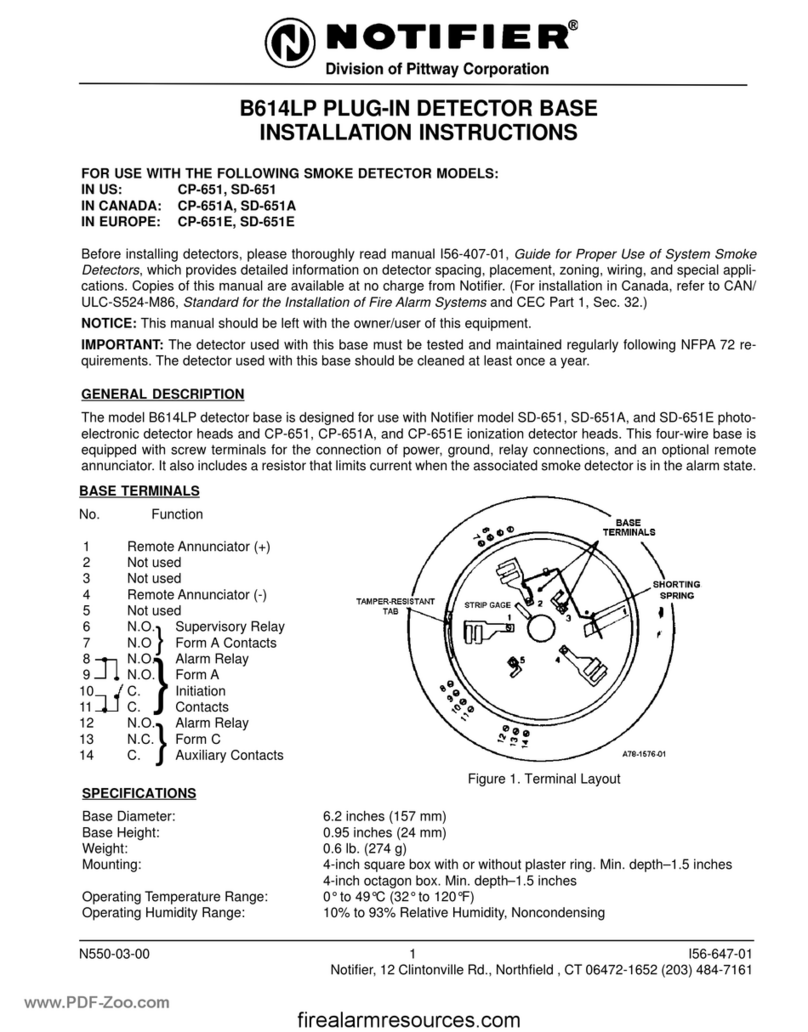
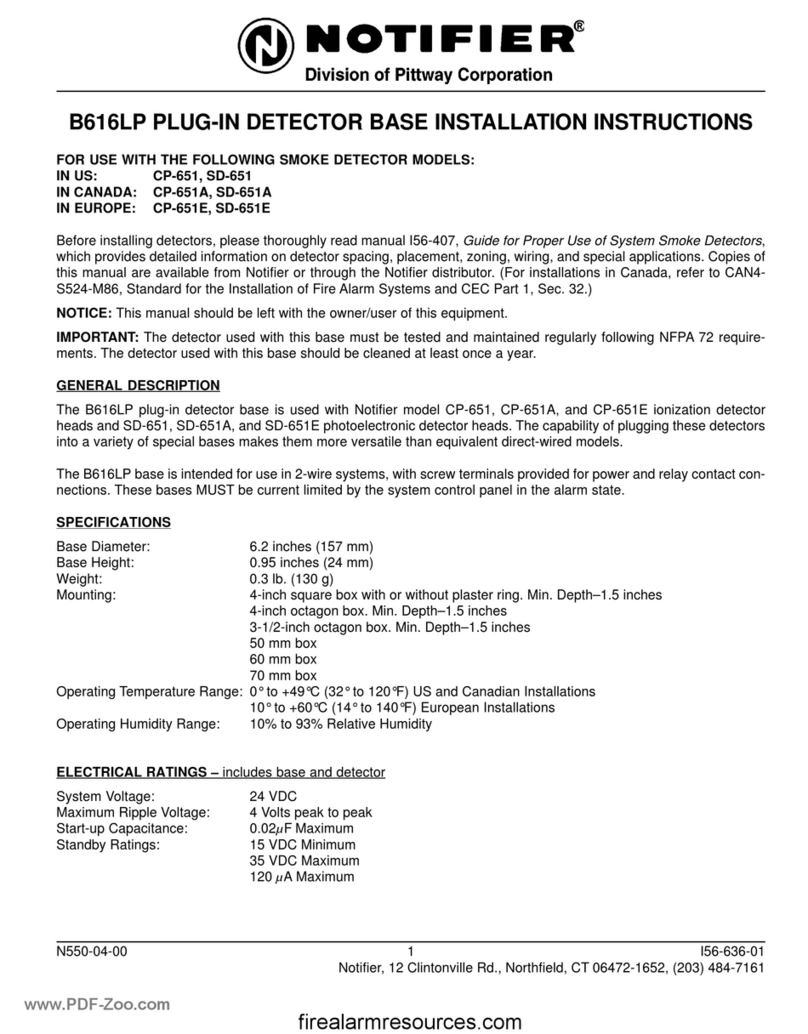
ELECTRICAL RATINGS — includes Base and Detector
Voltage Range: 15 – 32 Volts DC Peak
Standby Current (nominal): 150 µA at 24 VDC
Power-up Surge At
Max. Rated Voltage: 1.5 mA-sec.
LED Current (nominal): 6.5 mA at 24 VDC
electrical interference.
If shielded cable is used, the shield connection to and from the detector must be continuous by using wire nuts, crimping,
or soldering, as appropriate for a reliable connection.
Wire connections are made by stripping about 3/8” of insulation from the end of the wire (use strip gauge molded in
base), sliding the bare end of the wire under the clamping plate, and tightening the clamping plate screw. Do not loop
the wire under the clamping plate.
The zone wiring of the detector base should be checked before the detector heads are installed in them. The wiring
should be checked for continuity and polarity in the base, and dielectric tests should be performed.
The base contains a label to write the zone, address, and type of detector to be installed at that location. This informa-
tion is important to set the address of the detector head that will later be plugged into the base and to verify the type
required for that location.
C0129-00
Figure 3: Typical Wiring Diagram for 2-wire loop
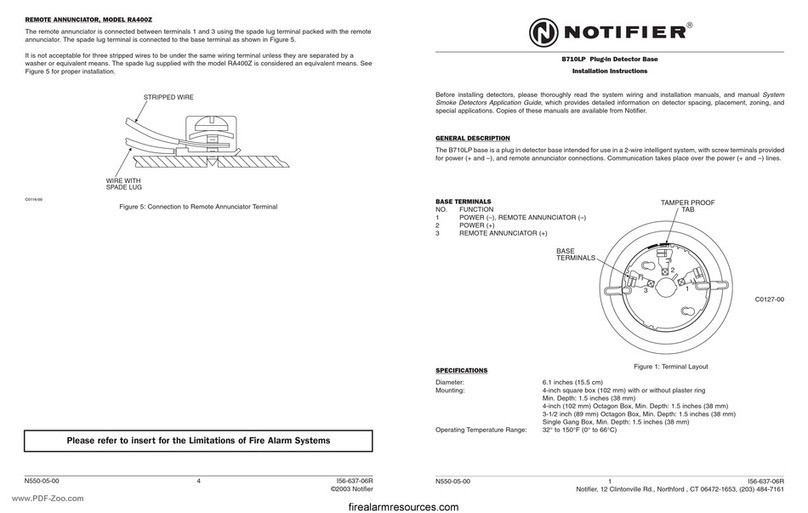
TAMPER-RESISTANCE
Note: Do NOT use the tamper-resistant capability if the XR2 or XR2B Removal Tool will be used.
The Tamper Resistant Tab, in the Detector Mounting Bracket, can make the detector tamper-resistant by making it nec-
essary to use a small screwdriver or similar tool to detach the detector from the base.
To make the detector tamper-resistant, use needle-nose pliers to break the smaller tab at the scribed line on the tamper
resistant tab. Figure 1 shows the location of this tab on the detector mounting bracket.
To remove the detector from the base after it has been made tamper resistant, remove the decorative ring by rotating it in
either direction and pulling it away from the base. Then, insert a small screwdriver into the notch, as indicated in Figure
HB, and press the plastic lever toward the mounting surface before rotating the detector counterclockwise for removal.
MOUNTING
This detector base mounts directly to 3-1/2 inch and 4
inch octagon boxes, 4 inch square boxes (with or without
plaster rings) and single gang boxes. To mount, remove
decorative ring by turning it in either direction to unhook
the snaps, then separate the ring from the base. Install the
base to the box using the screws supplied with the junction
box and the appropriate mounting slots in the base. Place
decorative ring onto base, then turn in either direction until
the ring snaps in place (see Figure 2).
INSTALLATION WIRING GUIDELINES
All wiring must be installed in compliance with the National
Electrical Code and all applicable local codes and any
special requirements of the authority having jurisdiction,
using the proper wire size. The conductors used to con-
nect smoke detectors to control panels and accessory
devices should be color-coded to reduce the likelihood of
wiring errors. Improper connections can prevent a system
from responding properly in the event of a fire.
All wiring must be installed in compliance with the National
Electrical Code and all applicable local codes and any
special requirements of the authority having jurisdiction,
using the proper wire size. The conductors used to con-
nect smoke detectors to control panels and accessory
devices should be color-coded to reduce the likelihood of
wiring errors. Improper connections can prevent a system
from responding properly in the event of a fire.
For signal wiring (the wiring between interconnected
detectors), it is recommended that the wire be no smaller
than AWG 18. However, the screws and clamping plate in
the base can accommodate wire sizes up to AWG 12. The
use of twisted pair wiring or shielded cable for the power
(+ and –) loop is recommended to minimize the effects of
N550-05-00 3 I56-637-06RN550-05-00 2 I56-637-06R