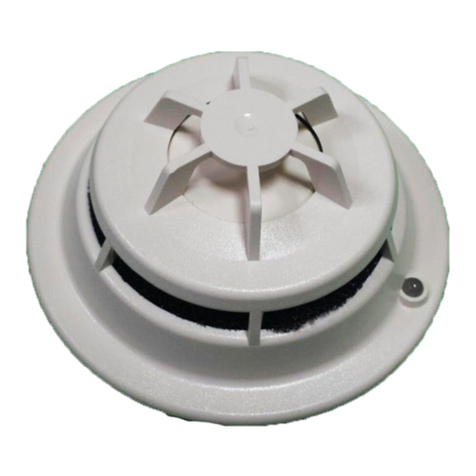
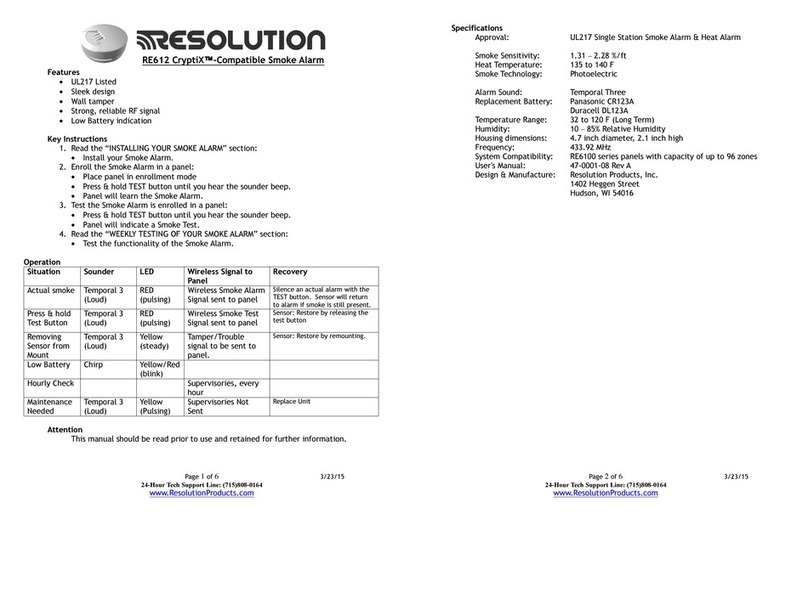
Product description and intended use
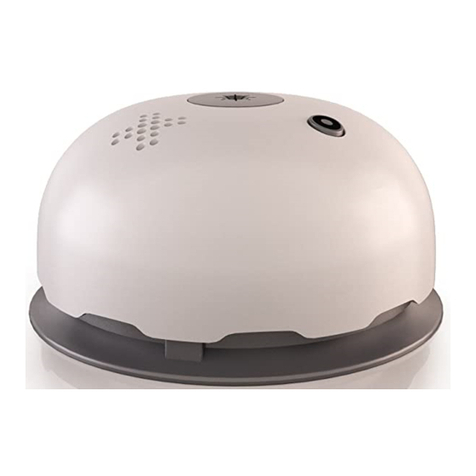
This unit is a photoelectric 3V DC smoke alarm which designed to provide an
early warning of fire smoke and fires to occupants. It is operated by PAIRD-
EER CR17450 lithium battery. With the photoelectric technology, it is more
responsive in detecting slow smoldering fires which generate light smoke, little
heat and may smolder for hours before bursting into flames. This smoke alarm
does not contain any radioactive materials. Smoke alarms should be installed
in every room, finished attics and hallways, making sure the people in the
home will be able to hear the alarm sound and react appropriately to the
hazardous event.
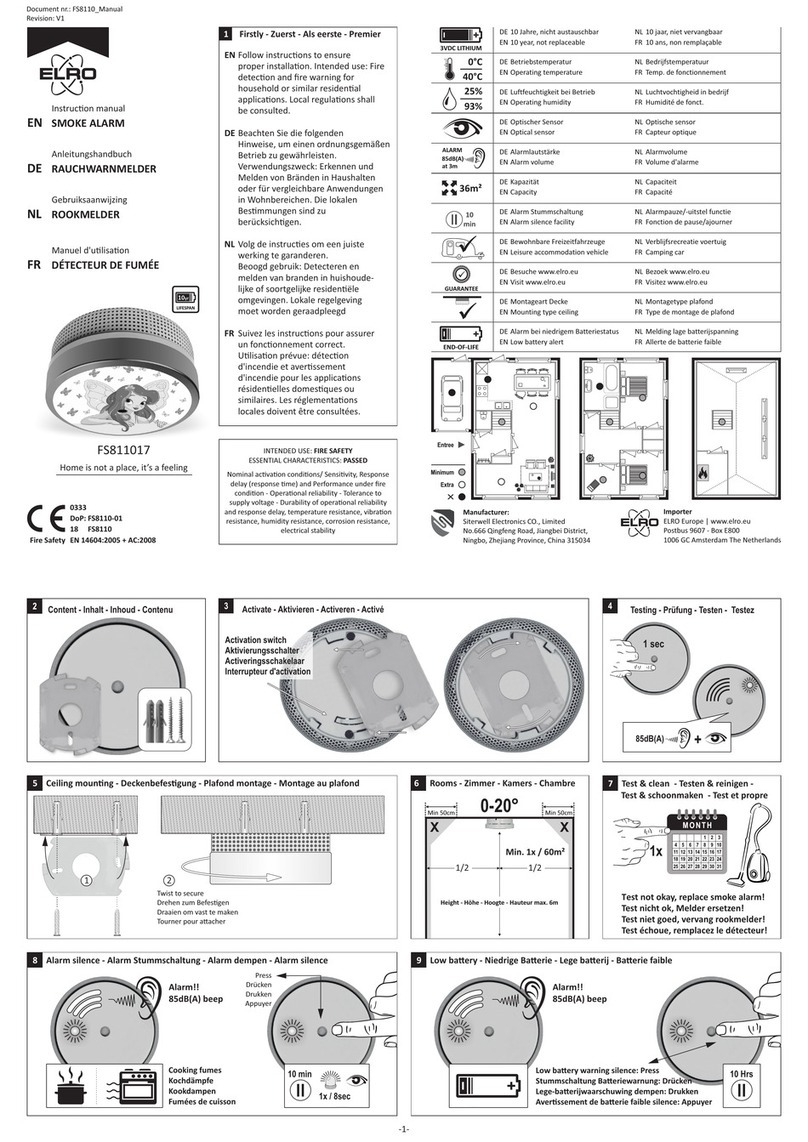
Alarm silence facility
When the smoke alarm has detected smoke and turns into the alarm mode,
you can silence the alarm for approximately 10mins by pressing the test
button. After that, the smoke alarm will automatically resets and returns into
the normal operation mode. If there are still particles of combustion in the air,
the smoke alarm will turn into the alarm mode again. WARNING: Before using
the alarm silence facility, always identify the cause of the alarm and make sure
that the circumstances are safe.
Low battery mode
When the battery is running low, the smoke alarm will indicate this with a
sound of “BI” accompanied with a LED flashing every 40 seconds for a
minimum of 7 days. The acoustic low battery warning signal can be silenced
for ten hours by pressing the test button. After that, the smoke alarm will
automatically resets and returns into the normal operation mode. The smoke
alarm is still functioning and able to detect smoke when it’s in low battery
silence mode, smoke alarm will flash LED every second when detected
combustion particles in this mode.
When smoke alarm under “low battery mode”, please replace the PAIRDEER
CR17450 lithium battery in right polarity as soon as possible to make sure the
smoke alarm operate normally.
Where to install a smoke alarm in rooms with special
geometries
Corridors with a maximum width of 3m: Max. 15m between 2 smoke alarms.
Max. 7.5m to the front side of the gallery and smoke alarms at edges/
crossings of corridors.
Rooms with sloping ceiling:
Ceiling inclination >20° to the horizontal: Smoke alarm must be installed
at least 0.5m to at most 1m from the ceiling top.
Partial roof slopes: If the flat ceiling is ≤1m wide, consider as ceilng
inclination is of >20°. If the flat ceiling is >1m wide, consider as flat
ceiling.
Rooms with subdivided ceilings:
Height of subdivisions ≤ 0.2m: Beams without consideration: smoke
alarm can be installed on the beam or the ceiling.
Height of subdivisions >0.2m and area of ceiling panels >36m2: smoke
alarm shall be installed in each ceiling panel.
Height of subdivisions >0.2m and area of ceiling panels ≤36m2:
individual ceiling without consideration.
If ceiling installation is not possible, the smoke alarm can be installed on the
wall. When mounting the alarm on the wall, the distance to the ceiling
should be between 30cm to 50cm.
Where not to install a smoke alarm
Environment with high airflow (e.g. close to air conditioning, fans and
ventilation outlets). The movement of air could affect the penetration of fire
smoke into the smoke alarm.
Areas where combustions regularly occurs, such as cooking appliances or
garages.
Areas with high humidity such as bathrooms or very close to hot water
heaters.
Areas where temperatures may fall below 0°C or rise above 40°C, or in
humidity higher than 95%.
Areas where in extremely dusty or dirty.
Warnings:
To prevent injury, this apparatus must be securely attached to the ceiling/
wall in accordance with the installation instructions.
Do not paint or cover the smoke alarm.
Product Specifications
Dimensions: 110mm (Diameter) x 36.3mm (Depth)
Detection Method: Optical Sensor
Power Supply: PAIRDEER CR17450 Lithium Battery
(3V DC)
Battery lifetime: 5 Years (IoT Application)
Communication: LoRa AS923MHz Module
Alarm Volume: ≥ 85dB (A) at 3 meters
Alarm Sensitivity: 0.09 – 0.15 dB/m
Operating Temperature: 0°C ~ 40°C
Operating Humidity: ≤ 95% RH Non-condensing
Low Voltage Threshold: 2.7V DC ± 5%
Standby Current: ≤ 11µA
Alarm Current: ≤ 90mA
Individual Alarm Indicator: Yes
Alarm Silence Facility: Yes | Hush Time: 10 minutes ± 10%
Low Battery Warning: Yes
Low Battery Silence Facility: Yes | Hush Time: 10 hours
Sensor Fault Warning: Yes
Mounting Location: Ceiling or Wall
Colour: White
Sound Output
Test / Mute Button
LED Indicator
Replace battery
1. Take a screw driver and push it into the mounting hole. Then, turn the alarm
body counter-clockwise to remove it from the mounting bracket.
2. Take out the old battery from the battery box and replace it with a new
PAIRDEER CR17450 lithium battery in right polarity.
3. Fit the alarm body on the mounting bracket and secure it by turning it
clockwise.
Battery insertion
Slide the battery into place with the negative end
first.
Press down the negative end spring, and snap
the positive end into place.
Make sure the battery polarity is in correct
direction.
Activation
Make sure the battery is installed well before operating the smoke alarm.
After inserted the battery, the smoke alarm will under “activating mode”,
LED will flicker four times every second.
When you hear the sound of “BI”, the smoke alarm is activated. LED
flashing about once 40 seconds.
You can then register the smoke alarm in the NOZE Apps.
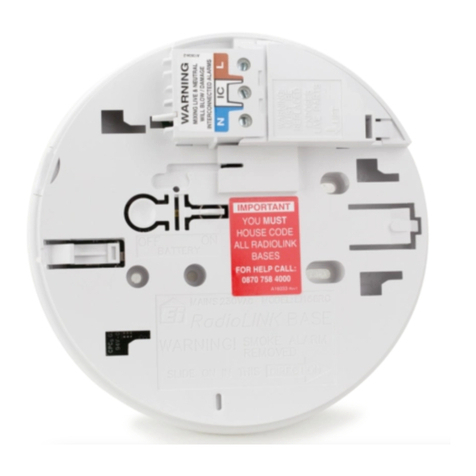
Mounting
Place the mounting plate on the desired
installation location and mark where
the holes should be drilled.
Drill two holes with a diameter of 5mm.
Push the plastic plugs into the holes.
Insert the screws into the mounting
plate, and tighten them firmly into the
plugs.
Place the smoke alarm on the mounting
bracket and secure it by turning it
clockwise.
Self-Testing
Test the unit monthly to ensure proper
operation by pressing the test button.
This will sound the alarm if the electronic
circuitry, horn, and battery are working
properly.
The sound pattern is 3 short and weak beeps, 1.5s pause, 3 short and weak
beeps, 1.5s pause, repeat it, if continue testing, the beeps will become
louder.
If no alarm sounds, the battery may be depleted or another problem, refer
to “Trouble Shooting” section for a solution.
DO NOT use an open flame to test your alarm, you could damage the alarm
or ignite combustible materials and start a structure fire.
CAUTION: Always stand an arms-length away from the unit when testing. Test
the alarm monthly to ensure proper operation. Erratic or low sound coming
from your alarm may indicate a defective alarm. Refer to “Trouble Shooting”
section for a solution.
Where to install a smoke alarm
Smoke alarms must be installed in such a way that they can be reached
unhindered by the fire smoke so that fires can be reliably detected during the
development phase.
Install at least in every bedroom and sleeping areas (especially children’s
and senior’s rooms).
Install at least in escape rooms.
In the middle of the ceiling of a room
Install at least at hallways
Install at least at stairways.
Install at least one alarm on every floor level.
Recommend in areas where electrical appliances are operated (i.e. portable
heaters or humidifiers).
Recommend a minimum of 3m from the nearest cooking appliance.
Recommend at both ends of hallway if more than 9.1m (30 ft) long.
At least 50cm away from the wall and other objects.
Maximum installation height of 6 meter.
Minimum
Extra
Entrance
A�c/Dachboden
Ground floor / Erdgeschoss
First floor / Erste Etage
PAIRDEER
CR17450
NegativePositive
Ceiling
plastic plugs
two screws
mounting
bracket
Alarm
body
4. Test the smoke alarm to make sure it
is working properly. (Please refer to
“Self-Testing” section).
- 1 - - 2 - - 3 -