LIMITED WARRANTY
LIMITED WARRANTY: If this product fails because of a manufacturing defect within five years after purchase,
we will, at our option, either repair or replace it at no charge. Our warranty does not cover damage caused
by accident, abuse or misuse. We assume no further liability with respect to the sale or use of this product.
THIS WARRANTY IS IN LIEU OF ALL OTHER WARRANTIES, EXPRESSED OR IMPLIED, INCLUDING THE WARRANTY
OF MERCHANTABILITY. We make no warranty with respect to the fitness of any goods for the users particular
application. This warranty gives you specific legal rights, and you also may have other rights which vary from
state to state. It is our intent to provide accurate and current specification information. However, in the interest of
product improvement, TORK may alter the specifications or constructional details without prior notice.
FOR TECHNICAL SUPPORT
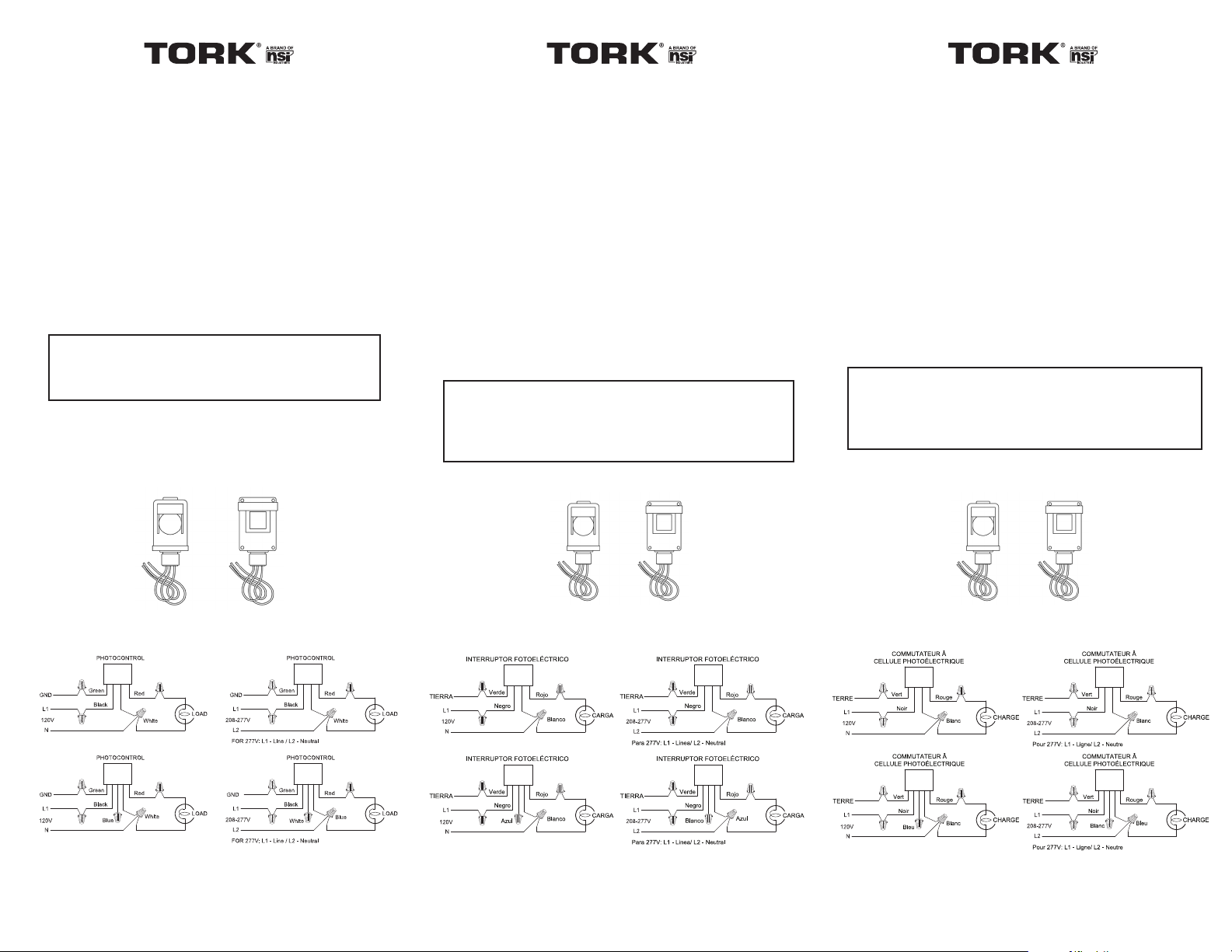
MOUNTING AND INSTALLATION
2100A SERIES MODELS WITH 1/2” NPT
The photocontrol can be mounted directly through a standard 1/2” knockout.
Connection to junction box must be watertight through a tapped opening and the
use of a nut and neoprene washer. In addition, use suitable tape or sealant on
nipple threads. MUST BE MOUNTED IN UPRIGHT POSITION.
TURN ON/TURN OFF: Turn ON - 1 to 5 fc, Turn OFF - 3 to 15 fc
ADJUSTMENT FOR MODELS WITH SLIDE: TORK Photocontrols permit easy
field adjustment. Move slide to cover cell for earlier turn-on and later turn-off.
Move slide to expose cell for later turn-on and earlier turn-off.
TIME DELAY FEATURE: (30 seconds minimum) prevents false switching
due to temporary cloud movements or momentary flashes of lighting or
car headlights. NOTE: LIGHTS WILL BE ON WHEN PHOTOCONTROL IS FIRST
INSTALLED. If installed during daylight hours, control will turn off after a short
delay. When testing, it will have a delayed response.
TROUBLESHOOTING TIPS
MONTAGE ET INSTALLATION
MODÈLES DE SÉRIE 2100A AVEC NPT DE 1/2 PO
La cellule photoélectrique peut être fixée directement à travers une pastille
défonçable standard de 1/2 po. Le raccord à la boîte de jonction doit être
effectué à travers une ouverture taraudée et à l’aide d’un écrou et d’une
rondelle en néoprène afin qu’il soit étanche. Appliquez également du ruban ou
un scellant adéquat sur le filetage de la tige. DOIT ÊTRE MONTÉ VERTICALEMENT.
MISE EN MARCHE/ARRÊT : Mise en marche – de 1 à 5 pieds-bougie; arrêt
– de 3 à 15 pieds-bougie.
AJUSTEMENT POUR LES MODÈLES MUNIS D’UN CAPUCHON
COULISSANT : Les cellules photoélectriques TORK permettent d’apporter
facilement des ajustements. Glissez le capuchon de façon à couvrir la cellule
photoélectrique pour une mise en marche plus tôt et un arrêt plus tard. Glissez le
capuchon de façon à exposer la cellule photoélectrique pour une mise en marche
plus tard et un arrêt plus tôt.
FONCTION DE RETARDEMENT : (30 secondes minimum) Permet de
prévenir les mises en marche accidentelles dues au mouvement des nuages et
aux éclats momentanés de l’éclairage ambiant ou des phares de voiture.
REMARQUE : UNE FOIS LA CELLULE PHOTOÉLECTRIQUE INSTALLÉE, LES LUMIÈRES
S’ALLUMERONT. Si vous installez la cellule photoélectrique pendant le jour, les
lumières s’éteindront après un court laps de temps. Si vous effectuez des tests, la
réponse sera retardée. DÉPANNAGE
MONTAJE E INSTALACIÓN
SERIE 2100A MODELOS CON NPT DE 1,27” El fotocontrol puede
instalarse directamente con un orificio ciego estándar de 1,27 cm. La conexión
a la caja de unión debe ser hermética con una abertura con cubierta y se debe
utilizar una tuerca y una arandela de neopreno. Además, se debe utilizar una
cinta o sellador adecuado para las roscas. SE DEBE COLOCAR EN POSICIÓN
VERTICAL.
ENCIENDA/APAGUE: Encienda: Vela de 0,31 m a 1,52 m, apague: Vela de
0,91 m a 4,57 m.
AJUSTE PARA LOS MODELOS CON DESLIZADOR: Los fotocontroles TORK
permiten un ajuste de campo fácil. Mueva el deslizador para cubrir la célula
para lograr que se encienda más temprano y se apague más tarde. Mueva el
deslizador para exponer la célula para lograr que se encienda más tarde y se
apague más temprano.
CARACTERÍSTICA DE RETRASO DE TIEMPO: (30 segundos mínimo) evita
un encendido falso debido a movimientos temporales de las nubes o a destellos
de iluminación o a los faros de los autos.
NOTA: LAS LUCES SE ENCENDERÁN LA PRIMERA VEZ QUE SE INSTALE EL
FOTOCONTROL. Si se instala durante las horas del día, el control se apagará
luego de un breve retraso. Al hacer pruebas, tendrá una respuesta atrasada.
CONSEJOS DE SOLUCIÓN DE PROBLEMAS
PROBLEM SOLUTION
Occasionally, lamp will not turn on after
dark. Artificial light may be shining on
the “eye” - shade the eye from
this light.
Lamp switches ON & OFF after dark. The “eye” may be exposed to the
lamp it is controlling - shade the eye
from this light.
Lamp switched ON & OFF during the day,
but stays on all night. Line and lamp leads may be
reversed - switch them around.
Lamp switches off some mornings but
not others. The “eye” is probably shaded too
much and needs to be reoriented or
possibly removed from the daylight
obstruction.
PROBLÈME SOLUTION
À l’occasion, l’éclairage ne s’allume pas
après la tombée de la nuit. Une lumière artificielle peut éclairer
l’œil. Abritez l’œil de cette lumière.
L’éclairage s’allume et s’éteint après la
tombée de la nuit. L’œil peut être exposé à la lumière
du luminaire qu’il contrôle. Abritez
l’œil de cette lumière.
L’éclairage s’allume et s’éteint pendant
le jour, mais il demeure allumé toute
la nuit.
Les conducteurs de la ligne et du
luminaire peuvent avoir été inversés.
Raccordez-les correctement.
L’éclairage demeure parfois allumé le
matin. L’œil est probablement trop
ombragé. Réorientez-le ou retirez ce
qui obstrue la lumière du soleil.
PROBLEMA SOLUCIÓN
De vez en cuando, la lámpara no se
encenderá después de oscurecer. La luz artificial puede ser brillante
para el “ojo”, protéjalo de esta luz.
La lámpara se ENCIENDE y se APAGA
después de oscurecer. El “ojo” puede estar expuesto a
la lámpara, se puede controlar:
Protéjalo de esta luz.
La lámpara se ENCIENDE y se APAGA du-
rante el día, pero permanece encendida
toda la noche.
Los conductores de la línea y de la
lámpara pueden estar invertidos:
Vuélvalos a su lugar.
La lámpara se apaga algunas mañanas
pero no otras. Es posible que el “ojo” haya recibido
demasiada sombra y necesite cam-
biar de orientación o posiblemente
tenga que retirarlo de la obstrucción
de la luz del día.
LI-1030(B)