VOLTAGE REGULATOR
AVR860
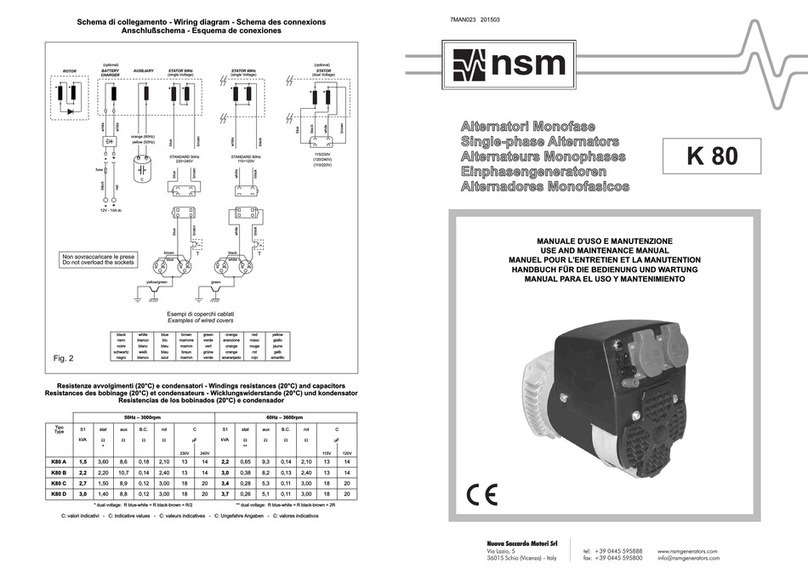
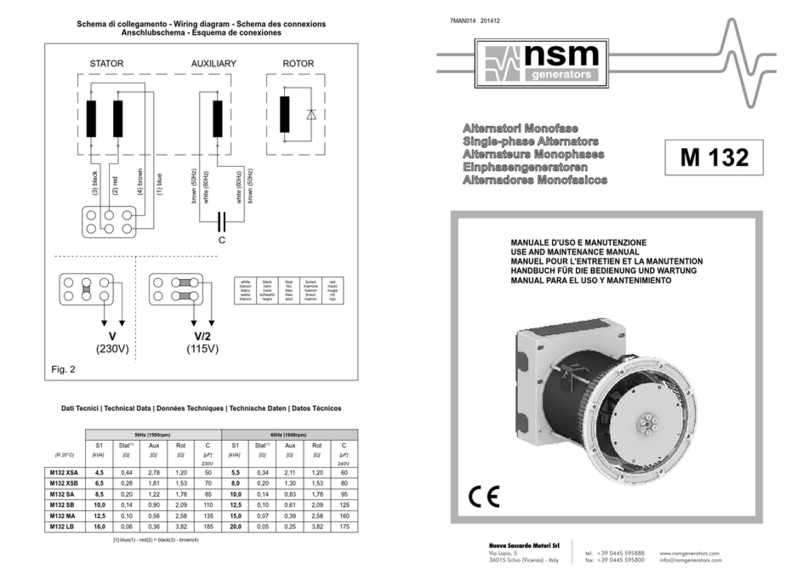
(look at the wiring diagram)
The generator is fitted with an automatic voltage
regulatorAVR860.
The regulator is provided with regulating trimmer
toadapt its performance to thedifferentgenerator
operatingconditions.
In particular, AVR860 is provided with adjustable
anti-oscillation circuits to allow for a vast range of
loads. Furthermore, the regulator is provided with
special internal protection circuits that allow the
generator to be operated no-load at a lower than
nominalspeed.
However, it is not advisable to operate the
generator with a load at a frequency (RPM) lower
than the nominal value: this type of operation
represents an overload condition for the whole
excitation system of the generator. Under these
circumstances the underspeed protection will
step in (see P4 trimmer) and the relevant yellow
Led(ifany)willlightupasaconsequence.
Intheeventofheavy overloads (a short circuit, for
example), the red led will light up andAVR860 will
limit the excitation current (and consequently the
output voltage): to reset the usual operating
conditions, switch the generator off and remove
thecauseoftheoverload.
In the event of prolonged slight overloads , the
orange led will light up and AVR860 will limit the
excitation current (and consequently the output
voltageandthepower)
A fuse is also supplied as extra protection for the
AVR
Connectingtheregulator:
the AVR860 is connected to the terminals of the
generator by means of Faston type connectors
between the terminals that identify the rated
voltage of the generator (as shown in fig.2; see
alsoindicationsforP1trimmer).
Regulatingtrimmers:
P1 regulation of the generator output voltage;
this internal trimmer enables a considerable
deviation in the voltage. If a finer adjustment is
requiredortheremotevoltagecontrol,anexternal
potentiometer(22k)mustbeadded
P2 settingthestability; intheeventofoscillations
(fluctuations) in the output voltage, use the
trimmer,turningitslightlyclockwise
P3 setting the static nature (for particular
applications); normally fully turned in an anti-
clockwise direction (zero static nature).
P4 Setting of protection activation for low
frequency, factory set during final testing; DO
NOT MODIFY UNLESS AUTHORISED TO DO
SO BY OUR TECHNICAL DEPARTMENT; it is
normally set to reduce the excitation when the
speed of rotation falls below 5% of the nominal
value relating to 50Hz. Taking out the jumper
connection the regulation is suitable for operation
at60Hz(check)
P5 maxkVA(ifany):settingofoverloadlimitation,
set during final testing; DO NOT MODIFY
UNLESS AUTHORISED TO DO SO BY OUR
TECHNICALDEPARTMENT
RÉGULATEUR DE TENSION
AVR860
(regardez le schema de connexions)
Le générateur est équipé d'un régulateur
automatiquedetensionAVR860.
Lerégulateurestdotéd'untrimmerderéglagepour
adapter son fonctionnement aux différentes
conditionsd'utilisationdugénérateur.
Enparticulier,l'AVR860adescircuits
d'antiinstabilité pour permettre l'utilisation d'une
vaste gamme de charges. Le régulateur est doté
par ailleurs de circuits internes conçus pour la
protection,quipermettentlefonctionnementàvide
àvitesseinférieureàcellenominale.
Il est toutefois déconseillé de faire fonctionner à
charge à une fréquence (n° tours) inférieure à la
valeur nominale : ce type de service représente
une condition de surcharge pour toute la partie
d'excitationdugénérateur.
Dans ces conditions, la protection de sous régime
se déclenchera (voir trimmer P4) et la LED jaune
correspondantes'allumera(siprésente)
Dans le cas de fortes surcharges (un court circuit,
par exemple), le LED lumineux rouge s'allumera et
l'AVR860 limitera le courant d'excitation (et donc la
tension de sortie): pour récupérer les conditions
normales de fonctionnement, arrêter le groupe
electrogeneetéliminerlacausedelasurcharge.
Dans le cas de légères surcharges prolongéè, le
LED lumineux orange s'allumera et l'AVR860
limitera le courant d'excitation (et donc la tension
desortieetlapuissance)
Un fusible est présent pour une meilleure
protectiondel'AVR
Connexionsdurégulateur:
l'AVR860estbranchéauxterminauxdugénérateur
par des connecteurs de type Faston, sur les
borniers identifiant la tension nominale du
générateur (comme indiqué figure 2; voir aussi les
indicationsrelativesautrimmerP1).
Trimmerderéglage:
P1 réglagedelatension de sortie du générateur ;
ce " trimmer " interne permet une très bonne
excursion de la tension. Dans le cas où l'on
souhaiterait obtenir un réglage plus fin, ou
contrôler la tension à distance, un potentiomètre
extérieurs'avèrenécessaire(22k).
P2 le tarage de la stabilité ; dans le cas
d'oscillations (fluctuations) de la tension en sortie,
agir sur ce dernier, en le faisant légèrement
pivoter à droite.
P3 le tarage du statisme (pour applications
particulières); normalement complètement tourné
à gauche (statisme zéro).
P4 étalonnage de déclenchement de la protection
pour basse fréquence effectué en phase de
contrôle ; NE PAS MODIFIER SANS AVOIR
AUPARAVANT CONTACTÉ NOTRE SERVICE
TECHNIQUE; normalement il est taré pour réduire
l'excitationquandlavitessede rotationdescendau
dessous de 5% de la valeur nominale relative à
50Hz. Enlevant la connection reporté sur le
schéma, le réglage est approprié au
fonctionnementà60Hz.
P5 max kVA (le cas échéant) : étalonnage de
limitation des surcharges effectué en phase de
contrôle ; NE PAS MODIFIER SANS AVOIR
AUPARAVANT CONTACTÉ NOTRE SERVICE
TECHNIQUE.
REGOLATORE DI TENSIONE
AVR860
(vedi schema elettrico)
Il generatore è provvisto di regolatore automatico
ditensioneAVR860.
Il regolatore è dotato di trimmer di regolazione per
adattare il suo funzionamento alle diverse
condizionidiutilizzodelgeneratore.
In particolare l'AVR860 è dotato di circuiti anti-
pendolamento adattabili per consentire l'utilizzo di
una vasta gamma di carichi. Il regolatore è dotato
inoltre di circuiti interni di protezione, che
permettono il funzionamento a velocità inferiore a
quellanominale.
E' comunque sconsigliabile il funzionamento a
carico ad una frequenza (n° giri) inferiore al valore
nominale: questo tipo di servizio rappresenta una
condizione di sovraccarico per tutta la parte di
eccitazione del generatore. In tali condizioni
interverrà la protezione di sottovelocità (vedi
trimmerP4),conrelativaaccensionedelLEDgiallo
(sepresente).
In caso di forti sovraccarichi (come nel caso di un
corto circuito) si accenderà il LED rosso, e
l'AVR860 limiterà la corrente di eccitazione (e
conseguentemente la tensione d'uscita): per
ripristinare le normali condizioni di funzionamento
spegnere il generatore e rimuovere la causa del
sovraccarico
In caso di leggero sovraccarico prolungato si
accenderà il LED arancione, e l'AVR860 limiterà
la corrente di eccitazione (e conseguentemente
la tensione d'uscita e la potenza).
Ad ulteriore protezione dell’AVR è presente inoltre
unfusibile
Connessionidelregolatore:
l'AVR860 è collegato ai terminali del generatore
mediante connettori di tipo Faston, tra i morsetti
che individuano la tensione nominale del
generatore (come indicato in fig.2; vedi anche
indicazionirelativeatrimmerP1).
Trimmerdiregolazione:
P1 regolazione della tensione di uscita del
generatore; tale trimmer interno consente una
notevole escursione della tensione. In caso si
voglia ottenere una regolazione più fine,
oppure controllare la tensione a distanza,
occorre aggiungere un potenziometro esterno
Re.(22k).
P2 taratura della stabilità; in caso di
pendolamenti (fluttuazioni) della tensione
d’uscita agire su esso, ruotandolo
leggermente in senso orario.
P3 taratura dello statismo (per applicazioni
particolari); normalmente tutto ruotato in
senso anti-orario (statismo zero).
P4 taratura di intervento della protezione per
bassa frequenza, tarato in fase di collaudo;
DA NON VARIARE, SE NON DOPO AVER
CONTATTATO IL NOSTRO UFFICIO
TECNICO. Normalmente è tarato per ridurre
l'eccitazione quando la velocità di rotazione
scende oltre il 5% al di sotto del valore
nominale.Nelcaso diilfunzionamentoa60hz,
verificare che il ponticello di figura sia stato
rimosso.
P5 max kVA (se presente): taratura di limitazione
deisovraccarichi,tarato infasedicollaudo; DA
NON VARIARE, SE NON DOPO AVER
CONTATTATO IL NOSTRO UFFICIO
TECNICO.