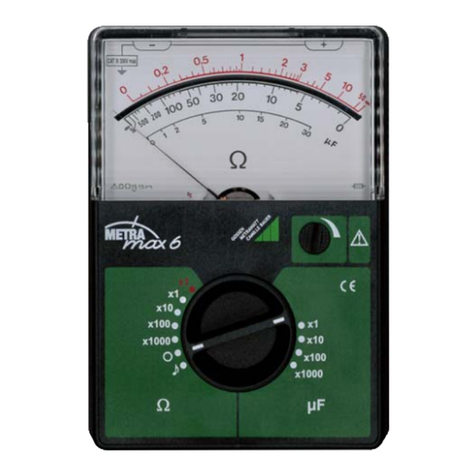
1 Double scale 0 … 3 / 0 … 10, linear, to be used for measurements
with zero at the left side
2 Indicator needle
3 “BAT” scale for checking battery capacity
4 Mirrored scale for exact readings
5 Double scale -5 … 0 … +5 / -1,5 … 0 … +1,5, linear, to be used for
measurements with zero at midpoint
6 Mode switch: AC, DC, zero-midpoint, battery check
7 4 mm safety receptacle “COM” (black) - common ground
8 4 mm safety receptacle “V/A” (red), positive terminal for current and voltage
measurements (all measuring ranges up to 1 A)
9 4 mm safety receptacle “10 A” (red), positive terminal for current
measurements (measuring range 10 A)
10 Step switch for selecting measuring range:
1 mV, 100 mV, 300 mV, 1 V, 3 V, 10 V, 30 V
100 µA, 10 mA, 30 mA, 100 mA, 300 mA, 1 A
11 Adjustment screw for mechanical setting of the zero-point
12 Overload-display
Operation:
1) The analogue multimeter is always ready for operation (as long as the batteries are
properly functioning).
2) The type of power to be measured is set by using the mode switch (6). In addition,
in the case of direct current, this switch is used to select between zero at midpoint or
at the left side. The adjustment screw (11) can be turned appropriately in order to set
the needle to zero if necessary.
3/a) When measuring current, set the step switch for selecting measurement range
(10) to the largest possible measurement range, 1 A, for the applicable current type
(AC/DC). Only for measuring current > 1 A the connecting wire is to be unplugged from
receptacle (8) and plugged into receptacle (9). In this fashion the device is automati-
cally switched to the 10 A measurement range. Under alternating current the indicator
needle always moves to the right, under direct current it moves to the right when the
positive terminal of the power source is connected to receptacle "V/A" (8) or "10 A" (9)
and to the left when the positive terminal is connected to receptacle "COM" (7).
3/b) When measuring voltage, only the receptacles “COM” (7) and “V/A” (8) are used.
The step switch for selecting measurement range (10) is set to the largest measure-
ment range, 30 V. Select the appropriate current type using the mode switch (6).
Switch the step switch (10) to a more sensitive range only after the power supply has
been connected. The indicator needle moves in the same way as when measuring
current.
Note: the current measurement range 100 µA corresponds to a voltage measurement
range of 100 mV.
Overload protection: The measuring element and the internal measuring circuits are
electronically protected against the ocurring overload. Due to safety reasons, a maxi-
mum voltage of 42 V is not to be exceeded.
Battery check: Turn the mode switch (6) all the way to the left. If the needle moves
all the way to the right within the measuring scale "BAT", then the batteries' capacity
is alright. In order to replace the four 1.5 V mignon cells, remove the rear panel. Only
alkaline batteries are recommended to be used with this device.
Turning off the measuring device: If the mode switch (6) is set to DC („OFF“), the
set of batteries should theoretically last about 10 years. The effective operating time
is limited by the natural durability of the batteries (Please check the information on the
battery package).
Should the device not be used for several months at a time, remove the batteries so
as not to damage the device in the case of battery seepage.
A special feature of this device is the very good frequency response: typical -1,5 db at
20 kHz. Therefore measurements are possible in all kinds of resonance circuits.
1
2
3
4
6
5
8
11
12
9
7
10