ecoSWITCH
NCP457xx Evaluation
Board User’s Manual
Introduction
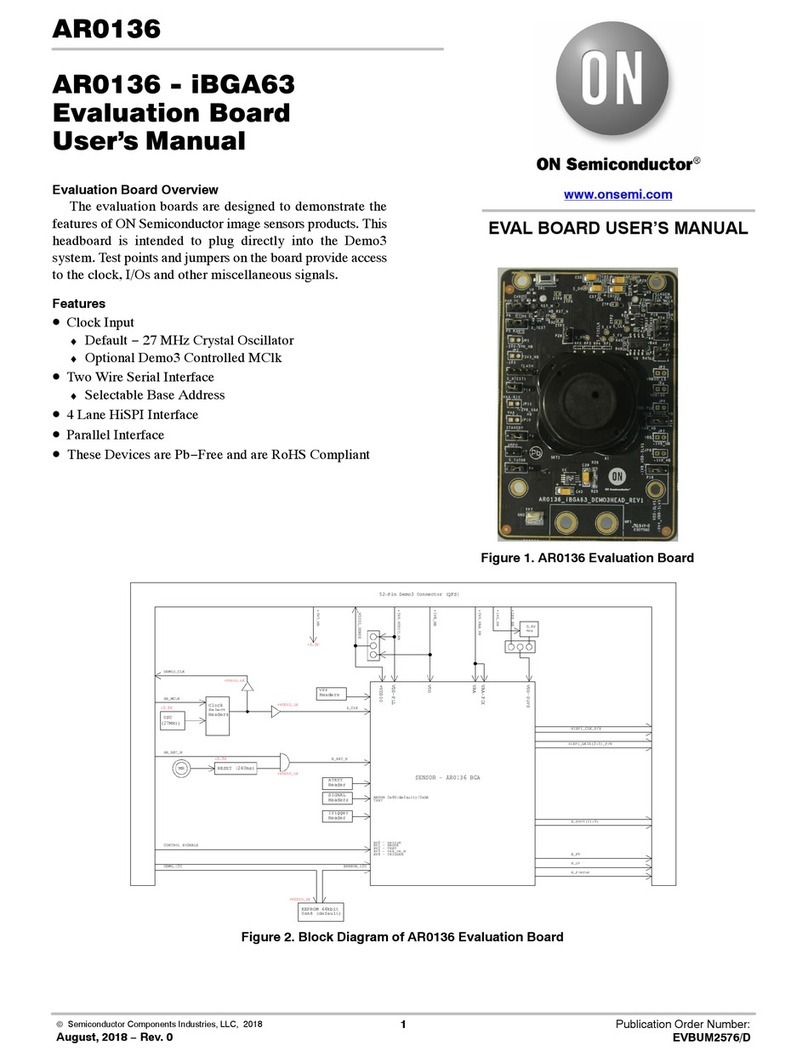
This user’s manual provides detailed information regarding
the configuration and use of the NCP457xx evaluation boards.
Each NCP457xx product has a different pin out, however, the
external connections to the evaluation boards are the same. This
manual focuses on the evaluations boards’ common external
connections and use.
Evaluation Board Features
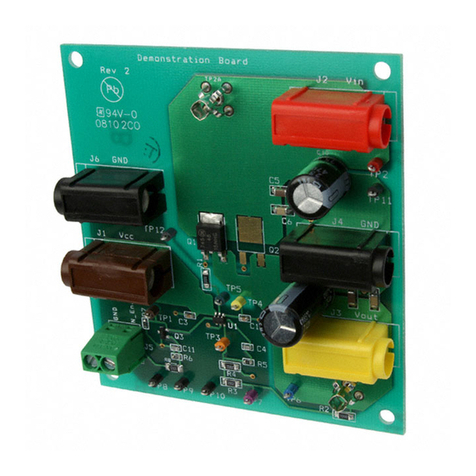
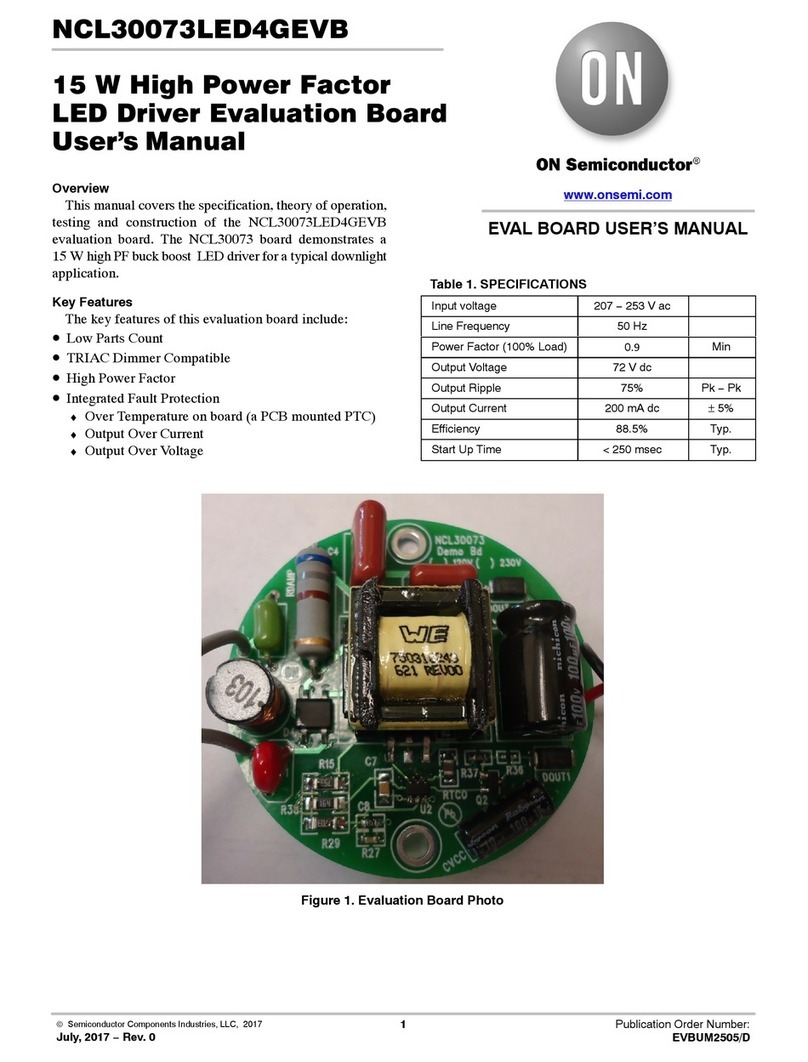
1 NCP457xx part
High Current Connection for Load Switch VIN.
High Current Connection for Load Switch VOUT.
Jumpers for connecting Power Good pull up resistor.
Jumper for connecting a capacitor to externally program
the slew rate.
Jumper for connecting a resistor to ground for OCP
programming.
Quick Start
Recommended Equipment
Before beginning, the following equipment is needed:
2 DC power supplies (1 capable of at least 24V, and 1
capable of at least 5V).
1 DC load (can be active or passive)
Function generator or DC supply to drive the EN signal
Oscilloscope (for observation of signals)
Digital Multi-meter (for observation of signals)
Banana cables for VIN / VOUT / VCC / GND connections
Board Setup
The table below describes the voltages or currents
intended for each connection on the evaluation board.
OCP setting affects
possible load currents.
Install for max
OCP setting.
OCP programming
connection.
Remove to for
fastest slew rate
setting.
SR programming
connection.
Connect if using
the PG signal
Connects a 100kΩ
pull-up resistor to
VCC PG pin
http://onsemi.com
Testing Procedure
The NCP457xx EVK comes fully assembled and tested.
Follow the steps below to verify board operation. Refer
to the schematic and layout diagrams found on the ON
Semiconductor website for specific device connections.
1) Ensure Jumper connection are correct for desired
SR, OCP, and PG settings.
2) Apply DC power to the VIN input (2V - 24V).
3) Apply DC power to VCC (3V –5.5V).
4) Apply 0.5A load current connected to VOUT.
(Steps 2, 3, and 4 can occur in any order).
5) Enable load switch by asserting the EN signal.
6) Measure VOUT using test loop. VOUT should be
within 20mV of VIN. This difference depends on
the specific RON of the part under test plus board
resistance from the measurement point to the
device.
7) Disable the device by asserting EN low.
Measure VOUT. It should measure 0V.
The PG signal should go high and low with the
enabling and disabling of the device if J3 is
connected. Attaching an oscilloscope to VOUT
will allow for observation of the soft start change
as J2 is connected or disconnected. This board
can be used to evaluate all fault conditions as
defined in the specific datasheets.