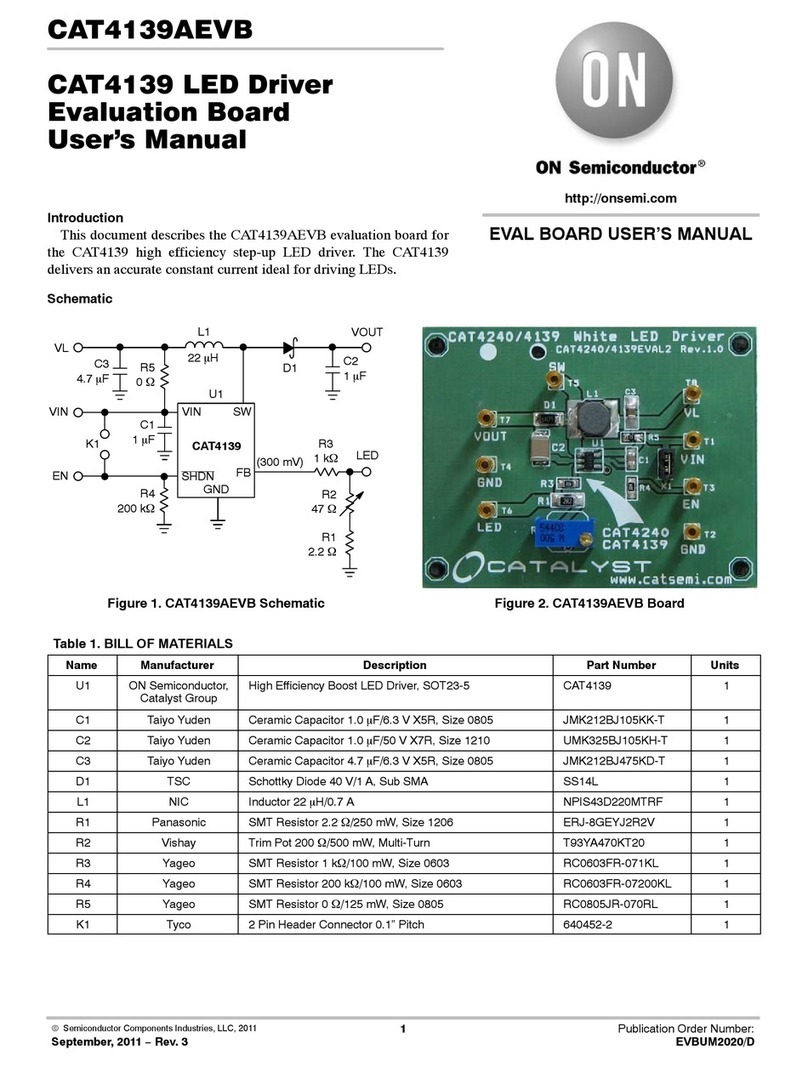
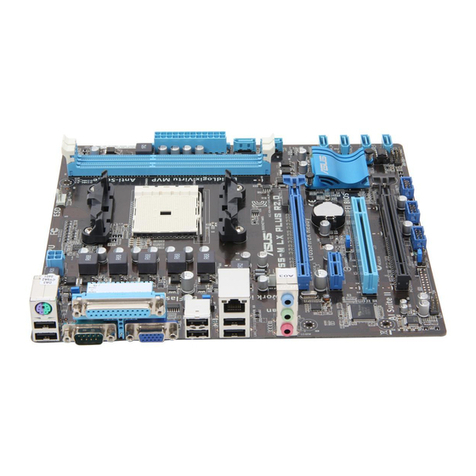
NCV73830V1GEVB
http://onsemi.com
2
GENERAL FEATURES
FlexRay Transceiver
•Two separate FlexRay channels with NCV7383 Bus
Driver compliant with the FlexRay Electrical Physical
Layer Specification Version 3.0.1,
•Reconfigurable bus termination – End node / Middle
node
•Common mode Choke and additional ESD protection
footprint
•SUBD-9 connectors – FlexRay bus
MCU
•Freescalet16-bit MC9S12XF family MCU
•Integrated FlexRay Communication Controller
(Protocol Specification Rev. 2.1)
•Integrated CAN 2.0 A, B Controller
•Background Debug Module – single-wire
communication with host development system
•512 k byte Flash
•32 k byte RAM
•50 MHz maximum CPU bus frequency
•Relatively small 112-pin LQFP package
Peripherals
•Optical isolated USB interface (USB to UART
converter)
•Additional CAN interface
•All NCV7383 digital I/O pins connected to test points –
easy connection to Logic Analyzer
•8 general purpose LEDs
•Address switch
•External Interrupt switch
Other
•Two Automotive Voltage regulators (Input battery
voltage up to 42 V)
•Power supplies voltage monitoring
•Instant 2-nodes FlexRay network with running
communication by connecting two NCV7383 EVBs.
•PC configuration software under development
(available upon request)
PCB Layout
•The FlexRay transceiver, the ESD protection and the
common mode choke are placed near to the FlexRay
the ECU connector
•The FlexRay signal lines (BP, BM) are decoupled from
disturbances on the ECU board
•The routing of the FlexRay lines (BP, BM, TxD and
TxEN) is symmetric
•The distance between the lines BP and BM resp. TxD
and TxEN is minimized
GETTING STARTED
The NCV7383EVB board is fully assembled,
pre-programmed and can be immediately used for
evaluation. Only a few steps need be proceeded to get fully
working simple FlexRay network.
Connect the evaluation boards as follows:
1. Set the boards to default configuration according
to Jumpers and Default Configuration section.
2. Select one of the bus termination type (Bus
Termination Configuration section) and adapt the
respective devices. End node termination type is
recommended for 2-node network.
3. Set a different board address on each board. One
of the boards must be set with address 1 and is
considered as Master Board. Node address is
configured by address switch SW12 – see Address
Switch for details.
4. Connect the boards according to Figure 3. Up to 5
boards with addresses 1 to 5 can be connected
together.
5. Connect the oscilloscope to any test-point as
needed.
6. When power supply is applied, MCU
automatically configures the FlexRay
Communication Controller setting based on the
current node address and initiates FlexRay
communication.
Downloaded from Arrow.com.