Lamp Connections should be kept as short as possible and under no
circumstances exceed 1m for self-contained luminaires.
The Omni-LED product should be secured using both xing points and the use
of M4x 6mm screws are recommended for most applications.
Test Switch inputs - Emergency Test Function (Optional)
This product offers the facility to perform a function test for the duration which
the switch is held. A non-latching push-to-make switch should be used as
shown in the wiring diagram.
EMC considerations: Mains input connections should be as far from the lamp
leads as possible and no ideally less than 10cm. Mains input wires should be
as short as possible and run direct from input terminations to the Omni-LED
product; they should not run alongside the case.
Other EMC tips:
>Keep the lamp wires raised off any earthed metalwork
>Twist mains leads together when ‘looping’ or ‘through wiring’
The switched and un-switched lives may be joined together for continuous
operation (un-switched) applications.
The symbol conrms the controlgear is built-in type, but accessible
parts (excluding terminals) are insulated from live parts by double/reinforced
insulation.
The unit employs self-resetting protection against short-circuit of battery
terminals. Normal charging will resume automatically once a fault is removed.
The mains supply should always be disconnected when servicing the luminaire.
If other devices are connected to the un-switched supply, please be aware that
to maintain compliance with EN60598-2-22 that in event of its failure it will not
affect other devices on the same circuit. In this case we recommend the use of
separate fused terminal blocks to each device.
Internal fuses used within Omni-LED product are not user serviceable.
The Omni-LED modules are not suitable for use with battery supplies having
‘trickle’ or ‘intemittent’ re-charging circuits.
www.one-lux.com 9
Disclaimers
This product and its associated accessory products have been manufactured
and designed to comply with the requirements of EN60598-2-22 in addition
to the standards detailed on page 1 of this document. Operation beyond
the parameters specied in this document and the associated standards
may result in reduced performance and ultimate premature failure, with the
warranty made void. It is the users responsibility to ensure full compitability
of the Omni-LED product for the intended application and for compliance of
the emergency conversion to relevant Standards. The user should be aware of
the environment to which the luminaire and these components are used and
follow the luminaire manufacturer’s specications. The Omni-LED modules are
not intended for use in high-risk task area luminaires. Installation should be in
line with the following guides. Please contact our Technical department if you
are in any doubt.
Precautions
This product should be installed as per the following guidelines, electric shock
or damage to the product may result if incorrectly installed. The luminaire
should be installed by a qualied and competent electrician. If the luminaire
is to be mounted in an external location, consider the battery as temperatures
below 0°C may be frequent in cold months. In this case, the design life of 4
years will be compromised and more frequent battery replacements may be
needed. Likewise, if the luminaire is situated in a hot environment where the
temperature is maintained at 25°C or above, or sited next to large panes of
glass in which case it may be exposed to thermal magnication.
It is recommended that IP65 luminaires are avoided for use in internal
applications as undue thermal stress may result.
Installation notes
Wire Preparation: maximum strip length 10mm (recommended 6mm)
Min/max Conductor sizes: 0.5 - 1.5 mm2.
Best effort should be made to keep the Omni-LED and battery away from
direct sources of heat, i.e. mains LED drivers and LED lamps. Avoid obstructing
airow around the sides of the Omni-LED and other electronic products. Allow
a clearance of 10mm or more wherever possible.
Ensure battery wiring is correct before connection as reverse polarity will
cause permanent damage to the module.
INSTALLATION
Installation particulars for end user
Commissioning: Once the luminaire has been installed in line with the
manufacturer’s recommendations, the battery should be allowed to charge
for a minimum period of 24 hours before testing for its rated duration.
If it is anticipated that the un-switched supply may be interrupted, it is
imperative that the battery is left disconnected and commissioning is delayed
until the supply is stable.
If the luminaire has been stored for a number of months, it may be necessary
to repeat the charge/discharge process several times to re-condition the
battery.
After successful commissioning, the battery should be marked with the date of
commission.
Routine test and inspection should be performed in accordance with EN50172
or otherwise local legislation. Short discharge periods of around 5 – 10
minutes each month for the purposes of inspection will not adversely affect
One-LUX batteries and should be considered as a maintenance exercise for the
battery. Regular full discharge cycles will adversely affect the design life of the
battery.
EMERGENCY | ONE-LEDTM
OMNI-LEDTM | LED EMERGENCY CONVERSION MODULE
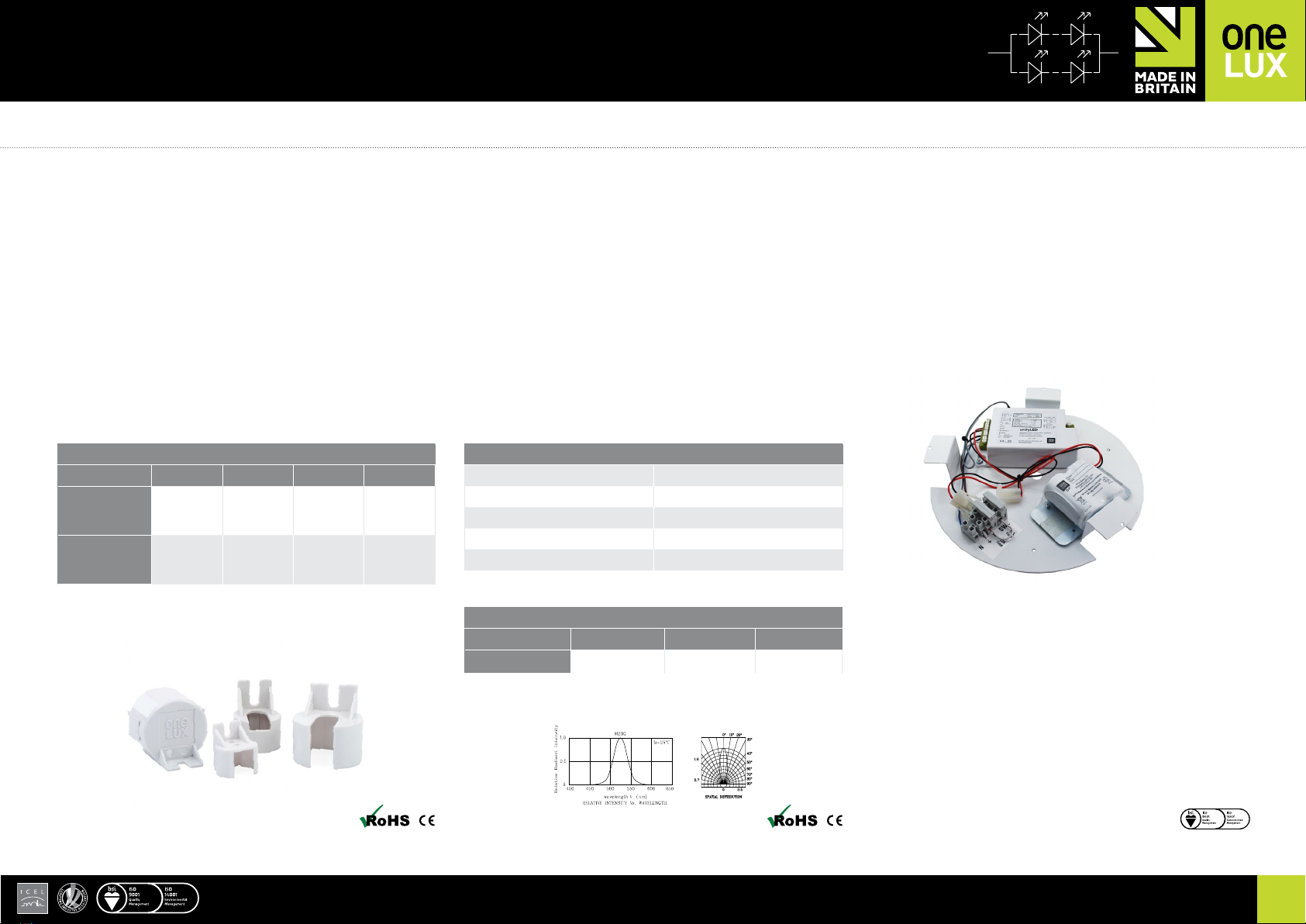
Autonomy Selection Information
Emergency Duration Jumper Setting
3 Hours
(Default Setting)
1 Hour
(Remove plastic jumper)
Omni-LEDTM modules are supplied with a small plastic selector tted, which
denotes 3 hour operation as standard. If 1 hour emergency operation is
required, the selector should be removed.
NiCD or NiMH batteries other than those supplied by One-LUX may be used
with the Omni-LED modules, but in all cases, refer to the ‘Battery & Emergency
Output Characteristics’ table on page 2 for full specication & requirements.
Warning! Permanent battery damage can occur if the 3 hour setting is used with
batteries of less than 4Ah capacity.