manuals.online logo
Brands
  1. Home
  2. •
  3. Brands
  4. •
  5. Orthogonal Devices
  6. •
  7. Controllers
  8. •
  9. Orthogonal Devices ER-102 User manual

Orthogonal Devices ER-102 User manual

Other manuals for ER-102

2

Other Orthogonal Devices Controllers manuals

Orthogonal Devices ER-102 User manual

Orthogonal Devices

Orthogonal Devices ER-102 User manual

Orthogonal Devices ER-102 User manual

Orthogonal Devices

Orthogonal Devices ER-102 User manual

Popular Controllers manuals by other brands

Sunricher SR-ZV9003T3-RGBW-US Installation

Sunricher

Sunricher SR-ZV9003T3-RGBW-US Installation

Ksenia intro Installation and configuration manual

Ksenia

Ksenia intro Installation and configuration manual

Inovance CAN200 Series manual

Inovance

Inovance CAN200 Series manual

Gauzy LC6 FLEX Controller Installation and operation guide

Gauzy

Gauzy LC6 FLEX Controller Installation and operation guide

Viking SLP-1 Technical practice

Viking

Viking SLP-1 Technical practice

CKD KBX-30E-U Series instruction manual

CKD

CKD KBX-30E-U Series instruction manual

Sharp Energy Sun Flux User manual & installation guide

Sharp Energy

Sharp Energy Sun Flux User manual & installation guide

Yamaha RCX40 user manual

Yamaha

Yamaha RCX40 user manual

AB Quality PowerFlex 400 Frames D-H Service bulletin

AB Quality

AB Quality PowerFlex 400 Frames D-H Service bulletin

Yamaha MJC8 owner's manual

Yamaha

Yamaha MJC8 owner's manual

AL-KO ATC operating instructions

AL-KO

AL-KO ATC operating instructions

Savant SmartControl 2 Deployment guide

Savant

Savant SmartControl 2 Deployment guide

GameSir T3S user manual

GameSir

GameSir T3S user manual

Kostal inveor operating manual

Kostal

Kostal inveor operating manual

Emerson Yarway 20-55 Operating and safety instructions

Emerson

Emerson Yarway 20-55 Operating and safety instructions

CoCo ACM-LV24 Quick installation guide

CoCo

CoCo ACM-LV24 Quick installation guide

Brooks SLA5810/20 Installation and operation manual

Brooks

Brooks SLA5810/20 Installation and operation manual

SIGMA TEK SR 011 Technical manual

SIGMA TEK

SIGMA TEK SR 011 Technical manual

manuals.online logo
manuals.online logoBrands
  • About & Mission
  • Contact us
  • Privacy Policy
  • Terms and Conditions

Copyright 2025 Manuals.Online. All Rights Reserved.

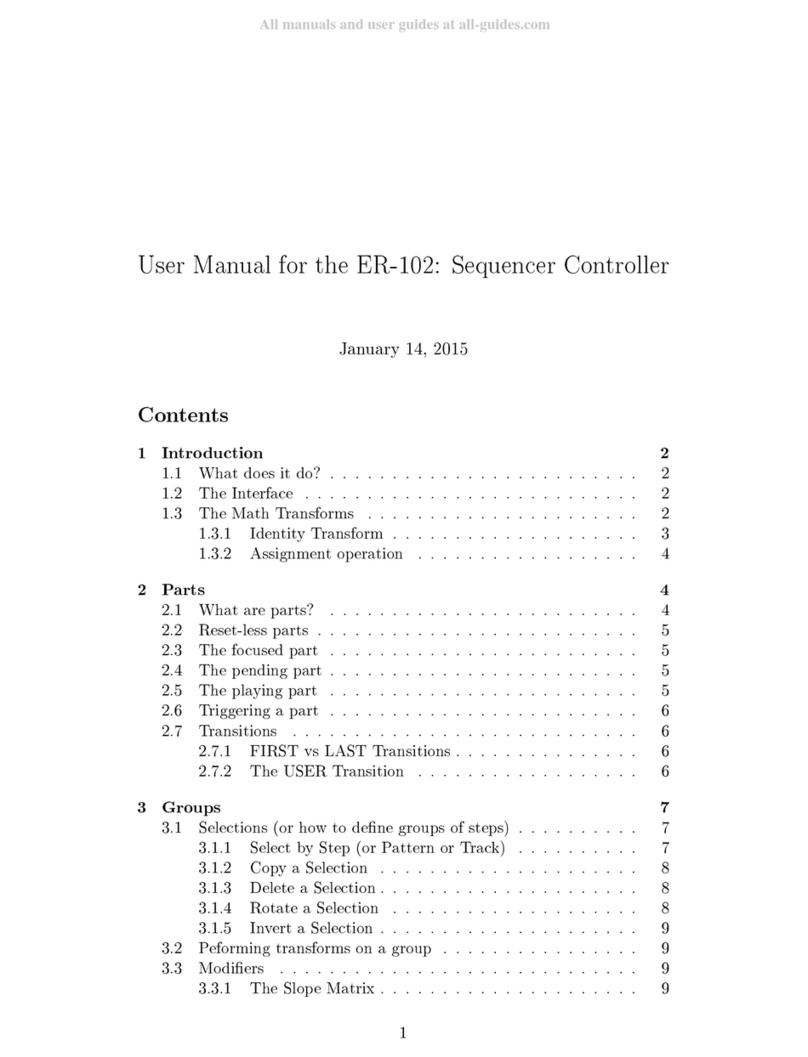
User Manual for the ER-102: Sequencer Controller
January 14, 2015
Contents
1 Introduction 2
1.1 Whatdoesitdo?......................... 2
1.2 TheInterface ........................... 2
1.3 The Math Transforms . . . . . . . . . . . . . . . . . . . . . . 2
1.3.1 Identity Transform . . . . . . . . . . . . . . . . . . . . 3
1.3.2 Assignment operation . . . . . . . . . . . . . . . . . . 4
2 Parts 4
2.1 Whatareparts? ......................... 4
2.2 Reset-lessparts.......................... 5
2.3 Thefocusedpart ......................... 5
2.4 Thependingpart......................... 5
2.5 Theplayingpart ......................... 5
2.6 Triggeringapart ......................... 6
2.7 Transitions ............................ 6
2.7.1 FIRST vs LAST Transitions . . . . . . . . . . . . . . . 6
2.7.2 The USER Transition . . . . . . . . . . . . . . . . . . 6
3 Groups 7
3.1 Selections (or how to dene groups of steps) . . . . . . . . . . 7
3.1.1 Select by Step (or Pattern or Track) . . . . . . . . . . 7
3.1.2 Copy a Selection . . . . . . . . . . . . . . . . . . . . . 8
3.1.3 Delete a Selection . . . . . . . . . . . . . . . . . . . . . 8
3.1.4 Rotate a Selection . . . . . . . . . . . . . . . . . . . . 8
3.1.5 Invert a Selection . . . . . . . . . . . . . . . . . . . . . 9
3.2 Peforming transforms on a group . . . . . . . . . . . . . . . . 9
3.3 Modiers ............................. 9
3.3.1 The Slope Matrix . . . . . . . . . . . . . . . . . . . . . 9
1
3.3.2 The High vs Low Transforms . . . . . . . . . . . . . . 10
4 Recording 11
4.1 Real-timemode.......................... 11
4.1.1 Smooth in, Stepped out . . . . . . . . . . . . . . . . . 13
4.2 Stepmode............................. 13
4.3 Altermode ............................ 14
5 Memory Card 15
5.1 Snapshots............................. 15
5.2 Updating the rmware . . . . . . . . . . . . . . . . . . . . . . 15
6 Notes 16
6.0.1 need more examples throughout the manual . . . . . . 16
1 Introduction
1.1 What does it do?
The ER-102 Sequencer Controller is an expander for the ER-101. It's main
purpose is to place various key aspects of the ER-101 under external voltage
control. These key aspects are control of the play cursor, real-time modula-
tion of step parameters, and the recording/alteration of sequences.
1.2 The Interface
1.3 The Math Transforms
Throughout this manual, you will encounter two types of transforms, de-
structive and non-destructive. A destructive transform permanently alters
the stored parameters of the target steps. These destructive transforms are
always accessed via the MATH button. A non-destructive transform alters
step parameters as they are being interpreted during playback but without
changing their stored values. You will nd non-destructive transforms in the
GROUP MODIFIER section of the ER-102's interface.
All transforms share the following interface:
2
UI element Function
LEFT knob Selects an operation (i.e. add, multiply, randomize, etc.).
RIGHT knob Changes the focused operator's parameter.
FOCUS buttons Focuses the interface on a particular step parameter.
DELETE button Clears all operations so that the transform has no eect.
The letter codes (aka variables) in the transform display are associated
with the following (parameterized) operations:
Code Operation Parameter Default Eect Order
Range Value
A Addition -99 to 99 0 add A 3
G Multiplication 1/99 to 99 1 multiply by G 2
Jt Jitter 0 to 99 0 add a random integer between [-Jt, Jt] 4
Rd Random 0 to 99 0 add a random integer between [0, Rd] 1
Qt Quantize 1 to 99 1 round to the nearest multiple of Qt 5
Currently, Jitter and Random are only available for destructive trans-
forms.
[diagrams of the various operations]
Whenever you perform a transform, all of the operations are applied
together in a specic order. This order of operations is shown in the table
above. The result is the following formula:
New =QUANTIZE G∗Old +RANDOM (Rd)+JITTER(Jt)+A|Q
(1)
where,
New
= the new value of the step parameter
Old
= the old value of the step paramter
QUANTIZE (y|x)
= round y to the nearest multiple of x
RANDOM (x)
= random integer between 0 and x (uniform dis-
tribution)
JITTER(x)
= random integer between -x and x (uniform distri-
bution)
1.3.1 Identity Transform
A transform with all default values for each of its operations has no eect
and is called the identity transform. You quickly reset any transform back
to the identity transform by pressing the DELETE button while the desired
transform is focused.
3
1.3.2 Assignment operation
To achieve the aect of an assignment operation, just set G = 0 and set A
to the desired value.
2 Parts
The top section of the ER-102 is dedicated to the manipulation of parts. Us-
ing parts, you can divide your sequences into smaller sub-sequences (called
parts) and then activate these parts during playback using the manual in-
terface or using voltage control. A single snapshot can contain up to 99
parts.
Figure 1: The PARTS section of the ER-102.
2.1 What are parts?
Looping dierent sections of a track on just the ER-101 is a very eective way
of introducing variations in real-time. However, there are some limitations
with the ER-101:
You cannot save and recall multiple loops. You cannot activate dierent
loops simultaneously across all or some tracks. You cannot change the step
4
that the ER-101 rewinds to on a reset signal. There is no external voltage
control of the play cursor.
The ER-102 removes each of these limitations by introducing the concept
of a part. A part species a reset step and a looped section for each of the
4 tracks such that when a part is triggered, potentially all tracks have their
reset steps and looped sections changed. A track's reset step can be set to
any location in relation to its looped section. This allows for lots of exibility
in arranging what is played as a part starts and then enters its looped section.
In fact, if the looped section is silent (e.g. Part 3 in the lower right gure)
then the reset section describes a kind of one-shot trigger.
2.2 Reset-less parts
This is an important special case. When a part does not have a reset step
specied then this part begins playing from where the previous part left o.
This means that the rhythmic relationship (e.g. sync) of such "resetless"
parts with other tracks can change depending on what part is playing when
they are triggered. On the other hand, parts with reset steps will always start
from the same place. Both kinds of parts are of course musically useful.
2.3 The focused part
The focused part is the part whose number is showing in the PART display.
When you are changing the reset step or the loop section for the current
track, then your changes are always applied to the focused part. The looped
section of the focused part is set with the LOOP START and LOOP END
buttons on the ER-101, while the reset step is specied with the RESET TO
button on the ER-102.
2.4 The pending part
The pending part is the part that is scheduled to play next, after the current
part nishes). When the PART display is focused then the pending part
will be shown in the INDEX display on the ER-101. Also, the PART orange
focus LED will ash when a part is pending but has not yet started playing
yet.
2.5 The playing part
The currently playing part is indicated by the dot in the lower right of the
PART display. Each track will perform according to the reset step and
5
looped section specied in the playing part.
2.6 Triggering a part
Parts are activated or triggered in two ways - manually via the TRANSI-
TION button or remotely via a rising edge on the ACTIVATE input. As
soon as the focused part is activated then it also becomes the pending part
and its number will be ashing in the INDEX display when the PART dis-
play is also focused. When you trigger a part, you are actually triggering
parts across all of the tracks.
2.7 Transitions
Once a part is triggered, the exact time it will start playing depends on the
setting of the TRANSITION switch.
2.7.1 FIRST vs LAST Transitions
When transitioning from one part to the next, it is musically useful to wait
for the current part to nish playing before starting the next pending part.
However, since a single part potentially contains a loop for each track, there is
an ambiguity about when a part exactly nishes. Which track gets to decide
for the other tracks that the current playing part has nished? The FIRST
and LAST transition modes solve this ambiguity. The FIRST transition
mode means that the transition to the pending part will occur as soon as
any track completes its loop. In other words, the rst track to complete its
loop is used to nish the current part and transition to the pending part.
The LAST transition mode waits all tracks to nish a loop at least once
before moving on to the pending part. In other words, the last track to
nish its loop determines the transition to the pending part.
[diagram of rst vs last transition modes]
When the current playing part ends (as dened by the TRANSITION
mode), then all tracks with a RESET TO step dened are reset and the
pending part becomes the current playing part.
2.7.2 The USER Transition
The USER transition mode is by default congured to transition immediately
without a reset (even if there is a RESET TO step dened). However, a reset
on the ER-101 will behave as normal.
6

Notice: Once conguration scripts are introduced in the next rmware,
the behavior of the USER transition mode can be customized. More infor-
mation on this feature will be made available at that time.
3 Groups
The middle section of the ER-102 is dedicated to groups. Groups are arbi-
trary selections of steps that can be the target of transforms and/or CV/gate
modulation. Each snapshot can contain up to 16 groups.
Figure 2: The GROUPS section of the ER-102.
3.1 Selections (or how to dene groups of steps)
3.1.1 Select by Step (or Pattern or Track)
The most basic way to add steps to the current focused group, is to press
the (DE)SELECT button while having the desired step focused. Pressing
the (DE)SELECT button adds the step if it is not part of the group already,
and removes the step if it is already part of the group. The selection LED
(next to the GROUP display) will light up when the focused step is in the
focused group. Furthermore, the navigation focus of the ER-101 (i.e. STEP
vs PATTERN vs TRACK) is used to determine whether a single step, or an
7
entire pattern, or the entire track should be added (or removed) from the
group.
For example, to add all the steps of pattern #3 to group #1:
1. Navigate to group #1.
2. Navigate to any step in pattern #3 that is NOT a member of group
#1.
3. Focus the PATTERN display.
4. Press the DE(SELECT) button.
And to remove all the steps of pattern #3 from group #1 just press the
DE(SELECT) button again. Notice how the selection state of the focused
step determines whether the whole pattern will be added or removed from
the group. In other words, whatever happens to the focused step will also
happen to all the other steps in the focused pattern. This same behavior
applies to entire tracks when we have the TRACK display focused.
3.1.2 Copy a Selection
If you press the COPY button while the GROUP display is focused then
the current group's selection (not the steps themselves) is copied to the
clipboard. At this point the GROUP display LED will start ashing. You
can now navigate to another group and paste the copied selection with the
INSERT button. The pasted selection of steps will combine with the existing
selection of steps in the target group, eectively creating the union of the
two sets.
3.1.3 Delete a Selection
If you press the DELETE button while the GROUP display is focused then
all steps are removed from the focused group.
3.1.4 Rotate a Selection
The ROTATE button will shift a group's selection later in the sequence by
one step. So if, step #4 and step #12 are selected then after pressing the
ROTATE button, step #5 and step #13 are selected. Holding the INVERT
button while pressing the ROTATE button will shift the selection earlier by
one step.
8
3.1.5 Invert a Selection
3.2 Peforming transforms on a group
Each group has its own destructive transform that is accessible via the MATH
button and also 6 non-destructive transforms accessible via the high/low
modiers. Pressing the MATH button while the GROUP display is focused
will show/apply the destructive transform just like accessing the track trans-
forms. When you apply a group transform by pressing and releasing the
MATH button, the transform will only alter the parameters of those steps
that are in the group.
You can edit the transform while holding down the MATH button and
then apply it by releasing the MATH button. Also, you can "pin" the trans-
form edit screen by pressing the VOLTAGE display button so that the screen
stays when you release the MATH button. In this case, press the MATH
button again to exit from the transform edit screen (without applying the
transform).
3.3 Modiers
The modiers of a group specify how the 3 channels of CV/gate modulation
(X, Y, and Z) aect the steps within the group. The SLOPE modier holds
the gain matrix that routes the 3 CV inputs to each parameter of each
step in a group. The HIGH and LOW modiers contain simplied (non-
destructive) transforms which are activated according to the logic state of
the 3 gate inputs.
3.3.1 The Slope Matrix
Each group is associated with a 4x3 matrix of slopes (or gain factors) that are
in the range of -99 to 99. The 3 columns of this slope matrix correspond with
the 3 channels of the modulation inputs: X, Y and Z. The 4 rows correspond
with the 4 step parameters: CV-A, CV-B, DURATION, and GATE. The
voltages, presented at each channel of the modulation bus, are multiplied by
the group's slope matrix and then added to each parameter of the steps in
a group:
{ P
mod[i]
= P
orig[i]
+ K[g] * V | for each step i in the group j }
P
mod[i]
= modied 4-vector of step i's parameters P
orig[i]
= original 4-
vector of step i's parameters K[g] = 4x3 slope matrix of group j (element
range: -99 to 99) V = 3-vector of the modulation CV inputs in Volts (element
range: -10V to 10V)
9
In the case of CV-A and CV-B, this adjustment is added after the voltage
table lookup (i.e. after converting the voltage index to an actual voltage).
To access the slope parameters for a particular modulation channel (i.e.
a row of the matrix K
g
):
1. Toggle the GROUP MODIFIER HIGH/SLOPE/LOW switch to SLOPE.
2. Toggle the GROUP MODIFIER XYZ switch to the desired channel.
3. Press the GROUP MODIFIER focus button.
[diagram: show SLOPE screen]
Now the GROUP display LED and the GROUP MODIFIER display LED
will be lit. This means that the LEFT knob on the ER-101 will alter the
focused group and the RIGHT knob will alter the slope value associated with
the focused step parameter (i.e. CV-A, CV-B, DURATION and GATE).
When altering the slope, please notice that the size of the encoder incre-
ments depends on the slope's magnitude:
Min Max Increment
-99 -10 1
-9.9 -1.0 0.1
-0.99 0.99 0.01
1.0 9.9 0.1
10 99 1
This logarithmic scheme allows for ne control when dialing in small
gains while also making very large gains easy to reach.
3.3.2 The High vs Low Transforms
The GATE inputs on the 3 modulation channels (X, Y, and Z) control which
of each group's (non-destructive) transforms are active. Each group has 6 of
these transforms because there are high and low transforms for each of the
3 channels which is 6 transforms per group. A high voltage (>1.5V) on the
X channel GATE input will activate all of the X-high transforms, while a
low voltage (<1.5V) will activate all of the X-low transforms and so on. If
there is no plug in the GATE input jack then the low transforms are active
by default.
The usual interface for transforms is used to edit a group's high/low
transforms. See the section on Math Transforms.
These high/low transforms have many uses:
10