6
EN
7
EN
3. Précision
Pedometer precision varies according to how you walk. Average variation is
around 10%.
However it may deteriorate according to product position, walking environment
or usage.
This product is not designed for walking races or hiking on hilly or bumpy terrain
as the measurement would be very imprecise (no recording of changes in
altitude/incline). In addition, walking on loose or muddy soil provokes around
5% imprecision.
4. Use
OK OK
OK
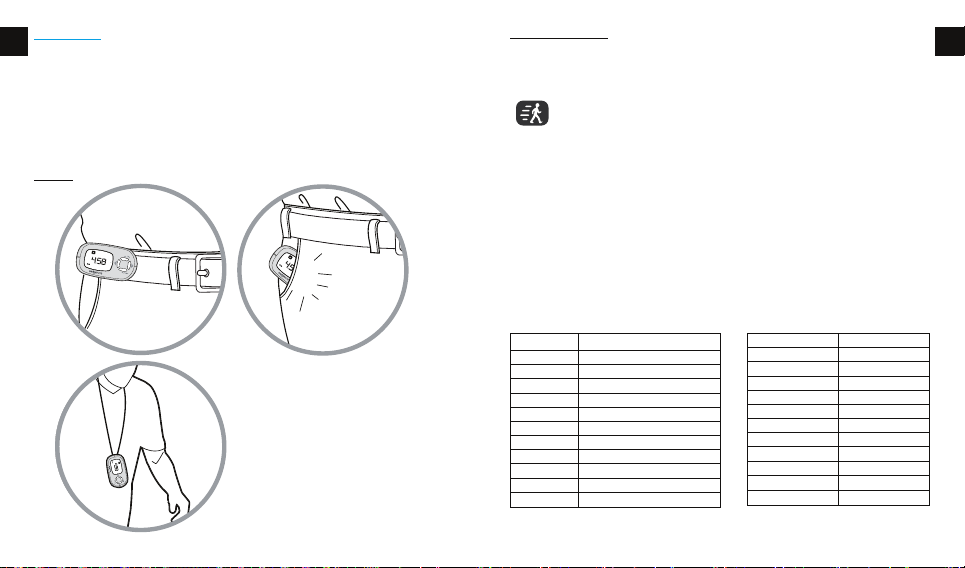
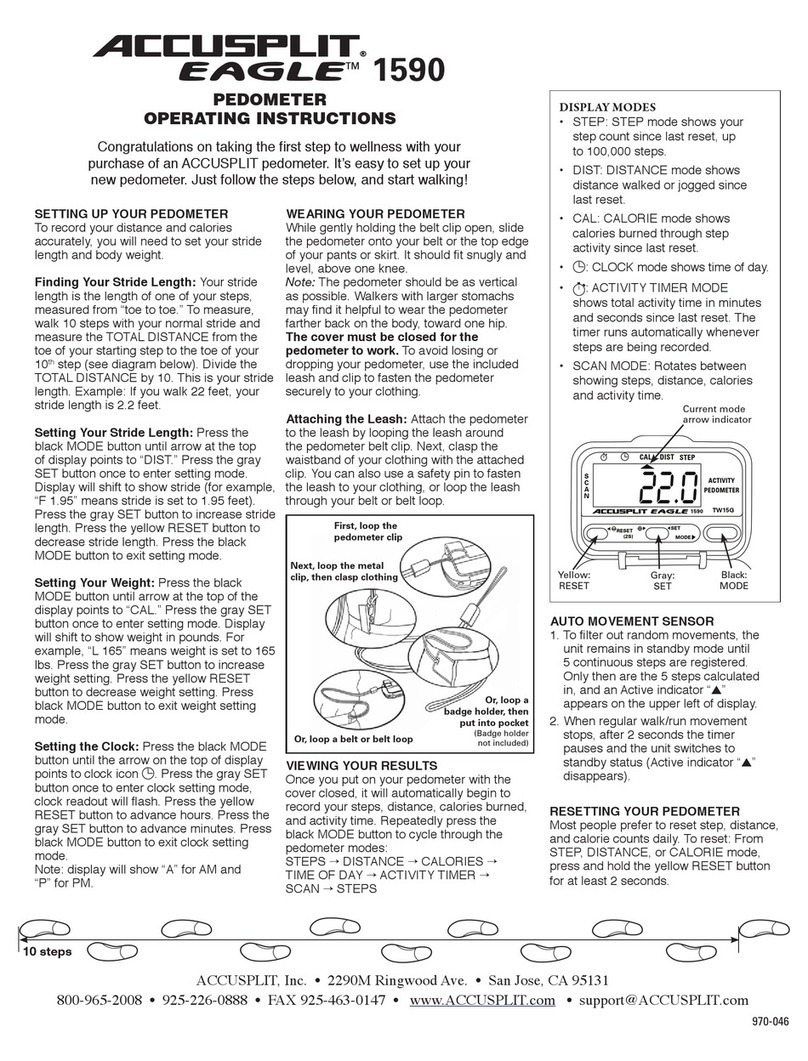
This pedometer is designed to measure
the different parameters of your steps
RQ ÀDW JURXQG 7HFKQLFDOO\ WKHVH
measurements are taken by recording
shock waves caused when your foot
makes contact with the ground; this
requires the product to be attached
somewhere around the hip (trouser or
shorts belt).
5. $FWLYHPLQXWHV
Your pedometer measures and differentiates between walking and active
walking in order to motivate you to walk more and at an increased pace on a
daily basis.
:KDWLV$FWLYH:DONLQJ"
This concept is related to the World Health Organisation’s (W.H.O.)
recommendation to walk for 30 minutes a day at a steady pace. Active
ZDONLQJLV ZDONLQJDWD VWHDG\ SDFHZKLFK LV PRUHEHQH¿FLDO WR \RXUKHDOWK
(helping to prevent obesity, cardiovascular illnesses, anxiety, etc.) according to
the W.H.O.
+RZGRHVLWZRUNIURPDWHFKQLFDOSRLQWRIYLHZ"
A patented algorithm was designed by the Oxylane Research and Development
GHSDUWPHQWVDQGXVHV\RXUZHLJKWDQGKHLJKWDVDEDVLVWRGH¿QHWKHWKUHVKROG
for active walking. Above this threshold (step frequency, etc.), you are actively
ZDONLQJZKLFKLVPRUHEHQH¿FLDOIRU\RXUKHDOWK
Brisk walking trigger point according to your height:
SIZE (cm) Number of steps / minute
120 149
... ...
150-151 132
152-153 131
154-155 130
156-158 129
159-160 128
161-162 127
163-165 126
166-167 125
168-170 124
171-172 123
173-175 122
176-178 121
179-181 120
182-184 119
185-186 118
187-190 117
191-193 116
194-196 115
197-199 114
... ...
220 108