4/TG SERIES
OZONE SOLUTIONS
SECTION 1
SAFETY PRECAUTIONS
Ozone is a powerful oxidizing agent. Observe strict
operating procedures while using ozone equipment.
It is imperative that only ozone compatible materials
are used in conjunction with the ozone system.
Ensure that the Ozone Generator is in a well-ventilated
area. Do not allow rain or condensation to contact the
Ozone Generator. The Ozone Generator is not weather
proof. The unit must be operated indoors or in an
enclosure in a non-condensing environment.
Carefully review and familiarize yourself with the
following important safety information concerning the
Ozone Generator:
1. Ozone is an extremely aggressive and powerful
oxidizer. The Occupational Safety and Health
Administration (OSHA) 8 hour exposure limit is
0.10 PPM. The OSHA 15 minute exposure limit for
ozone is 0.3 PPM. Above 0.3 PPM, there is the risk
of damage to respiratory tissues.
2. People who have no sense of smell should not
operate this equipment.
3. Never attempt to verify ozone production by directly
breathing or smelling the ozone outlet.
4. The Ozone Generator contains high voltages.
Unauthorized entry can result in serious injury or
death. For service instructions, contact Ozone
Solutions.
5. Make sure all connections are secure and are
not leaking. Failure to do so could result in the
discharge of ozone into an undesired space.
INTRODUCTION
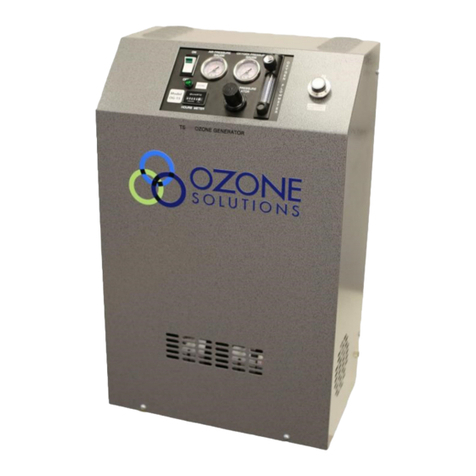
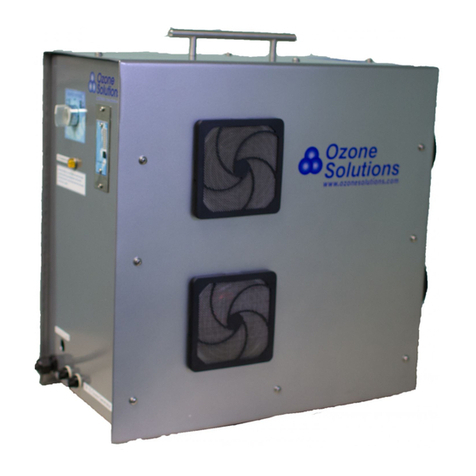
The water cooled ozone generator produces ozone from
oxygen via corona discharge. The TG series is capable
of generating 75-600g/hr of ozone with a feed gas of
90% oxygen. Ozone has many uses including pathogen
inactivation and destruction of odorous gases.
THEORY OF OPERATION
The Ozone Generator produces ozone via the corona
discharge method. This process uses an electrical
spark to split the molecular bond of natural diatomic
oxygen to form the atomic O-form of oxygen. These
O-atoms then bond to other O2molecules to form O3
(ozone).
The spark inside the corona cell is a controlled corona
or spark. This spark is produced by forcing a high
voltage source through a dielectric and a small air gap
where the feed gas ows through. The spark occurs at
a higher-than-line voltage and much higher-than-line
frequencies, which are increased and regulated by the
onboard electronics in the machine.
The basic fundamentals of ow and velocity of gas
through the corona cell allow for more ozone production
(g/hr) as oxygen ow increases. As the ow increases,
the concentration of ozone (% by weight) decreases.
Conversely, as the ow decreases, the concentration
of ozone increases. At very low oxygen ow rates, the
oxygen remains in the corona cell for a longer period
of time.
The contact time (CT value) allows a higher percentage
of oxygen to be converted into ozone. The ozone
production and concentration of the TG ozone machine
can be determined using the performance charts in
this manual.
While the ow rate of the oxygen feed gas affects the
ozone output the most, the pressure of the feed gas
also effects the ozone output. Higher pressures create
higher concentrations of the feed gas which result in
a higher ozone output or concentration. If the feed
gas ow rate remains the same while under a higher
pressure, it allows an increased contact time (CT
value). With increased feed gas pressures, additional
electrical power is needed to create a spark in the
pressurized corona cell. The electronics of the TG series
automatically compensate for the varying pressure to
maximize the ozone output. While increased feed gas
pressure helps achieve a higher output, it also forces
the created ozone molecules back into oxygen at a
quicker rate.
NOTE: If the operator has asthma, he or she must
not enter an airspace that has a signicant ozone
concentration. Ozone can induce an asthma attack.