TS SERIES /7
INSTALLATION & OPERATIONS MANUAL
III. INSTALLATION AND OPERATION
REQUIREMENTS
Location
Ensure that the Ozone Generator is in a well-ventilated
area. This system is not weather proof; therefore a
dust-free, non-condensing, enclosed environment is
required for operation.
There are ventillation openings on the sides and
bottom of the cabinet, which provide ltered air into the
cabinet and exhaust out of the cabinet. A minimum of
eight (8) inches of clear space should be provided to
the left and right sides of the unit, and two (2) inches
from the bottom. The cabinet door must be able to fully
swing open for future maintenance and service.
If mounting the machine, ensure the wall or support
system can withstand the weight of the unit.
Temperature & Humidity
Water must not be allowed to condense in or on
the machine. For best performance, the operating
temperature should be between 40ºF and 95ºF with
a maximum relative humidity of 85%. The storage
temperature should be between -20ºF and 170ºF.
If humidity levels are expected to exceed 85%, it is
recommended that a quality air dehumidier should
be installed in the area of the generator.
Note: Operation outside of specied temperature and
humidity ranges will not be warranted.
Ventillation
Proper ventillation is necessary to ensure safe
conditions for workers around the machine. As the
oxygen concentrator operates, it purges nitrogen into
the area around the system. For systems installed
in conned spaces (less than 2000 cubic feet),
approximately three (3) air changes per hour is
recommended.
Mechanical Connections
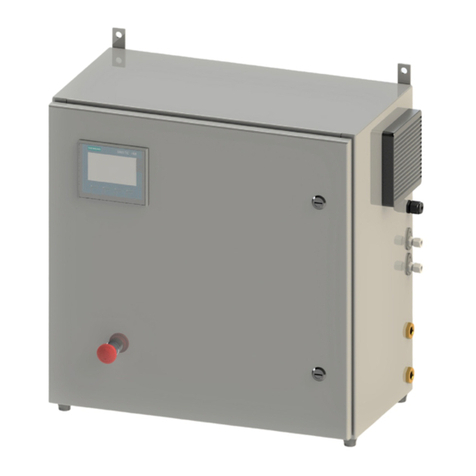
The TS series unit can provide gaseous ozone out of
the 1/4” Swagelok tube compression bulkhead on the
left side of the enclosure. Only use ozone compatible
tubing and ttings to direct the ow of ozone to the nal
point of use.
Electrical
The system requires 110V, 60Hz, 15 amp power. A
power cord is attached and stored on the right side of
the enclosure. The power cord can be omitted if direct
wiring is desired. It is required that a 15 Amp circuit be
dedicated to each unit. Additionally, the unit must be
plugged into this circuit using only the supplied power
cord, and without additional extension cords.
INITIAL START-UP
Once the unit has been installed in a suitable location
in accordance with this manual, it is ready to run.
Complete the following instructions to start up the
system and prepare it for your process.
1. Set the variable output knob to the “0” position so
that ozone is not produced.
2. Ensure that all electrical connections and ozone
tubing connections are complete.
3. Set the system switch to on. The compressor and
oxygen concentrator on board the system will start.
4. The oxygen pressure gauge on the TS system
will indicate increasing pressures as the oxygen
concentrator starts.
5. Check all external ozone tubing connections
for possible leaks or restrictions. Leaks can be
detected by using a spray bottle to apply soapy
water to ttings.
6. Observe the oxygen ow and oxygen pressure on
the system while it is running. Ensure that any
ancillary equipment connected to the system is
also running. Pressure will decrease slightly (1-2
PSI) after the ozone generator has run for about 10
minutes, as the air compressor warms up. Adjust
ow via needle valve in order to maintain 1-10 liters
per minute of ow and 10-15 PSI oxygen pressure.
7. Once ow is properly adjusted, the air pressure
gauge will continuously cycle between 15 and
40 PSI. This is due to the cycling of the oxygen
concentrator, and is normal expected operation.
8. Turn the variable ozone output knob to the “2” or
“3” position to start producing a limited amount of
ozone. After 2-3 seconds, the ozone indicator lamp
should illuminate.