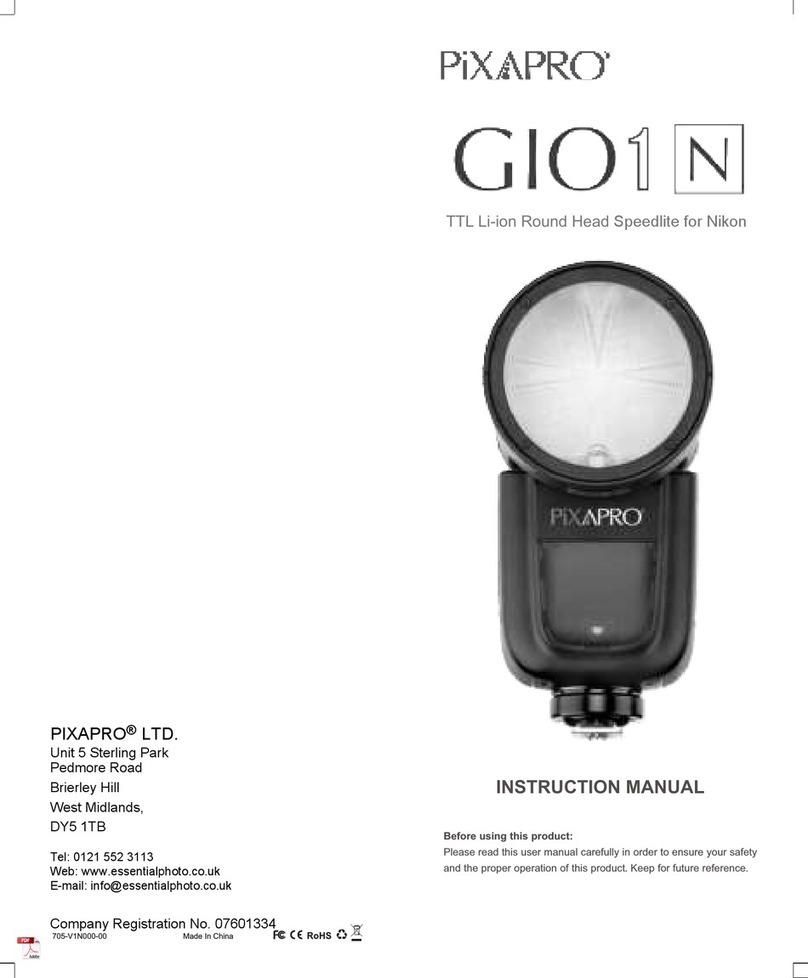
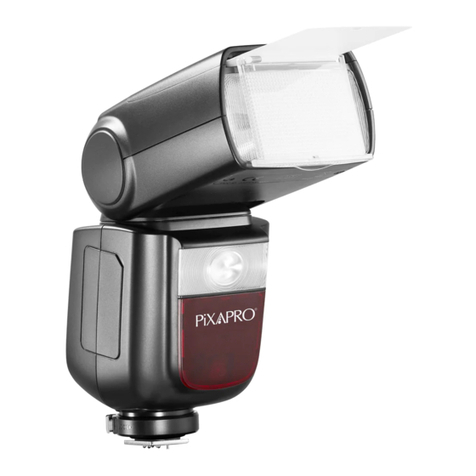
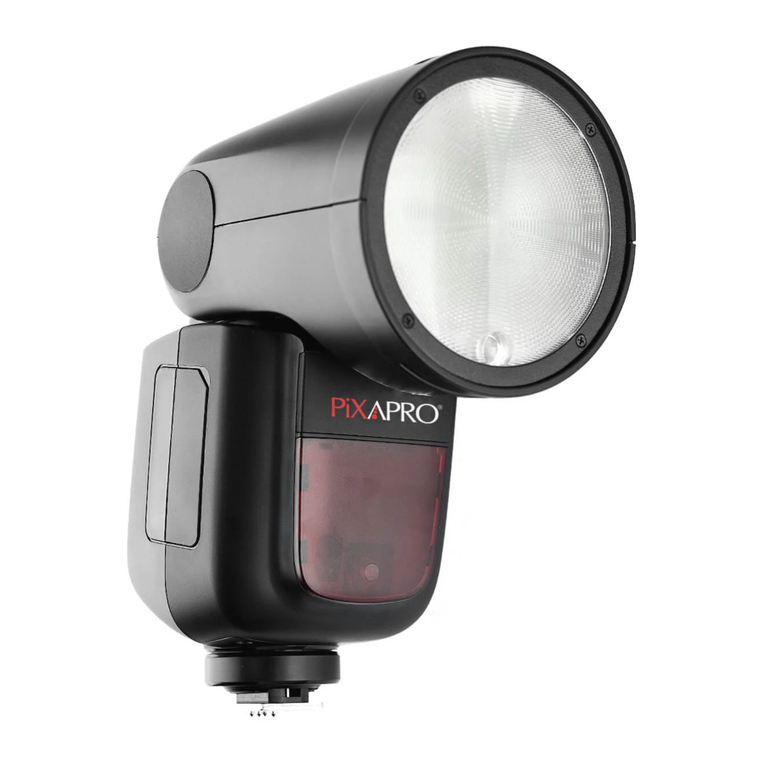
Pixapro GIO1 O User manual

INSTRUCTION MANUAL
Before using this product:
Please read this user manual carefully in order to ensure your safety
and the proper operation of this product. Keep for future reference.
TTL Li-ion Round Head Camera Flash
PIXAPRO® LTD.
50 Popes Lane,
Oldbury,
West Midlands,
B69 4PA
Tel: 0121 552 3113
Web: www.essentialphoto.co.uk
E-mail: info@essentialphoto.co.uk
Company Registration No. 07601334

Always keep this product dry. Do not use in rain or in damp
conditions.
Keep out of reach of children.
Do not disassemble. Should repairs become necessary, this
product must be sent to an authorized maintenance center.
Stop using this product if it breaks open due to extrusion, falling
or strong hit. Otherwise, electric shock may occur if you touch
the electronic parts inside it.
Do not fire the flash directly into the eyes (especially those of
babies) within short distances. Otherwise visual impairment
may occur.
Do not use the flash unit in the presence of flammable gases,
chemicals and other similar materials. In certain circumstance,
these materials may be sensitive to the strong light emitting
from this flash unit and fire or electromagnetic interference may
result.
Do not leave or store the flash unit if the ambient temperature
reads over 50℃. Otherwise the electronic parts may be
damaged.
Turn off the flash unit immediately in the event of malfunction.
● Support with firmware upgrade.
● With round flash head to achieve soft, even and more creative light
effects. It has a 2W LED modeling lamp, which can be used off
the camera.
● 6 max 480Pro 2 00mAh Li-ion Battery- .1.5s recycle- full power pops.
● Use dot-matrix LCD panel to make clear and convenient
operations.
Thank you for purchasing this product.
This GIO1 O camera flash applies to Olympus/Panasonic series
cameras and is compatible with TTL autoflash. With this TTL
compatible flash, your shooting will become simpler. You can
easily achieve a correct flash exposure even in complex light-
changing environments. This camera flash features:
● With built-in 2.4GHz wireless remote system to support
transmitting and receiving.
● Fully support Olympus/Panasonic TTL camera flash. Workable as
Master or Slave unit in a wireless flash group.
● Provided multiple functions, include HSS (up to 1/8000s), FEC,
FEB, etc.
● 76Ws power output at the max step. 81 steps from 1/1 to 1/128.
● Stable consistency and color temperature with good even lighting.
Warning
Foreword
-01 - - 02 -

01
02
05
09
10
10
10
11
13
14
15
22
24
25
26
27
28
28
28
Foreword
Warning
Name of Parts
Body
Control Panel
Dot-matrix LCD Panel
LCD Panel in Three Modes
What's in the Box of GIO1 O
Kit?Separately Sold
Accessories Battery
LED Modeling Lamp
Attaching to a Camera
Power Management
Flash Mode — TTL Autoflash
FEC (Flash Exposure Compensation)
High-Speed Sync
Second-Curtain Sync
M: Manual Flash
Multi: Stroboscopic Flash
Wireless Flash Shooting: Radio (2.4G) Transmission
Wireless Settings
Group Mode Selection
Setting the Communication Channel
Wireless ID Settings
Scan the Spare Channel
TTL: Fully Automatic Wireless Flash Shooting
M: Wireless Flash Shooting with Manual Flash
Multi: Wireless Flash Shooting with Manual Flash
Other Applications
Sync Triggering
Bounce Flash
ZOOM: Setting the Flash Coverage
Low Battery Indicator
C.Fn: Setting Custom Functions
Protection Function
Technical Data
Troubleshooting
Firmware Upgrade
Compatible Camera Models
Maintenance
Contents
-03 - - 04 -
Conventions used in this Manual
● This manual is based on the assumption that both the camera
and camera flash’s power switches are powered on.
● Reference page numbers are indicated by “p.**”.
● The following alert symbols are used in this manual:
The Caution symbol gives supplemental information.
The Note symbol indicates a warning to prevent shooting
problem.

16
22
23
14
12
11
24
15
21
13
17
18
20 19
08
04
06
07
03
01
05
02
09
10
01. Flash Head
02. LED Modeling Lamp(01~10)
03. Wireless Sensor
05. Type-C USB Port
07. Hotshoe
08. LCD Panel
10. Lithium Battery04. Sync Cord Jack
06. Battery Remove Button
09. Hotshoe Fixing Buckle
●Body
●Control Panel
●LCD Panel
Name of Parts
(1)TTL Autoflash
Zoom : zoom display (Page 23)
: Automatic
: Manual(Page 13)
TTL : TTL autoflash
Focus length (Page 23)
: High-speed sync
(Page 12)
Distance indicator
display
Flash exposure
compensation amount
(2)M Manual Flash
● The functions displayed above function buttons 1 to 4, such
as and <M/A/B/C/D> , change according to settings’
status.
● The display will only show the settings currently applied.
● When a button or dial is operated, the LCD panel illuminated.
M : Manual flash
Manual flash output
(3)Multi Flash
Multi : Stroboscopic flash
Number of flashes
Flash frequency
12. < >Wireless Selection
Button
15. ON/OFF Power Switch
16. < > Test Button / Flash
Ready Indicator
13. Select Dial
18. <MODE>Mode Selection
Button
19. < >Modeling Lamp Setting
11. <MENU>Flash Menu
Button/Locking Button
20. <+/->Power Output
24. Function Button 4
14. Set Button
17. <ZOOM> Focus Length
Setting
21. Function Button 1
22. Function Button 2
23. Function Button 3
SYNC
-05 - - 06 -

Firing group
Flash mode
Channel
: Radio transmission
wireless shooting
(4) Radio Transmission Shooting
● Master Unit
●Slave Unit
: Slave
: Slave icon
●LCD Panel in Three Modes
● Attached to the Camera
● 2.4G Radio Transmission: As a Master Unit
● 2.4G Radio Transmission: As a Slave Unit
●What’s in the Box of GIO1 O Kit?
1. Flash Unit 2. Lithium Battery 3. USB Battery Charger
4. USB Cable 5. Charger 6. Mini Stand
7. Protection Case 8. Instruction Manual
●Separately Sold Accessories
The product can be used in combination with the following accessories
sold separately, so as to achieve best photography effects:
ST-IV O & ST-III O TTL wireless flash trigger, Round Head accessory
kit for round flash head, etc.
-07 - - 08 -
1 2 34
67
5

●Features
1. This flash unit uses Li-ion battery which has long runtime. The
available charge-and-discharge times are 500.
3. Take only 3.5 hours to fully charge the battery by using the
standard battery charger.
2. It is reliably safe. The inner circuit is against overcharge,
overdischarge, overcurrent, and short circuit.
●Cautions
6. Do not put aside or into fire.
8. If the battery had ceased using for over 3 months, please make a
full recharge.
4. No over 24 hours’ continuous charging.
1. Do not short circuit.
5. Store in dry, cool, ventilated places.
7. Dead batteries should be disposed according to local regulations.
2. Do not expose to rain or immerse into water. This battery is not
water proof.
3. Keep out of reach of children.
●Loading and Unloading the Battery
Battery
To unload the battery, hold
1down the battery remove
button and push the battery
downwardly to take it out.
According to the triangle sign
2on the battery pack, insert it
into the compartment until a
white knob locks the battery
with a click sound.
●Battery Level Indication
Make sure the battery pack is securely loaded in the flash. Check
the battery level indication on the LCD panel to see the remaining
battery level.
Battery Level Indication
3 grids
2 grids
1 grid
Blank grid
Blinking
Attaching to a Camera
Attach the Camera Flash.
1● Rotate the hotshoe fixing
buckle to the left and insert
the camera flash into the
camera's hotshoe.
Secure the Camera Flash.
2● Rotate the hotshoe fixing
buckle to the right until it
locks up.
Detach the Camera Flash.
3● Press the button and
rotate the hotshoe fixing
buckle to the left until it is
loosened.
Power Management
Use ON/OFF Power Switch to power the flash unit on or off. Turn
off if it will not be used for an extended period of time. Setting as a
master flash, it will turn the power off automatically after a certain
period (approx. 90 seconds) of idle use. Pressing the camera
shutter halfway or pressing any flash button will wake up the flash
unit. Setting as a slave flash, it will enter sleep mode after a certain
period (adjustable, 60 minutes by default) of idle use. Pressing any
flash button will wake it up.
The battery level is going to be used out
immediately. And the flash will auto power off
in 1 minute.
Note: Please recharge the battery as soon as
possible (within 10 days). Then, the battery can be
used or be placed for long period.
Meaning
Full
Middle
Low
Lower battery, please recharge it.
LED Modeling Lamp
Press the Modeling Lamp Setting button to set the modeling
lamp. Short press the Set Button to turn on or off the modeling
lamp. When turning the modeling lamp on, turn the select dial
to set its brightness. There are 10 levels(01~10) for choice.
- 09 - - 10 -

Flash Mode—TTL Autoflash
TTL Mode
* Press < MODE > Mode Selection Button and three flash modes
will display on the LCD panel one by one with each pressing.
This flash has three flash modes: TTL, Manual (M), and Multi
(Stroboscopic). In TTL mode, the camera and the flash will work
together to calculate the correct exposure for the subject and the
background. In this mode, multiple TTL functions are available:
FEC, HSS, second curtain sync, modeling flash, control with the
camera’s menu screen.
● When the shutter button is fully pressed, the flash will fire a pre-
flash that the camera will use to calculate exposure and flash
output the instant before the photo is taken.
● Press the camera release button halfway to focus. The aperture
and effective flash range will be displayed in the viewfinder.
Press < MODE > Mode Selection Button to enter TTL mode. The
LCD panel will display.
Setting FEC:
With FEC function, this flash can adjust from -3 to +3 in 1/3rd stops.
It is useful in situations where minor adjusting of the TTL system is
needed based on the environment.
FEC: Flash Exposure Compensation
● Turn the Select Dial to set
the amount.
Set the flash exposure
2compensation amount.
● “0.3”means 1/3 step,
“0.7”means 2/3 step.
● To cancel the flash
exposure compensation,
set the amount to “+0”.
Press Set Button again to
3confirm the setting.
Press Function Button 2
1Press the <+/-> button. The
icon < > and flash
exposure compensation
amount will be highlighted on
the LCD panel.
C.Fn
C.Fn
Disabling Auto Power Off function is recommended when
the flash is used off camera. (C.Fn-STBY, Page 24) Slave
Auto Power Off Timer is set to 60 minutes by default.
Another option “30 minutes” is available. (C.Fn-Sv STBY,
Page 24)
-11 - - 12 -
Shutter Sync Settings:
● Try not to use high-speed sync flash, for using this
function will reduce flash tube’s service life.
● Multi flash mode cannot be set in high-speed sync mode.
● With high-speed sync, the faster the shutter speed, the
shorter the effective flash range.
● Over-temperature protection may be activated after 15
consecutive high-speed sync flashes.
Note: In the wireless remote control mode, using high-speed
sync flash with Panasonic camera may occur out of sync.
1. High-speed sync: press the <SYNC> button and is displayed
on the LCD panel. Press the OK or button on OLYMPUS or
MENU button on PANASONIC camera to enter Flash Mode and
choose Fill-flash . Then, set the camera shutter.
2. Press OK or button on Olympus camera or MENU button on
Panasonic camera to set second-curtain mode. And set camera
shutter after mode is displayed.
2nd-C

The flash output is adjustable from 1/1 full power to 1/256th power
in 1/10th stop increments. To obtain a correct flash exposure, use a
hand-held flash meter to determine the required flash output.
M: Manual Flash
Press < MODE > button so
1that < M > is displayed.
Press the <+/-> button and turn
2the Select Dial to choose a
desired flash output amount.
Press Set Button again to
3confirm the setting.
Optic S1 Secondary Unit Setting
In M manual flash mode, press <S1/S2> button so that this flash can
function as an optic S1 secondary flash with optic sensor. With this
function, the flash will fire synchronously when the main flash fires,
the same effect as that by the use of radio triggers. This helps create
multiple lighting effects.
Optic S2 Secondary Unit Setting
Press <S1/S2> button so that this flash can also function as an optic
S2 secondary flash with optic sensor in M manual flash mode. This
is useful when cameras have pre-flash function. With this function,
the flash will ignore a single “preflash” from the main flash and will
only fire in response to the second, actual flash from the main unit.
● S1 and S2 optic triggering is only available in M manual
flash mode.
Turn the Select Dial to
3choose a desired flash
output.
● After you finish the setting,
press Set Button and all the
settings will be displayed.
Multi: Stroboscopic Flash
You can set the firing frequency (number of flashes per sec.
expressed as Hz), the number of flashes, and the flash output.
With stroboscopic flash, a rapid series of flashes is fired. It can be
used to capture a multiple images of a moving subject in a single
photograph.
Press <MODE> button so
1that < > is displayed.
Calculating the Shutter Speed
During stroboscopic flash, the shutter remains open until the firing
stops. Use the formula below to calculate the shutter speed and set
it with the camera.
For example, if the number of flashes is 10 and the firing frequency is
5 Hz, the shutter speed should be at least 2 seconds.
Number of Flashes / Flash Frequency = Shutter Speed
To avoid overheating and deteriorating the flash head, do not
use stroboscopic flash more than 10 times in succession.
After 10 times, allow the camera flash to rest for at least 15
minutes. If you try to use the stroboscopic flash more than 10
times in succession, the firing might stop automatically to
protect the flash head. If this happens, allow at least 15
minutes’ rest for the camera flash.
● Stroboscopic flash can be used with“buLb”.
● If the number of flashes is displayed as “--”, the firing will
continue until the shutter closes or the battery is
exhausted. The number of flashes will be limited as shown
by the following table.
● A flash output of 1/1 and 1/2 cannot be set for stroboscopic
flash.
● Using a tripod and a remote control is recommended.
● Stroboscopic flash is most effective with a highly reflective
subject against a dark background.
MULTI
● Press the Function Button
3 <Hz> to select the flash
frequency. Turn the Select
Dial to set the number.
● Press the Function Button
2 <Times> to select the
flash times. Turn the Select
Dial to set the number.
Set the flash frequency and
2flash times.
-13 - - 14 -

Hz
Maximum Stroboscopic Flashes:
Flash
output
Hz
Flash
output
Wireless Flash Shooting: Radio (2.4G) Transmission
The basic relative position and operation range are as shown in the
picture. You can then perform wireless TTL autoflash shooting just
by setting the master unit to <TTL>.
Using a flash (master/slave) with a radio transmission wireless
shooting function make it easy to shoot with advanced wireless
multiple flash lighting, in the same way as TTL autoflash shooting.
●The GIO1 O attach to the camera is called the master unit,
and a GIO1 O that is wirelessly controlled is called the
slave unit.
●You can also wirelessly control the GIO1 O set as the slave
unit with the transmitter ST-III O or ST-IV O (sold
separately). For details on setting the master unit functions,
see the transmitter’s instructions.
1/4
1/8
1/16
1/32
1/64
1/128
1/256
1
8
14
30
60
90
90
90
2
6
14
30
60
90
90
90
3
4
12
30
60
90
90
90
4
3
10
20
50
80
90
90
5
3
8
20
50
80
90
90
6-7
2
6
20
40
70
90
90
8-9
2
5
10
30
60
80
80
1/4
1/8
1/16
1/32
1/64
1/128
1/256
10
2
4
8
20
50
70
70
20-50
2
4
8
16
30
40
40
60-100
2
4
8
12
20
40
40
Positioning and Operation Range (Example of wireless flash
shooting)
● Autoflash Shooting with One Slave Unit
● Before shooting, perform a test flash and test shooting.
● Use the supplied mini stand to position the slave unit.
● The transmission distance might be shorter depending on
the conditions such as positioning of slave units, the
surrounding environment and whether conditions.
Transmission distance is about 100m.
● Auto Shooting with Two Slave Groups
● Auto Shooting with Three Slave Groups
You can divide the slave units into two or three groups and perform
TTL autoflash while changing the flash ratio (factor). In addition, you
can set and shoot with a different flash mode for each firing group,
for up to 4 groups.
Wireless Multiple Flash Shooting
A
B
A
B
C
-15 - - 16 -

Slave Unit Setting
Master Unit Setting
Press < > button so that < >
is displayed on the LCD panel.
Press < > button so that < >
or < > are displayed on
the LCD panel.
2. Group Mode Selection
The function button 1/2/3/4
1can can control the group
M/A/B/C. Short press
function button can select
TTL/M/OFF. Choose one of
them as the flash mode of
the master unit.
Press <MODE> button to
2switch to Multi mode.
You can switch between normal flash and wireless flash. For normal
flash shooting, be sure to set the wireless setting to OFF.
1.Wireless Settings
If there are other wireless flash systems nearby, you can change the
channel IDs to prevent signal interference. The channel IDs of the
master unit and the slave unit(s) must be set to the same.
3. Setting the Communication Channel
Press <MENU> Button to
1enter C.Fn CH setting.
In C.Fn CH, turn the Select
2Dial to choose channel ID
from 1 to 32.
Press the Set Button to
3confirm.
4. Wireless ID Settings
Change the wireless channels and wireless ID to avoid interference
master unit and the slave unit are set to the same.Press the <MENU>
button to enter C.Fn ID. Press the Set Button to choose OFF channel
expansion shutdown, and choose any figure from 01 to 99.
for it can only be triggered after the wireless IDs and channels of the
C.Fn Ver 0.5
CLEAR
CH
ID
BEEP
STBY
07
SCAN
5. Scan the Spare Channel
To avoid the interference of using the same channel by others, this
function can be used: enter the C.Fn settings and find the SCAN
option. When setting it to START, it will scan from 1% to 100%. And
the 8 spare channels will be displayed after the scan is completed.
6. TTL:Fully Automatic Wireless Flash Shooting
Using Automatic Wireless Flash with a Single Slave Unit
Master Unit Setting
1● Attach a GIO1 O camera
flash on the camera and
set it as the master unit.
●M/A/B/C can be set to
TTL separately.
- 17 - - 18 -
C.Fn Ver 0.5
CLEAR
CH
ID
BEEP
STBY
99
SCAN
C.Fn Ver 0.5
CLEAR
CH
ID
BEEP
SCAN
22 08 32 23
30 21 07 06
Table of contents
Other Pixapro Camera Flash manuals

Pixapro
Pixapro GIO 1 C User manual

Pixapro
Pixapro HYBRID360 ITTL User manual

Pixapro
Pixapro CITI600 User manual

Pixapro
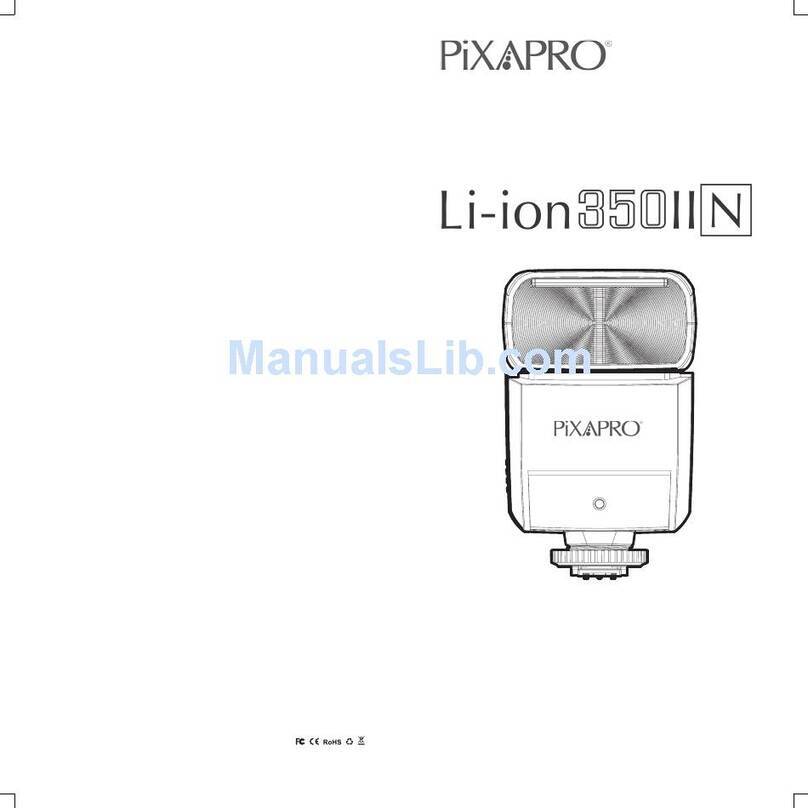
Pixapro Li-ion 350 II N User manual

Pixapro
Pixapro Li-ion580 ETTL User manual

Pixapro
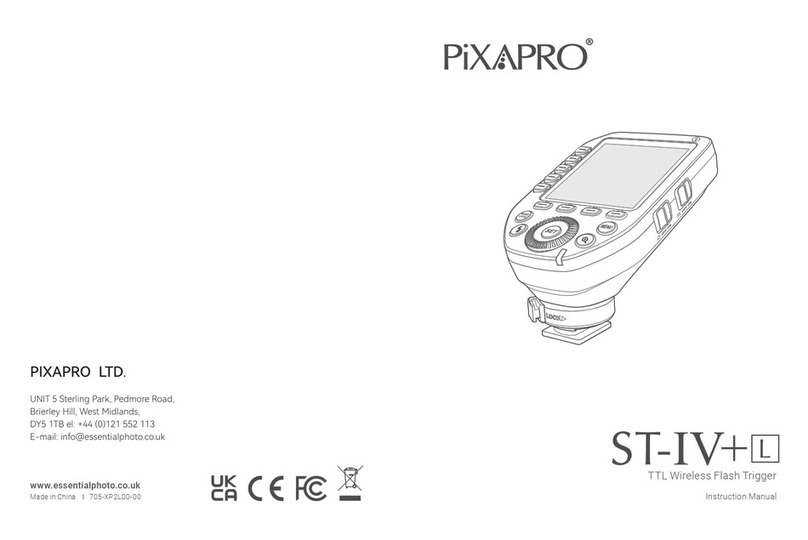
Pixapro ST-IV+ L User manual

Pixapro
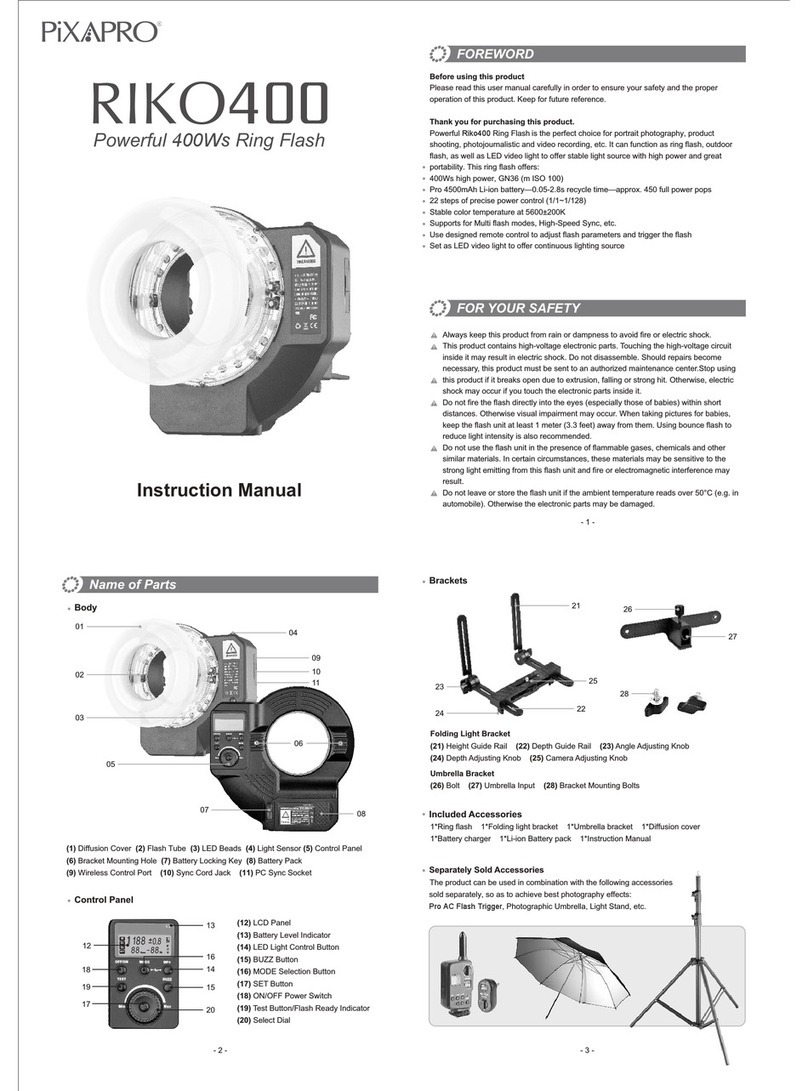
Pixapro RIKO400 User manual

Pixapro
Pixapro Li-ion580 III F User manual

Pixapro
Pixapro GIO1N User manual

Pixapro
Pixapro MACRO MF-R76 User manual