Rev. A 10/18
3
Application NoteAN-72
www.power.com
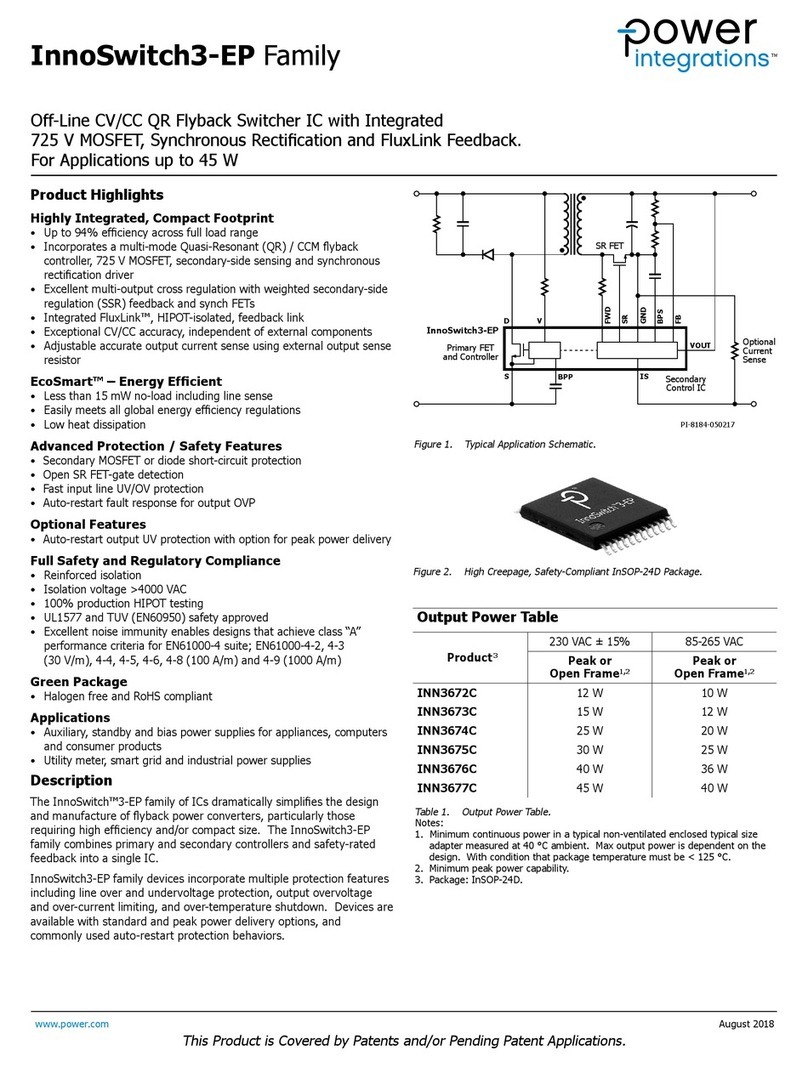
Table 1. Output Power Tables of InnoSwitch3-CE and EP.
• Enter AC input voltage range and line frequency, VAC_MIN [B3],
VAC_MAX [B4], LINEFREQ [B6]
• Enter input capacitance, CAP_INPUT [B7]
• 3 µF / W for universal (85-265 VAC) or single (100/115 VAC) line.
A more aggressive value of 2 µF / W can be used for many
charger designs that do not need to meet hold up time require-
ment
• Use 1 µF/W for 230 VAC or for single (185-265 VAC) line. If this
cell is left blank then the capacitance value for a VMIN of 70 V
(universal input) or 150 V (single 230 VAC) is calculated. Often
this will lead to an optimal input lter capacitance value
• Enter nominal output voltage, VOUT [B8]
• Enter desired cable drop compensation, PERCENT_CDC [B9]
• “0%” for no cable compensation
• “1% - 6%” for featured H-code trim
• Enter continuous output current, IOUT [B10]
• Enter efciency estimate, EFFICIENCY [B12]
• 0.83 for universal input voltage (85-265 VAC) or single 100/115
VAC (85-132 VAC) and 0.85 for a single 230 VAC (185-265 VAC)
design. Adjust the number accordingly after measuring the
efciency of the rst prototype-board at max load and VACMIN
• Select power supply enclosure, ENCLOSURE [B14]
• Select current limit mode, ILIMIT_MODE [B19]
• Two current limit congurations are available, STANDARD or
INCREASED
• Select InnoSwitch3 from drop-down list or enter directly [B20]
• Select the device from Table 1 according to output power, input
voltage and application
• InnoSwitch3-CE for CV/CC yback application
• InnoSwitch3-EP for CV/CC yback application with 725 V
MOSFET
• Enter desired maximum switching frequency at full load, FSWITCH-
ING_MAX [B34]
• Enter desired reected output voltage, VOR [B35]
• Enter core type (if desired), CORE [B63] from drop down menu
• Suggested core size will be selected automatically if none is
entered [B63]
• For custom core, enter CORE CODE [B64], and core parameters
from [B65] to [B72]
• Enter secondary number of turns [B88]
If any warnings are generated, make changes to the design by
following instructions in spreadsheet column D.
• Build transformer as suggested in “Transformer Construction” tab
• Select key components
• Build prototype and iterate design as necessary, entering measured
values into spreadsheet where estimates were used (e.g. efciency,
VMIN). Note that the initial efciency estimate is very conservative.
Output Power Table
Product3
230 VAC ± 15% 85-265 VAC
Peak or
Open Frame1,2
Peak or
Open Frame1,2
INN3672C 12 W 10 W
INN3673C 15 W 12 W
INN3674C 25 W 20 W
INN3675C 30 W 25 W
INN3676C 40 W 36 W
INN3677C 45 W 40 W
Notes:
1. Minimum continuous power in a typical non-ventilated enclosed typical size
adapter measured at 40 °C ambient. Max output power is dependent on the
design. With condition that package temperature must be < 125 °C.
2. Minimum peak power capability.
3. Package: InSOP-24D.
Output Power Table
Product3
230 VAC ± 15% 85-265 VAC
Adapter1Open
Frame2Adapter1Open
Frame2
INN3162C 10 W 12 W 10 W 10 W
INN3163C 12 W 15 W 12 W 12 W
INN3164C 20 W 25 W 15 W 20 W
INN3165C 25 W 30 W 22 W 25 W
INN3166C 35 W 40 W 27 W 36 W
INN3167C 45 W 50 W 40 W 45 W
INN3168C 55 W 65 W 50 W 55 W
Notes:
1. Minimum continuous power in a typical non-ventilated enclosed typical size
adapter measured at 40 °C ambient. Max output power is dependent on the
design. With condition that package temperature must be < 125 °C.
2. Minimum peak power capability.
3. Package: InSOP-24D.