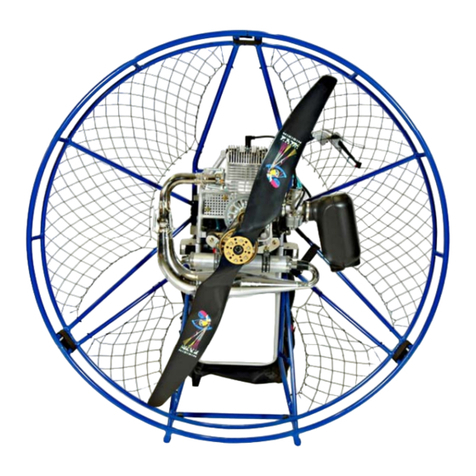
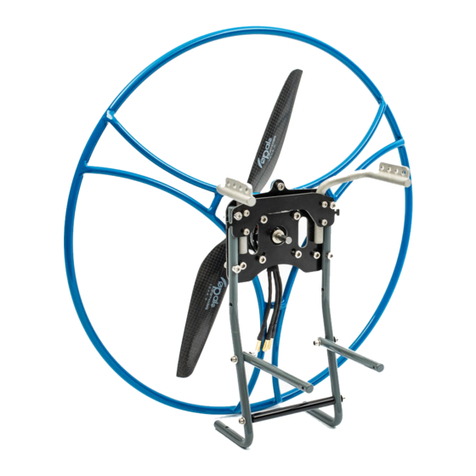
Propeller Sky100 User manual

User Manual
For paramotors
Sky100
and
Sky100 Light
We reserve all rights including technical modification and possibility of errors.
Reprinting, translation or copies in whole or in part, authorized only by:
Propeller OÜ

Thank you for choosing the Propeller Paramotor equipped with the Sky100 engine type
Propeller OÜ has been specialised in the development of powered paragliding since 200 .
Our paramotors are built for performance and resistance.
Warning: Before starting with installation and operation of the engine, observe the carefully this
manual and attached Sky 00 engine manual and follow all written instructions.
NB
●This is not a „How-to-fly“ manual.
●Don't take risk to fly without proper training.
●You need to learn paramotor piloting by a professional instructor.
The paramotor package contains the following parts:
Qty. Description
Propeller paramotor with Sky 00 engine
4 Propcage elements
Sky 00 engine manual and Paramotor end user manual
2 or 3-blade Helix-Carbon propeller with mounting equipment
2 propeller covers
Technical specification
2
Sky100
CC
: 4
Starter
4 l
4 parts
,4 ,28
Propeller
,25 ,20
Sky100 Light
Engine type Sky 00 , monocyl. 2-stroke, water cooled
02 cm3
Carburator Walbro W8
Power 8 hj / 0200 rpm
Reduction Mechanical, oil lubrificated
Reduction ratio
Clutch Centrifugal
Manual
Thrust up to 60 kg up to 56 kg
Fuel Unleaded 95 + 2-3% synthetic oil
Fuel tank
Fuel Consumption Ca 3-4 l/h
Frame Aluminium alloy D 6T
Propcage
Propcage diameter
Carbon 2 or 3 blade
Propeller diameter
Weight 25 kg 22,5 kg
Max pilot weight 0 kg 00 kg
Recommended pilot weight 80 - 00 kg 75-95 kg
Harness APCO automatic buckles
Sizes cm 40 x 40 x 40 28 x 28 x 40

Frame mounting procedure
The Propeller paramotor frame and propcage are made using a aluminium alloy D 6T welded with
argon gas. Its simplicity should not let you forget its technical level of construction. The ratio
between its weight and strength properties represent ideal protection for the pilot in case there is an
impact because it property warps and smoothly absorbs the impacts.
The frame and propcage also helps to protect the pilot from the propeller.
Turning propeller is the most dangerous part of your paramotor
You should always mount properly your propcage before starting the engine
The netting is an important part of this protection disposal because it can prevent medium size
objects going into your propeller (and therefore damaging or breaking it). But mostly, it is there to
prevent any exposure of the pilot with the propeller. It is important for the netting to remain tensed
and well maintained – make sure to have spare cable ties in your tool kit.
Propcage come in 4 parts
NB When tightening the Velcros: use one hand to press firmly the parts together and the other hand
to secure the Velcros into place.
Four part propcage
3

. Assemble parts A and B of the propcage to the
frame. First join firmly lower connector(s)
2. Then join the lateral 2 connectors.
3. Proceed to tighten lower Velcros
(Sky100 Light has only lateral Velcros)
4. Tighten lateral Velcros in a bottom to top order.
4

5. Plug comfort bars of the harness into
appropriate hole on the frame and push them to
the end.
6. Pay attention not to twist any straps or webbing
on the harness. Comfort bar must be outside of
any webbing.
7. Turn comfort bar so that it points vertically up. 8. Secure the comfort bars with the pins attached
on propcage.
5

9. Then assemble parts C and D.
0. First join firmly connectors placed on the top
of the frame
. Join firmly lateral and top plastic connector(s)
on the propcage
2. Proceed to tighten lateral and upper Velcros in a bottom to top order.
3. Tighten all remaining Velcros on the propcage.
6

Starter chord mounting
. Open the shackle screw fixed on the propcage. 2. Put the pulley on starter rope into the shackle
as shown.
3. Close the shackle screw.
NB If you let the shackle screw open the forces applied by starting procedure will certainely
damage the shackle.
7

Propeller mounting procedure
The propeller included in your paramotor pack is 2-blade (or 3-blade) carbon fibre propeller. It
dismantles into two parts and therefore is particularly interesting for those who travel often. It is
quite resistant to impacts produced by small stones, pebbles, and sand. Also, compared to wooden
propeller, it will give you a couple of kilos more of thrust and reduce considerably the noise made
by your paramotor.
Use the six bolts, six nuts and front plate provided.
Always tight the propeller bolts following an “X” shape order ( , 4, 2, 5, 3, 6 etc.)
Attention You have to use always the same type of propeller with the Sky 00 engines. If you plan
to use a different propeller model then you have to contact your local dealer or directly speak to us.
Otherwise you risque to make serious damage your engine which are in this case not covered by
any warranty!
8

Harness adjustment
We equipe our paramotors with the prestigious APCO harness. This harness has been specially
designed for Propeller paramotors
Harness include:
●3 automatic metallic buckles, one ventral and two for the legs;
● small plastic buckle on chest to secure harness on shoulders
●Adjustable extension for the harness seatplate;
●High-quality pulleys for the foot accelerator;
●Connection points for rescue system;
● very large pocket below the seatplate
●AustriAlpin automatic steel karabiners
Harness is specially designed to provide the best comfort for long-lasting flights. Take opportunity
to familiarise yourself with your harness and adjust all the straps that can be adjusted.
●Ventral strap should never be loose. Otherwise the forces will damage comfort bars.
●Small strap with a plastic buckle secure the harness on shoulders.
●For take off and landing convenience, dont loose too much leg straps. When straps properly
adjusted the pilot can get into harness without any additional helping with hands.
●Check that the belts of your harness are properly tightened around the paramotor frame
9

Fuel system
Your paramotor has a simple and very effective fuel system which gives you approx 3 hours of
autonomy. It has 4 l tank with maintenance-free air valve and priming pump located on the frame.
The tank is secured to the frame with 3 bolts (Sky100 Light with 2 bolts). Check them after every 0
flights.
Fuelling up procedure
This engine needs fuel and oil mixture.
NB Using unmixed fuel will surely damage your paramotor engine.
Always fuel up your paramotor according to your flight plan. If you are going to do an half an hour
flight, there is no need to fill your tank to the brim.
Try always do the oil and fuel mixture before going to the air field.
Always respect the proportions of fuel and oil in the mixture (see engine manual).
Always use the type of oil recommended by the engine manufacture and when ever possible, use
the same brand and reference (see motor manual). Always use clean and uncontaminated fuel. Make
sure that your tank is clean and when ever possible use filters to prevent any residues or dirt going
into the fuel system of your paramotor.
●Prepare your fuel mixture in a separate jerry can.
●Before fuelling put your paramotor on a clean and flat surface
●Pour the already mixed fuel in the gas tank using special pouring gate
●Make sure not to splatter the fuel/oil mixture onto the harness or parts of your paramotor.
NB! Beware of external disturbance that may perturb you during fueling procedure.
0
Table of contents